


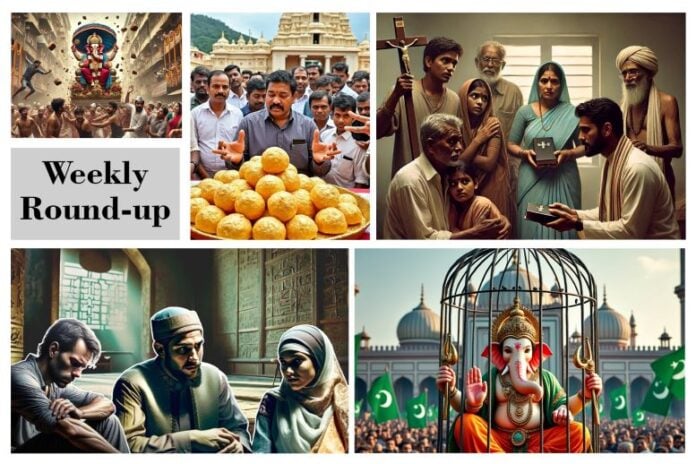
Attacks on Hindus and Hindu Dharma, both in Bharat and overseas, are frequent and unrelenting. In many regions of the world, this persecution is like a genocide slowly unfolding before our eyes. For decades, the world has ignored the actual depth and breadth of these attacks, driven by disturbing anti-Hindu bigotry. From murders, forced conversions, land grabs, assault on festivals, desecration of temples and murtis, hate speech, and sexual violence to institutionalised & legal discrimination, Hindus are facing an increasing assault on their very existence along with an unprecedented Hindu hatred.
In this weekly summary for the period from 14 June to 20 June 2026, we hope to provide a snapshot of such crimes and hopefully awaken more people around the world to this human rights crisis:
Bharat
1) Cockroach Janta Party (CJP), the self-styled “youth movement” that burst onto the political scene barely weeks ago, spokesperson Vijeta Dahiya stands accused of producing a Haryanvi music video from 2017 that openly derides Bhagwan Shiva and Maa Parvati. He is the owner of Unmaad Artworks, which produced the Haryanvi music video “Bhole Cutting Kara Le” that has a derogatory portrayal of Bhagwan & Devi.
2) Two seemingly disconnected events unfolding in June 2026 reveal a disturbing pattern: the systematic marginalization of Hindu victimhood in Bharatiya subcontinent’s discourse, whether through the selective framing of rights activism in Bharat or the intimidation of Sanatan minorities in Bangladesh.
3) A high-profile marketing campaign by Amazon Bharat’s quick-commerce platform “Amazon Now” has erupted into a major cultural and legal controversy, with Hindu organisations and legal practitioners alleging the trivialisation of one of ancient Bharat’s most revered mathematicians and astronomers. The campaign, which began as a mysterious viral marketing stunt featuring a lookalike of the 5th-century scholar Aryabhata at major public events, has drawn legal notices, police complaints, and widespread social media backlash, placing the e-commerce giant at the centre of a heated debate over cultural sensitivity in commercial advertising.
4) The Hindu Janajagruti Samiti (HJS) has formally approached the Director General and Inspector General of Police (DGP & IGP) of Karnataka, seeking legal action against Prof. K.S. Bhagawan for remarks made during a public program in Harihar, Davanagere District. The organization has alleged that Bhagawan’s statements regarding Bhagawan Sri Ram, Hindu Granthas and traditions were derogatory, provocative, and deeply offensive to the religious sentiments of millions of believers across the country. Prof. K.S. Bhagawan stated, “Sri Rama was not born to Dasharatha. Dasharatha performed the Putrakameshti Yajna. In that ritual, the queen had to spend the night with the priest. You can understand the rest yourself.”
5) Two persons have been arrested after a 24-year-old married woman approached the Sonegaon Police in Maharashtra’s Nagpur alleging rape, blackmail, extortion and forced religious conversion. The arrested accused have been identified as Ayyaz Taj Madare and Ameen Shaikh. Police have launched a search operation to trace Hazrat Maulana, a resident of Chhindwara district in Madhya Pradesh, who has also been named in the First Information Report (FIR).
6) The release of Amazon Prime Video’s eight-episode crime thriller Raakh, has reignited a fierce debate about the platform’s pattern of injecting ideological narratives into stories inspired by real Bharatiya events. Headlined by Ali Fazal and Sonali Bendre, the series—marketed as “inspired by” the 1978 Ranga-Billa kidnapping and murder case—has drawn sharp criticism for systematically altering the caste, religion, and identities of real-life figures to fit what critics describe as a “Bhim-Meem” (Dalit-Muslim solidarity) narrative framework.
7) Prakash Raj has spent years insisting that he is not anti-Hindu but anti-majoritarian politics, yet his own public language often blurs that distinction so carelessly that the contradiction is no longer just political — it is cultural and commercial too.
Bangladesh
Attacks on Hindus in Bangladesh are relentless and designed to cleanse the religious minority from the country gradually. According to a study by Prof. Abul Barakat of Dhaka University, no Hindus will be left in Bangladesh by 2050 due to systemic and institutionalized persecution. Temple desecration, land grabbing, mob attacks after false blasphemy charges, rape/forced conversion of women, and hate speech are tools used to intimidate and drive Hindus out.
1) Ripon Mondol and his aged mother were among four people injured after an armed mob of approximately 15–20 individuals allegedly launched a violent daylight attack on a business establishment in Chitalmari Upazila of Bagerhat district, leaving the principal victim hospitalized with serious injuries and raising concerns over the police response. The primary victim, Ripon Mondol (35), son of the late Nikhil Chandra Mondol of Charkudaltala village, was reportedly dragged from his workplace and brutally assaulted by the group.
2) The custodians of one of Bangladesh’s most prominent Hindu religious institutions announced an indefinite suspension of the construction of what was planned to be the largest murti of Bhagwan Shri Ram in the country at the Sri Sri Radha Govinda and Kali Temple in Madhya Ramchandrapur of Palashbari Upazila under Gaibandha District.
Most hate crimes are driven by anti-Hindu bigotry encoded in certain religious teachings and political ideologies. While the anti-Hindu hate in Islamic countries is evident, there is another subtler form of anti-Hindu sentiment within institutions and the public sphere of ostensibly secular states (like India) that provides an enabling environment for Hinduphobia and hate crimes. This subtle, everyday discrimination can be missed unless one studies prevailing laws and patterns. The gradual ban on firecrackers during Diwali is a good example – it might seem pollution-related on the surface. Still, the double standards at play become apparent when one looks at the larger picture of restrictions on Hindu festivals and the lack of sound reasoning behind the ban.
We request all readers to share other anti-Hindu hate crimes that we might have missed in this period in the comments below or by emailing [email protected]. We also solicit support in maintaining the Hindu human rights tracker database.
