


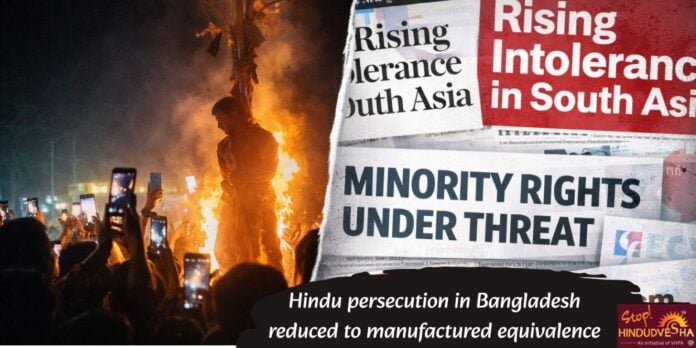
Two seemingly disconnected events unfolding in June 2026 reveal a disturbing pattern: the systematic marginalization of Hindu victimhood in Bharatiya subcontinent’s discourse, whether through the selective framing of rights activism in Bharat or the intimidation of Hindu minorities in Bangladesh.
The APDR Controversy: When Rights Activism Becomes Narrative Warfare
A recent detailed investigation by HinduPost exposed how the Association for Protection of Democratic Rights (APDR)—an organization founded in 1972 claiming commitment to universal human rights—has developed a pattern of selective documentation that consistently minimizes Hindu suffering while amplifying narratives damaging to Bharat’s credibility abroad.
The controversy centers on APDR’s claims, reproduced in Bangladeshi outlets including Prothom Alo and Daily Ittefaq, that Bharatiya border authorities were pushing West Bengal residents into Bangladesh at gunpoint without proper verification. Hindu Voice Trust’s representation argues these allegations ignore the statutory framework governing deportations under the Foreigners Act, 1946 and the Immigration and Foreigners Act, 2025, turning a sovereign obligation into “a caricature of cruelty” before foreign audiences.
More damning is the pattern across communal violence investigations. In the April 2025 Murshidabad riots, the 2016 Kaliachak violence, and the Telinipara attacks, APDR’s fact-finding reports reportedly reframed anti-Hindu violence through “a vocabulary of equivalence, mutuality, context, and dilution”—acknowledging Hindu losses just enough to mention them, but never enough to make them the moral center of the story. The organization’s historical proximity to radical-left networks and alleged assistance to Naxalite extremists, documented as early as 2003 by then-Midnapore SP K.C. Meena, further complicates its claims to impartial advocacy.
Bangladesh’s Ram Murti Crisis: The Physical Manifestation of Selective Outrage
While Bharatiya rights organizations debate narratives, Hindus in Bangladesh face physical erasure. In Gaibandha district’s Palashbari upazila, construction of what would have been one of Asia’s largest Lord Ram statues—an 81-foot monument at the Sri Sri Radha Govinda and Kali Temple complex—has been forcibly suspended following Islamist mobilization.
The Imam Ulama Parishad organized demonstrations and human chains along the Dhaka-Rangpur motorway, demanding not just suspension but complete removal of the structure. Temple committee member Shyamal Kumar Mahanta stated they halted work “to preserve social harmony,” effectively conceding to intimidation. Videos circulating on social media show Islamists slapping images of Bhagwan Ram with sandals and shoes during a June 12 protest rally, while leaders of Insaf Kayemkari Chatra Dal threatened to bulldoze the murti themselves if the government refused.
The Shahbagh Contrast: Hindu Youth Alone on the Streets
Perhaps most revealing is the response from Bangladesh’s Hindu youth. Despite constituting merely 7.95% of the population, Hindu students have taken to Shahbagh in Dhaka with flaming torches, risking their lives to protest the desecration of Shri Ram’s image. Meanwhile, political parties and organizations in Bharat that “never miss an opportunity to invoke Shri Ram’s name have responded with deafening silence”.
A Pattern of Institutional Failure
These parallel crises expose a dual failure. In Bharat, rights organizations accused of ideological selectivity undermine the documentation of Hindu persecution, creating an archival deficit that future generations will inherit as truth. In Bangladesh, state authorities surrender to mob veto, suspending lawful religious construction on “law and order” grounds rather than protecting minority rights guaranteed by the 1971 Constitution.
As Nirmol Rozario, president of the Bangladesh Christian Association, warned: “If Hindus are prevented today from building their own places of worship or religious symbols, the same thing could happen tomorrow to Buddhists and Christians”.
Hindu Voice has submitted formal representations to the Bangladesh High Commission in Delhi, the Bangladesh Ministry of Foreign Affairs, Bharat’s Ministry of Home Affairs, the National Human Rights Commission, and Gaibandha district authorities—demanding protection of Hindu safety, religious freedom, and constitutional rights. The representation rightly notes: “The true test of a democracy is its ability to safeguard the rights of all citizens, especially when those rights become controversial.”
The Stakes
What connects APDR’s selective fact-finding to Gaibandha’s surrendered temple site is the same mechanism: the denial of Hindu agency in defining their own victimhood. Whether through intellectual reframing in Kolkata or physical intimidation in Palashbari, the result is identical—Hindu suffering is either softened into equivalence or silenced by threat.
A democracy survives not merely by protecting dissent, but by protecting truth from distortion. The Hindu public must build institutions that “document meticulously, argue rigorously, publish fearlessly, and preserve memory before it is edited by hostile or ideological intermediaries” . The alternative is a future where Hindu wounds are minimized, Hindu symbols are desecrated with impunity, and the language of rights is monopolized by those who recognize injustice only when it suits their politics.
