


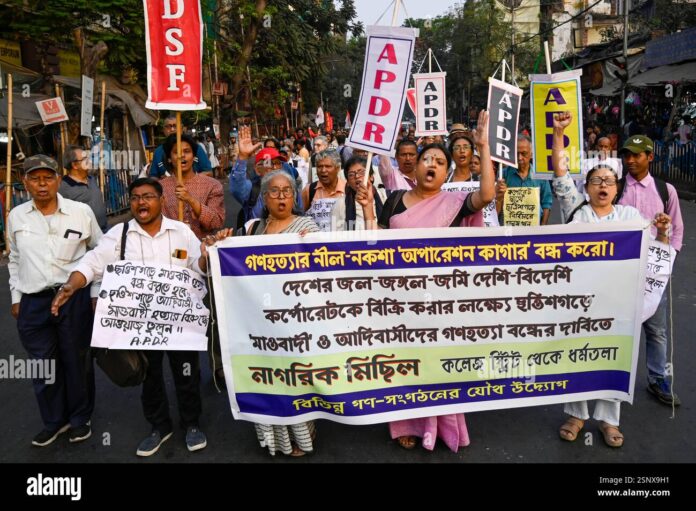
When ‘rights activism’ becomes narrative warfare
There is a profound difference between defending civil liberties and manufacturing narratives that weaken a nation’s moral legitimacy. That distinction lies at the heart of the controversy surrounding the Association for Protection of Democratic Rights, or APDR, whose recent interventions on deportation, border security, communal violence, and insurgency deserve far more scrutiny than they have received so far.
The issue is not whether dissent is permitted in a democracy. It is. The issue is whether an organization claiming the language of human rights can circulate allegations to foreign media without full factual verification, while consistently framing events in a way that harms Bharat’s credibility, blurs the suffering of Hindu victims, and dilutes accountability in matters of national security and social cohesion.
The representation submitted by Hindu Voice Trust states that APDR’s public statements, especially those carried in Bangladeshi outlets, may have contributed to misleading portrayals of Bharatiya enforcement agencies and therefore merit administrative examination. It further argues that the concern is not isolated to one controversy, but arises from a cumulative pattern visible across deportation narratives, communal fact-finding reports, and historical allegations regarding conflict-sensitive activism.
The border narrative and the politics of accusation
The most immediate controversy concerns APDR’s claim, as cited in the linked report and the article posted by Hindu Voice, that Bharatiya border authorities were allegedly pushing residents of West Bengal into Bangladesh at gunpoint without proper nationality verification. According to the article, these claims were then reproduced by Bangladeshi publications including Prothom Alo, Daily Ittefaq, Star International, and Daily Asia, helping construct an international perception that Bharat’s deportation practices are arbitrary and abusive.
That is no small matter. In the age of cross-border information warfare, one activist quotation can travel farther than a government clarification. Once such allegations appear in foreign media ecosystems, they cease to be local commentary and become geopolitical ammunition. APDR’s assertions were used to portray Bharat’s deportation regime as legally reckless and morally suspect.
Yet the representation by Hindu Voice Trust and the article both insist that deportation in Bharat is not an informal or whimsical exercise. The identification, detention, and deportation of foreign nationals are governed by statutory procedure under the Foreigners Act, 1946 and the Immigration and Foreigners Act, 2025, and that Bharatiya authorities have maintained that deportations occur only after verification and in accordance with legal requirements. If that framework is indeed being ignored in APDR’s public claims, then the matter is not simply one of disagreement. It is a question of whether a rights body is substituting rhetoric for fact in one of the most sensitive arenas of state power.
A sovereign nation has not only a right but also a duty to identify illegal entrants, secure its borders, and deport foreign nationals in accordance with law. To turn that sovereign obligation into a caricature of cruelty, especially before foreign audiences, is not morally serious advocacy. It is selective storytelling with consequences. And those consequences are borne not by elite activists, but by border populations, security personnel, and vulnerable citizens who already live amid the pressures of illegal migration, demographic instability, and chronic administrative strain.
Selective empathy and the invisibilization of Hindu suffering
The deeper issue raised by both documents is not one border controversy, but an alleged pattern. The APDR presents itself, since its founding in 1972, as an organization committed to democratic rights and universal human dignity. But APDR’s public interventions have not consistently reflected that universalism, especially when it comes to the long and painful question of Hindu persecution in the subcontinent.
This critique deserves serious engagement. For decades, displaced Bangladeshi Hindus and other non-Muslim minorities have lived with a reality that policy circles often discuss in abstractions but rarely confront in moral terms: targeted intimidation, religious vulnerability, dispossession, insecurity, and migration under pressure. The article argues that APDR has been vocal on Muslim grievance narratives in Bharat while remaining comparatively silent on the suffering of persecuted Hindus and other minorities in neighboring countries, and that it actively opposed the Citizenship Amendment Act despite that law’s stated purpose of offering a pathway to citizenship for persecuted non-Muslim minorities from the neighborhood.
Whether one supports or opposes the CAA, the ethical question remains. Can a human-rights organization credibly claim universalism while appearing indifferent to the civilizational trauma of Hindus driven out, terrorized, or structurally marginalized across the border? Can it invoke minority protection in one direction but grow evasive when the victims are Hindu? The charge made in the article is that APDR’s moral lens is not universal, but ideological.
That accusation becomes sharper when the discussion turns to communal violence in West Bengal. The report specifically points to APDR’s interventions in Murshidabad, Kaliachak, and Telinipara, contending that in each case the organization adopted narratives that minimized, reframed, or diluted anti-Hindu violence rather than confronting it directly.
Murshidabad, Kaliachak, Telinipara
The article cites APDR’s involvement in a fact-finding exercise concerning the April 2025 riots in the Suti and Samsherganj regions of Murshidabad. It says APDR argued that violence began after protesters against the Waqf Amendment Act were allegedly pelted with stones in Ghoshpara, Dhulian, but that the report devoted substantial space to demonstrating Muslim suffering while giving comparatively less attention to the systematic and selective targeting of Hindus.
This is where the ethics of documentation become decisive. In communal violence, facts do not speak for themselves. They are arranged, weighted, interpreted, and presented. A report can technically mention Hindu losses while still draining those losses of political and moral centrality. It can acknowledge arson yet obscure motive, recognize injury yet blur identity, describe destruction yet avoid naming the civilizational target. Such framing does not merely “add nuance.” It can erase the truth in plain sight.
The article makes a similar allegation regarding the 2016 Kaliachak riots. It says the violence began in the context of protests over an alleged blasphemy issue and escalated into attacks on property, businesses, religious structures, and homes, but that APDR largely interpreted the events through political mobilization and wider socio-political tensions. APDR’s conclusion downplayed both the communal character and the scale of the attacks against Hindus, despite contemporary accounts of extensive destruction, looting, and vandalism.
The importance of Kaliachak cannot be overstated. When a riot of that magnitude is reframed as a generalized disturbance instead of being assessed with clarity about targeted communities, the public archive itself is corrupted. Future commentary, academic discourse, and institutional memory are then built on a softened version of the event. In that sense, selective fact-finding becomes a long-term political instrument.
Telinipara, too, is presented in the article as another case of asymmetrical narrative construction. Critics believe APDR overlooked evidence that the violence was triggered after armed Muslim mobs attacked Hindu localities and set homes and commercial establishments on fire, while instead giving disproportionate attention to a limited area where Muslims suffered in retaliatory violence. The result was an altered public impression in which Hindus appeared as principal aggressors rather than as one of the primary victim groups.
Taken separately, defenders may call each of these disputes interpretive. Taken together, they begin to resemble a pattern: anti-Hindu violence is not denied outright, but consistently reframed through a vocabulary of equivalence, mutuality, context, and dilution. In practical terms, that means Hindu suffering is acknowledged just enough to be mentioned, but never enough to become the moral center of the story.
The older shadow: radical-left proximity
The report does not confine itself to communal issues. It also revives long-standing allegations of APDR’s proximity to radical-left networks. It says concerns have been raised for decades by security officials, law-enforcement personnel, and critics over whether APDR’s activism has always remained within the boundaries of civil-rights work.
One example cited is from August 2003, when, the then Midnapore Superintendent of Police K.C. Meena publicly stated that diaries recovered from arrested PW activists including Sudip Chongdar, Naba Dule, Rita Chongdar, and Sanjay Mandi indicated APDR was covertly assisting Naxalite extremists.
The report also states that APDR has been a consistent critic of large anti-Maoist security operations and was among the signatories supporting appeals for negotiations between the Bharatiya state and Maoist groups in 2025. It then argues that many national-security experts and political commentators viewed such ceasefire and negotiation demands as tactical opportunities for Maoist regrouping rather than sincere steps toward peace.
Now, criticism of the state is not illegitimate. But in insurgency theatres, asymmetry of outrage matters. If a rights organization appears tireless in condemning state force but restrained in confronting insurgent brutality, extortion, assassination, and terror, people are entitled to ask whether the organization is documenting violence or politically curating it. The article’s central point is precisely this: that APDR’s interventions repeatedly seem designed to constrain the state while showing insufficient urgency toward the predations of extremist actors.
For a Hindu readership, this concern is not abstract. In eastern Bharat, as elsewhere, the erosion of state capacity rarely empowers the innocent. It empowers the violent, the sectarian, the insurgent, and the ideologically ruthless. When activist ecosystems normalize suspicion toward the state but relativize hostility toward armed anti-state actors, the first casualties are usually ordinary families, border populations, and vulnerable communities with little protection beyond the law.
Why this matters beyond APDR
This debate is larger than one organization. It concerns the ecology of legitimacy in modern Bharat. Who gets to define victimhood? Who decides whether communal violence was “really communal”? Who speaks for persecuted Hindus? Who frames Bharat before foreign audiences? And who benefits when institutions of the Bharatiya state are presented as uniquely suspect while cross-border failures, ideological violence, and Hindu insecurity are downplayed?
The representation explicitly asks competent authorities to examine the factual basis of APDR statements published abroad, assess whether they require verification in the public interest, review whether patterns in its fact-finding reports indicate selective framing, and take lawful action if irregularities are established. This is a reasonable demand in a constitutional democracy. Scrutiny is not censorship. Investigation is not persecution. Accountability is not authoritarianism.
Indeed, the representation itself carefully acknowledges that democratic dissent and civil-liberties advocacy are constitutionally protected, while arguing that such freedoms operate within the limits of factual accuracy, non-misrepresentation, and the avoidance of material that may harm public order or national security discourse. That is an important line, because the purpose of scrutiny should not be to criminalize disagreement, but to distinguish principled rights work from partisan narrative management.
From a Hindu perspective, this distinction is morally urgent. Hindu society has too often learned that its suffering becomes legible to elite discourse only after being translated into someone else’s ideological framework. Direct testimony is dismissed as majoritarian emotion. Civilizational memory is mocked as paranoia. Demographic anxiety is treated as vulgarity. Cross-border persecution is reduced to policy inconvenience. And whenever Hindus are targeted, there is a rush not first to justice, but to balance, qualify, soften, and reinterpret.
That pattern has bred a deep and understandable distrust. It is why cases like this resonate far beyond the institutions immediately involved. They speak to a broader Hindu concern that a section of Bharat’s activist and intellectual class has become adept at weaponizing human-rights language while remaining curiously unwilling to center Hindu vulnerability with the same moral seriousness it extends to others.
The state must investigate, and the public must remember
The proper response now is neither hysteria nor passivity. It is rigorous scrutiny. If APDR’s claims to foreign media were accurate, a transparent inquiry will establish that. If its fact-finding reports were balanced, evidence will vindicate them. If allegations of misleading dissemination or ideological selectivity are overstated, that too should come out in the open.
But if an investigation finds that unverified claims were amplified abroad, that anti-Hindu violence was repeatedly reframed through selective documentation, or that activism crossed into conduct prejudicial to national security or public order, then the state must act within the law and without hesitation. No civil-liberties vocabulary can become a permanent shield against accountability.
A democracy survives not merely by protecting dissent, but by protecting truth from distortion. Bharat’s border regime cannot be judged through activist allegation alone. Hindu suffering cannot be archived through revisionist euphemism. National security cannot be perpetually interrogated only from one side. And organizations that shape public discourse, especially in communally sensitive and internationally consequential matters, must be held to the highest standard of factual honesty.
The Hindu public, too, must draw a lesson from this episode. It is not enough to react after each riot, each narrative distortion, each foreign report, each selective dossier. Hindu society must build institutions that document meticulously, argue rigorously, publish fearlessly, and preserve memory before it is edited by hostile or ideological intermediaries. In an era of weaponized narratives, facts without civilizational confidence are often defeated by framing.
What is at stake here is not simply the reputation of one activist body. It is the right of a civilization to insist that its wounds not be minimized, that its nation not be casually defamed, and that the language of rights not be monopolized by those who recognize injustice only when it suits their politics.
Representation by the Hindu Voice Trust:
