


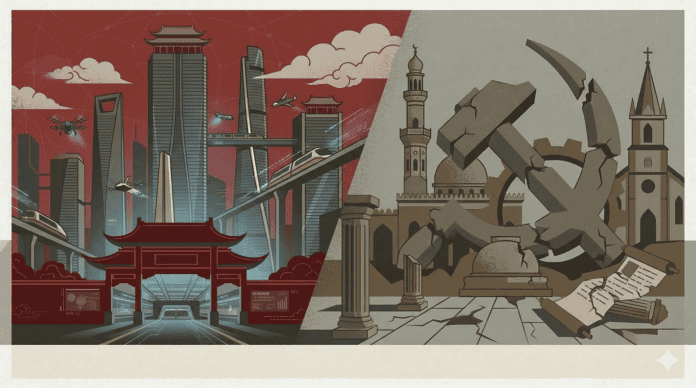
In the early 20th century, as empires frayed and new ideologies rushed in to fill the vacuum, both China and India produced powerful communist movements. They drew from similar sources of anger—humiliation at foreign rule, disgust with entrenched hierarchies, impatience with gradual reform. Yet a century later, their trajectories could not be more different. The Chinese Communist Party now presides over one of the world’s most dynamic capitalist economies while wrapping itself in the language of Confucius and “5,000 years of civilization.” Indian Marxists, by contrast, remain ideologically frozen, far more comfortable attacking Hindu Dharma than attempting any serious reconciliation between Marxism and the civilizational matrix in which they actually operate.
What changed in China was not simply policy, but the Party’s relationship to its own past. The intellectuals who founded the CCP came out of the May Fourth ferment of 1919, when students in Beijing denounced the Versailles settlement that handed German concessions in Shandong to Japan and turned their fury inward at China’s “feudal” inheritance. Figures like Chen Duxiu, Li Dazhao, and the young Mao Zedong imbibed the radicalism of that moment. They saw a semi‑colonial, semi‑feudal China strangled by Western and Japanese imperialism on one side and by landlord power, clan patriarchy, and Confucian ritualism on the other. Marxism offered not only a critique of capitalism, but a seemingly scientific way to smash both foreign domination and the internal order that had failed to resist it.
Mao’s Iconoclasm and Its Limits
Mao’s breakthrough was to move the centre of gravity away from the industrial working class that classical Marxism privileged and toward the peasantry. The CCP’s early documents are explicit: the Chinese revolution had to be both national and democratic, aimed at driving out imperialist powers and overturning landlord rule, with poor and middle peasants as the main force under party leadership. In practice, this meant decades of land struggles, guerrilla warfare, and a constant ideological assault on what Mao called the “Four Olds”—old ideas, culture, customs, and habits—which were treated as the spiritual cement of feudalism.
By the time of Mao’s final decade, this hostility to the past had become self‑destructive. Land reforms in the early 1950s had already broken the back of the old gentry; new marriage laws had weakened the authority of patriarchal clans; literacy campaigns and socialist mobilization had reoriented millions of lives. Yet in the Cultural Revolution of 1966–76, Mao unleashed a new wave of iconoclasm that went far beyond the destruction of landlord power. Red Guards rampaged through Buddhist monasteries, Confucian temples, and Daoist shrines, smashing statues and burning scriptures as if every remnant of pre‑revolutionary culture were by definition reactionary. In Qufu, the ancestral home of Confucius, thousands of artifacts were destroyed and the sage’s cemetery was desecrated.
The violence did not end with buildings and objects. Monks and priests were forced to return to lay life, often after public humiliation and imprisonment; scholars of classical literature were denounced as parasites. Confucianism was singled out for special venom, portrayed as the ideology that had justified centuries of hierarchy, patriarchy, and obedience. For Mao, who had grown up in a Confucian world, the repudiation was personal as much as political.
Deng’s Turn to Markets and Memory
It is precisely this experience of excess, however, that created the conditions for Deng Xiaoping’s turn after 1978. Deng and his allies were not critics from outside the system; they were senior revolutionaries who had lived through purges and campaigns and understood the costs of permanent ideological mobilization. Their slogan—“socialism with Chinese characteristics”—is often treated outside China as a cynical cover for capitalism. It was also, importantly, a way to reframe the relationship between Marxism and Chinese civilizational memory.
Deng’s reforms dismantled communes, allowed markets and private enterprise to grow, and invited foreign capital in, but they did not come packaged as a repudiation of the Party’s right to rule. Instead, they were justified as the only realistic route to national rejuvenation. Over time, that national story became more explicit. The state funded Confucian studies, rehabilitated classical philosophers, and in the 2000s created Confucius Institutes abroad as instruments of cultural diplomacy. Xi Jinping now regularly invokes “excellent traditional culture” as a moral anchor for contemporary governance, presenting the CCP not as the gravedigger of Chinese civilization but as its guardian and curator.
In this new narrative, Confucius is no longer the symbol of feudal oppression. He embodies the values of harmony, hierarchy moderated by benevolence, and a meritocratic bureaucracy shaped by learning. The Confucian ideal of ren—humaneness or benevolence—combined with li, the observance of proper roles and rituals, is presented as a way to maintain social stability and ethical rule in a vast, diverse society.
Seen from India, this Confucian turn is striking. Chinese communists who once denounced Confucianism as the ideological backbone of feudalism have found ways to extract from it a language of order, duty, and merit compatible with a one‑party state overseeing a mixed economy. The CCP today presides over a form of state‑led capitalism in which large state‑owned enterprises control strategic sectors, private firms drive growth but remain politically subordinate, and national pride is keyed to both economic success and civilizational continuity. The red flag now flies alongside symbols that predate Marxism by millennia.
India’s Communists and a Missing Civilizational Language
India’s communists travelled a very different path. The Communist Party of India, formally founded in 1925, was from the start anti‑colonial too. Its early leaders saw British rule as fundamentally aligned with zamindars, princely elites, and compradors; they did not view the Raj as a painful but necessary stage of “modernization” in the way some of Marx’s own writings on colonialism indicated. Strikes in Bombay’s textile mills, peasant struggles in Telangana and Bengal, and sedition trials in the 1920s and 1930s show that the party’s core energy was directed against the empire and its local allies. Although it is true that in the Second World War, the same party abruptly adopted a pro‑British ‘People’s War’ line at Moscow’s behest, opposing Quit India and backing the Allied war effort once Nazi Germany invaded the Soviet Union.
Yet, even after independence, the Indian communist movement never found a way to articulate its project in civilizational terms, even though it continued—often quite rightly—to criticise the Nehru‑led Congress as a comprador bureaucratic‑bourgeois force presiding over a semi‑colonial, semi‑feudal order rather than a genuinely liberated republic.
There were moments of tactical flexibility: the decision to end armed struggle in Telangana and enter electoral politics; the first communist government in Kerala in 1957; the later creation of the CPI(M) after the 1964 split, when one wing of the movement began arguing that India was still a bourgeois‑landlord state tied to imperialism and needed a more militant line than the CPI’s increasingly parliamentary, Congress‑friendly approach. There were also efforts at land reform and union organizing. But through all these shifts, the deeper attitude towards Hindu civilizational forms remained one of suspicion and disdain.
For most communist and fellow‑travelling intellectuals, Hindu Dharma was not a vast plural civilizational framework with its own ethical and philosophical resources. It was, rather, “Brahminism,” a convenient shorthand for feudalism (labelled ‘caste hierarchy’), patriarchy, and superstition. The fact that many pre‑modern feudal structures were manufactured under colonial rule to aid resource extraction through loyal elites, and that complex realities of varna were flattened and mis-labelled as “caste” by colonisers, were ignored—everything was collapsed into a single enemy to be hammered, as though attacking “caste hierarchy” were simply the Indian equivalent of fighting feudalism.
The idea that varna, in its classical articulation, was meant to rest on guna and karma—on qualities and actions rather than birth; that varna system did not in itself preach inherent hierarchical superiority of one varna over another; and that Dharmic thought consistently placed ethical, morally upright conduct in service of society above all inherited status, rarely figured in their analyses. Just as late imperial Confucianism had once been weaponized to legitimize ossified hierarchies in China, Dharma was seen primarily through the lens of its later applied distortions, not its foundational principles.
This had political consequences. In Kerala and West Bengal, where communists came to power through elections, they did show some administrative ability and initiated reforms. But they did not use that authority to craft a distinctively Indian or Dharmic idiom for socialism. Because this suspicion of India’s own civilizational inheritance ran so deep, the communist movement never quite earned the emotional trust of most Indians; it could mobilise some voters around class or welfare, but it rarely convinced them that it understood, let alone shared, the cultural world they lived in.
Humiliation, Memory, and Deracination
The contrast with Deng’s China is not that one is “soft” on religion and the other is not. The CCP remains avowedly atheist and tightly controls all organized religion, including Buddhism, Daoism, and revived Confucian practice. The difference is that Beijing has come to understand the importance of civilizational pride as a resource for legitimacy in a post‑revolutionary era. Dharmic traditions in India could, in principle, have played a similar role for Indian leftists—providing a language of duty, balance and restraint that could have been placed in creative conversation with Marxist critiques of exploitation.
Instead, the organised left in India moved in the opposite direction—defining itself ever more explicitly in anti‑Dharmic terms and, in practice, drifting into an ideological and electoral alignment with the very Abrahamic frameworks that had long sought to marginalise that Dharmic civilizational inheritance. Where Beijing now insists that Abrahamic religions ‘sinicise’ themselves—subordinating even the appointment of bishops and imams to party authority—in India the left has more often indulged Abrahamic fundamentalism and encouraged trans‑national solidarities in the name of ‘minority rights,’ even when those loyalties cut against any shared civilizational center.
Behind that divergence lies a deeper history of humiliation and response. China suffered terribly at the hands of Western and Japanese powers in the 19th and early 20th centuries, but it was never subjected to centuries of systematic civilizational replacement. However devastating the Opium Wars or the occupation of parts of its territory, the Chinese did not live under the continuous rule of a foreign religious law that branded their ancestral practices as idolatrous, nor did they see their elite educational institutions wholly retooled to serve an exogenous theology. India experienced something closer to that: centuries of Muslim rule in many regions, followed by the British Raj, and the deliberate cultivation of a class of “brown sahibs” encouraged to be ashamed of their own traditions.
Indian communists and the broader left‑liberal intellectual world emerged out of that matrix. They inherited not only Marxist internationalism, but also the colonial academy’s disdain for Sanskritic and Dharmic learning. The result has been a peculiar combination: a politics that denounces imperialism in economic terms, yet remains curiously deferential to the categories and judgments of Western social science when it comes to evaluating its own civilizational inheritance. Hindu Dharma is caricatured as nothing more than a hierarchical, exclusionary order, while its core emphasis on inner discipline, compassion, the ethical restraint of power, and an egalitarian idea of spiritual liberation is quietly edited out of the picture.
While Marxist theory treats organised religion as something to be overcome, Indian communists have tended to read Christian and Islamic movements through a sympathetic lens when these can be aligned with anti‑caste, anti‑imperialist or ‘Third World’ liberation projects, even as comparable Hindu assertions are coded as communal or reactionary.
Chinese communists, for all their violence and authoritarianism, eventually found a way back to their own sources, even if in highly curated form. Confucius, once held up for public ridicule, now appears on official posters and in party speeches, his teachings subtly repurposed to buttress a one‑party state overseeing market‑driven growth. The message to ordinary Chinese is that their modern success is not a break from the past but its fulfillment.
Indian communists have not developed a comparable story. In the absence of such a narrative, they increasingly define themselves in negative terms: against Hindutva, against “majoritarianism,” against “Brahminism.” They have no vision of how a modern, prosperous, and just India rooted in Dharmic civilization might look.
That imaginative vacuum has been filled by others: it is the Hindutva movement that offers something resembling the kind of civilisational project Chinese communists claim for themselves. The Indian left must decide whether it has the courage—and the intellectual suppleness—to make its own turn if it wishes to remain relevant and be remembered with any generosity by history.
(This article was first published at Reverse The Gaze under a different headline. If you believe in breaking away from Western lenses and building an authentic, homegrown understanding of our world, please subscribe to the substack and support this work)
