


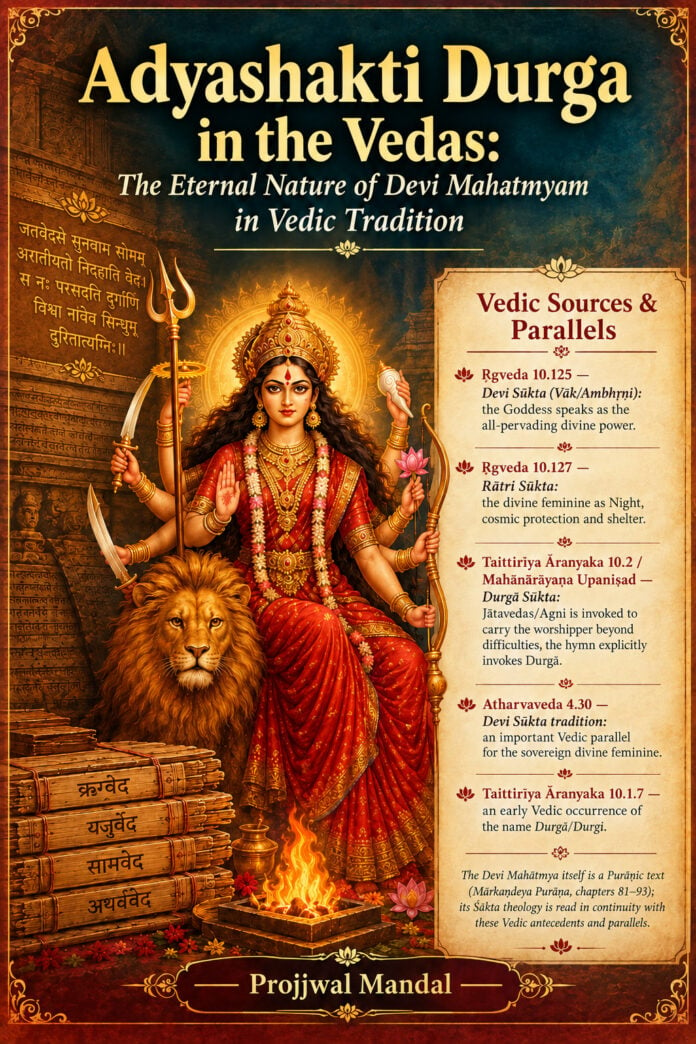
The worship of Shakti is one of the oldest and most enduring traditions of Sanatana Dharma. From the earliest layers of Vedic literature to the Puranas and the later Shakta traditions, the Divine Mother has been worshipped in many forms and understood through many names. Yet, there is a common idea that the worship of Goddess Durga belongs essentially to the Puranic period and that Her presence in Hindu religious thought developed much later. A closer reading of the Vedic texts, however, suggests that the idea of a supreme feminine divine power is much older. The names and forms may have changed over time, but the underlying idea of Shakti—the power that protects, sustains, illumines and leads a person beyond suffering—is deeply rooted in the Vedic tradition.
The Vedic literature contains several hymns in which the feminine divine is approached with reverence. The Devi Sukta, Ratri Sukta and Shri Sukta of the Rigveda are particularly important in this context. Alongside them, the Durga Sukta of the Taittiriya Aranyaka of the Krishna Yajurveda occupies a special place. It is one of the most familiar Vedic prayers associated with Goddess Durga and gives us a glimpse into how the idea of the Divine Mother can be understood at a deeper spiritual level.
One of the well-known mantras of the Durga Sukta is:
**“Jatavedase sunavama somam aratiyato nidahati vedah.
Sa nah parshadati durgani vishva naveva sindhum duritatyagnih॥”**
The imagery in this mantra is beautiful and simple. The devotee prays to Agni to carry him across all difficulties, just as a boat carries a person across a river. The word *durgani* can be understood in connection with difficulties, obstacles and hardships. Life itself is often compared to an ocean that is difficult to cross, and the prayer asks for divine assistance in making that journey safely.
This gives us a broader understanding of Durga. She is certainly known as the destroyer of evil and the slayer of demons, but Her significance does not end there. She is also the one who protects a person when he is surrounded by difficulties. She is the refuge of the helpless and the power that helps the devotee cross the uncertain waters of worldly life. The name Durga itself carries this beautiful sense of that which helps one pass through what is difficult.
Another important mantra says:
**“Tamagnivarnam tapasa jvalantim vairochanim karmaphaleshu jushtam.
Durgam devim sharanamaham prapadye sutarasi tarase namah॥”**
Here the Goddess is described as radiant like fire and shining with the power of *tapas*. She is associated with *karmaphala*, the fruits of action, and the devotee approaches Her seeking refuge. There is a great deal contained within these few words. Fire is not only something that burns; it also gives light. In the same way, the divine Shakti destroys ignorance while revealing knowledge. She gives strength to act, but She also reminds us that every action has its consequences.
For this reason, Durga may be understood not merely as a warrior Goddess who destroys demons but as a deeper spiritual principle. She represents strength, illumination, discipline and protection. When a person turns towards Her with sincerity, the prayer is not simply for the removal of an external difficulty. It is also a prayer for the strength to face one’s own weaknesses and to move towards a better and more disciplined life.
The Durga Gayatri expresses another aspect of the Goddess:
**“Katyayanaya vidmahe kanyakumari dhimahi.
Tanno Durgih prachodayat॥”**
The final prayer, *tanno Durgih prachodayat*, asks that Durga may inspire and guide us. This is significant. Divine grace is not sought only for material protection; it is also sought for the awakening of the intellect. In the Indian spiritual tradition, knowledge without right understanding is incomplete. The Divine Mother is therefore approached as the power that can guide the mind towards what is true and beneficial.
There is also an interesting connection with the name Jatavedas. The Vedic Nirukta explains:
**“Jatani veda iti Jatavedah.”**
That is, the one who knows all that has been born or created is called Jatavedas. Agni, therefore, cannot be understood merely as the physical fire burning on a sacrificial altar. In Vedic thought, Agni has several levels of meaning. He is the visible sacred fire, the carrier of offerings, the source of light and, at a deeper level, a symbol of knowledge and consciousness. Thus, the invocation of Jatavedas in the Durga Sukta can also be seen as an invocation of the divine light that enables one to overcome darkness.
As Hindu thought developed, the nature of the Divine Mother received increasingly elaborate expression in the Puranas and Shakta scriptures. In the Sri Sri Chandi, for example, the Goddess is praised as the supreme Vaishnavi Shakti:
**“Tvam Vaishnavi shaktiranantavirya vishvasya bijam paramasi maya.
Sammohitam devi samastametat tvam vai prasanna bhuvi muktihetuh॥”**
The Goddess is described here as the infinitely powerful Vaishnavi Shakti and as the supreme Maya, the power behind the universe. The same passage also points towards one of the central ideas of Shakta philosophy: when the Goddess is pleased, Her grace becomes a means of liberation.
Seen in this light, there is a continuity between the earlier Vedic understanding of divine power and the later conception of Durga as the supreme Mother. One should, of course, be careful not to treat every Vedic deity as identical in every respect to the Goddess described in the later Puranas. Vedic literature belongs to a different historical and philosophical setting. Nevertheless, the presence of the Divine Feminine and the idea of a protecting and illuminating Shakti provide an important foundation for understanding the later development of Shakta worship.
The purpose of Durga Puja also deserves some thought. In our time, Durga Puja has become one of the most important religious and cultural festivals of Bengal and of many other parts of India. The celebrations, the images, the decorations and the gatherings are all part of its living tradition. But behind all these external expressions lies the spiritual purpose of worship. The festival is not meant merely to be a display of grandeur. At its heart are devotion, discipline, purification and surrender.
The Bhagavad Gita explains the nature of a sattvic sacrifice in these words:
**“Aphalakankshibhir yajno vidhidrishto ya ijyate.
Yashtavyam eveti manah samadhaya sa sattvikah॥”**
The teaching is quite clear: an act of worship performed without selfish expectation and according to the proper scriptural principles is regarded as sattvic. This principle is worth remembering during Durga Puja. If worship is performed only for personal gain, the deeper purpose of the ritual can easily be forgotten. True worship should gradually change the person who performs it.
The traditional prayer to the Goddess beautifully expresses Her compassionate and auspicious nature:
**“Sarvamangalamangalye shive sarvarthasadhike.
Sharanye tryambake Gauri Narayani namostu te॥”**
She is invoked as the source of all auspiciousness, as the one who fulfils righteous aspirations and as the refuge of those who seek shelter in Her. The prayer is simple, but its meaning is profound. The devotee does not approach the Goddess merely as a giver of worldly possessions. He approaches Her as a source of protection, strength and spiritual well-being.
Perhaps this is also why the story of Durga continues to have such a powerful place in Hindu religious life. The battle between the Goddess and the forces of evil can be understood at more than one level. The demons described in the scriptures belong to the sacred narratives, but human beings also carry their own inner enemies—anger, greed, jealousy, arrogance, hatred, fear and ignorance. These tendencies often create greater suffering than any external enemy. The victory of the Goddess can therefore remind us of the victory that must take place within ourselves.
To worship Durga sincerely is, in this sense, to ask for the courage to overcome these weaknesses. It is to seek the strength to choose Dharma when the easier path is otherwise, to remain truthful when falsehood seems convenient, and to remain compassionate when anger would be easier. A person’s conduct, therefore, becomes an important part of his devotion. Service to others, self-restraint and kindness are not separate from spiritual life; they can themselves become expressions of worship when performed with sincerity.
It is in this broader sense that Adyashakti Durga may be understood as a timeless presence within the Sanatana tradition. She is not simply a figure belonging to a particular mythological story or a deity whose significance begins with the Puranas. The idea of a divine feminine power that protects, gives knowledge, removes obstacles and ultimately leads the individual towards liberation has a much deeper history. The Vedic texts provide some of the earliest expressions of this spiritual vision, while the later Puranic and Shakta traditions develop it through stories, philosophy, mantra and devotion.
The true meaning of Durga worship, therefore, lies not only in the rituals performed before an image of the Goddess. It lies in what those rituals awaken within us. If the worship of the Mother makes us more truthful, more disciplined, more compassionate and more courageous, then the worship has found its real meaning. If it helps us recognize and overcome the darkness within ourselves, it becomes more than a festival—it becomes a spiritual practice.
Adyashakti Durga is thus a symbol of Shakti, knowledge, compassion, Dharma and liberation. Her worship reminds us that divine strength is not merely the power to defeat an enemy; it is also the strength to control oneself, to stand by what is right and to help others in times of difficulty. May the grace of the Divine Mother give us that strength. May Her worship bring truth, justice, peace and welfare into our lives and into society. And may we learn to cross the difficulties of life with faith, courage and an awakened heart.
