


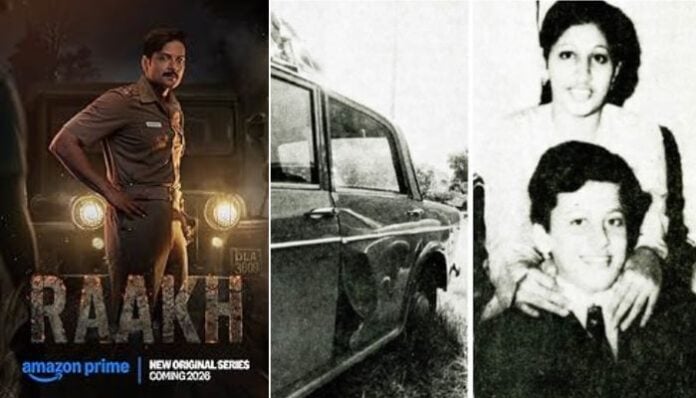
The release of Amazon Prime Video’s eight-episode crime thriller Raakh on June 12, 2026, has reignited a fierce debate about the platform’s pattern of injecting ideological narratives into stories inspired by real Bharatiya events. Headlined by Ali Fazal and Sonali Bendre, the series—marketed as “inspired by” the 1978 Ranga-Billa kidnapping and murder case—has drawn sharp criticism for systematically altering the caste, religion, and identities of real-life figures to fit what critics describe as a “Bhim-Meem” (Dalit-Muslim solidarity) narrative framework. This article compiles reporting, social media reactions, and critical analysis from multiple platforms to examine the Raakh controversy and situate it within a broader pattern across Prime Video’s Bharatiya originals.
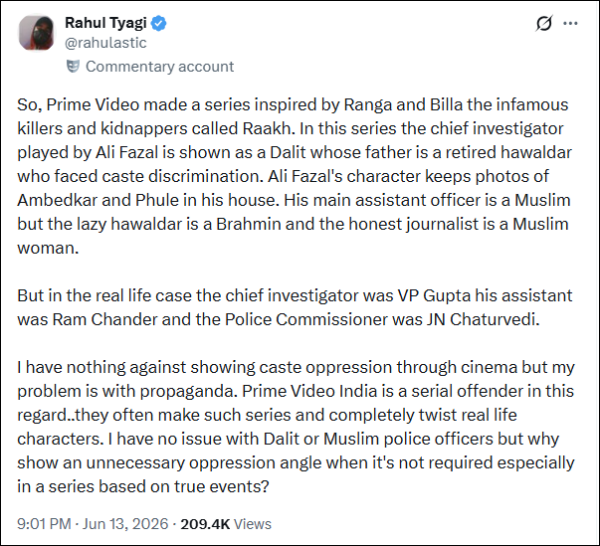
The Raakh Controversy: What Changed from the Ranga-Billa Case
The Historical Record
On August 26, 1978, siblings Geeta Chopra (16) and Sanjay Chopra (13)—children of Navy officer Madan Mohan Chopra—were kidnapped in Delhi while en route to an All India Radio program. The kidnappers, Kuljeet Singh (alias Ranga) and Jasbir Singh (alias Billa), were Sikh men. After a nationwide manhunt, the duo was apprehended by alert army personnel—Lance Naik Gurtej Singh and AV Shetty—who spotted them on the Kalka Mail train near Agra. Both were convicted, sentenced to death, and hanged in Tihar Jail.
Key real-life figures in the investigation and aftermath:
- Inspector VP Gupta – Lead investigator
- SI Ram Chander – Gupta’s main aide
- Police Commissioner JN Chaturvedi
- Prabha Dutt – Journalist who covered the case extensively
- Babulal – Civilian who attempted to intervene during the kidnapping
What Raakh Depicts Instead
According to detailed breakdowns from news reports and social media analyses on X and YouTube, Raakh replaces these figures with fictional characters designed around contemporary identity politics:
| Real-Life Figure | Raakh Character | Identity Change |
|---|
| Real-Life Figure | Raakh Character | Identity Change |
|---|---|---|
| Inspector VP Gupta | SI Jayprakash Jatav (Ali Fazal) | Upper-caste Hindu → Dalit officer with Ambedkar/Phule portraits, “Jai Bhim” chants |
| SI Ram Chander | SI Javed Murtaza | Hindu → Muslim officer (“iman ka pakka” archetype) |
| Prabha Dutt (journalist) | Nisar Rizvi | Hindu woman → Muslim woman journalist |
| Babulal (civilian rescuer) | Salim | Hindu man → Muslim man |
| Kuljeet Singh (Ranga) | Rajendra Bhardwaj / “Rajjo” | Sikh → Hindu (Haryanvi) |
| Jasbir Singh (Billa) | Kumar Bhide / “Babu” | Sikh → Hindu (Maharashtrian) |
| — | Hawaldar Mishra | Added character: Lazy, incompetent Brahmin |
The series also introduces a caste-oppression subplot for Jatav and his retired hawaldar father—entirely absent from the historical record—while framing the Muslim officer and journalist as uniquely honest and virtuous.
The Pattern: A Compilation of Prime Video Controversies
Raakh is not an isolated incident. A recurring pattern emerges across Prime Video’s Bharatiya originals:
1. Paatal Lok (2020)
- Produced by Anushka Sharma, directed partly by Prosit Roy (who later directed Raakh).
- Depicted Sikhs oppressing Dalits/backward castes; objectionable scenes involving Sikh community.
- Villain “Tyagi” portrayed as ardent Shiva devotee.
- Muslim criminal Kabir’s backstory: father claims eldest son killed by “Hindu extremists carrying saffron flags.”
- Show framed criminals as victims of systemic framing by ISI/Pakistan narratives.
2. Mumbai Diaries 26/11 (2021)
- Centered on 26/11 terror attacks but inserted “bad Hindu, good Muslim” dynamic.
- Dr. Ahaan Mirza (Muslim) portrayed as tolerant, emotional, offering prayers for victims.
- Nurse Samarth (Hindu, Maharashtrian) depicted as bigoted, communal, physically assaulting Mirza.
- Journalist Mansi delivers monologue redefining jihad as “internal struggle,” called out as whitewashing Islamic jihadist motivations.
3. Tandav (2021)
- Directed by Ali Abbas Zafar; sparked FIRs across multiple states (UP, MP, etc.).
- Mohammad Zeeshan Ayyub depicted as Lord Shiva in college play, holding trishul; host jokes about social media followers; “Azaadi” slogans follow.
- Caste narrative: Dino Morea’s character berates Sandhya Mridul for wanting to marry “lower-caste” Anup Soni.
- Police shown as casually killing Muslim youths by branding them terrorists.
- Amazon issued rare unconditional apology (Reuters, Asia Nikkei, March 2021); scenes edited/removed.
4. Sherni (2021)
- Vidya Balan played IFS officer based on real events.
- Real-life Hindu officer K. Abharna → Christian character Vincent.
- Real hunter Asghar Ali Khan → Kalawa-wearing Hindu character Ranjan Rajhans.
5. Dahaad (2023)
- Sonakshi Sinha, Gulshan Devaiah, Vijay Varma.
- OpIndia review (May 2023): “Anti-Hindu propaganda bouquet which whitewashes love jihad.”
- Parallel tracks: Upper-caste Hindu girl Rajni elopes with Muslim boy Altaf (love jihad denied); serial killer based on Cyanide Mohan but villain carefully cast as upper-caste Hindu.
- Rajputs shown as goons; Hindu organisations (Bajrang Dal-coded) shown negatively; fake caste discrimination subplots inserted.
- The Print (May 2023): Acknowledged Dahaad addresses caste/gender but noted where it “utterly failed” on caste depiction tenets.
6. Mirzapur (2018–2020)
- Reported (Oct 2020) that a Muslim man in Mewat harassing a Hindu girl for conversion decided to kill her after watching Mirzapur.
Creative Liberty vs. Historical Responsibility: The Core Debate
The Raakh controversy crystallizes a tension that has accompanied each of these releases:
| Creative Liberty Argument | Historical Responsibility Argument |
|---|
| Creative Liberty Argument | Historical Responsibility Argument |
|---|---|
| Fiction adapts reality; no docudrama obligation | “Inspired by true events” marketing creates factual expectation |
| Caste/religion dynamics reflect contemporary Bharat | Retroactively inserting identity conflicts distorts history |
| Dalit/Muslim representation matters in media | Representation shouldn’t come via erasure of real Hindu/Sikh figures |
| Villains need not mirror real perpetrators’ demographics | Systematic pattern: Hindu upper-caste villains, Muslim/Dalit heroes |
| OTT platforms cater to diverse audiences | Platform bias: Aparna Purohit (former creative head) called out for anti-Hindu social media posts (2020) |
The issue is not that Raakh is fictionalised, but that it is presented as being inspired by real events while simultaneously replacing documented historical figures with invented characters and social conflicts that were never central to the original case.
Conclusion: A Platform Pattern or Coincidence?
The compilation of evidence across six major Prime Video originals—Paatal Lok, Mumbai Diaries 26/11, Tandav, Sherni, Dahaad, and now Raakh—reveals a consistent trajectory:
- Identity substitution: Real Hindu/Sikh figures → fictional Dalit/Muslim/Christian protagonists
- Villain coding: Antagonists disproportionately upper-caste Hindu, often with religious symbolism (Shiva devotees, kalawa-wearing)
- Narrative arcs: Caste oppression, Muslim victimhood, “Bhim-Meem” solidarity inserted into stories where they were historically absent
- Creative leadership: Directors/writers with documented ideological leanings (Prosit Roy, Ali Abbas Zafar, Zoya Akhtar/Reema Kagti) given repeated platforms
- Institutional response: Apologies (Tandav), edits, police complaints—but pattern persists across years
Whether this reflects a deliberate platform strategy, the preferences of a specific creative ecosystem, or the inevitable friction of adapting real events for dramatized storytelling remains contested. What is clear is that Raakh has become the latest flashpoint in a debate that shows no signs of resolution—one that touches on the very definition of “creative liberty” when the raw material is a nation’s documented history.
