


“Ideological Rebirth: The Formation of the BJP, Strategic Realignment, and Support to the National Front Part 9”, MyIndMakers, 22 Aug 2026.
“The Bharatiya Janata Party was born on April 5, 1980, after the Janata Party’s disintegration—but as something conceptually new rather than a mere reconstitution of the Jana Sangh. The decision to establish a new party, rather than resume the Jana Sangh’s identity, reflected a deliberate strategic calculation: the founders wanted to signal a break from the Jana Sangh’s perceived inflexibility while retaining the organisational and ideological core that gave the movement its distinctive character. The result was a party that carried forward the Jana Sangh tradition while reimagining it for a changed political environment. This ideological renewal would eventually produce the most electorally formidable political organisation in Indian history.
The Founding Moment: Atal Bihari Vajpayee and the BJP’s Initial Vision
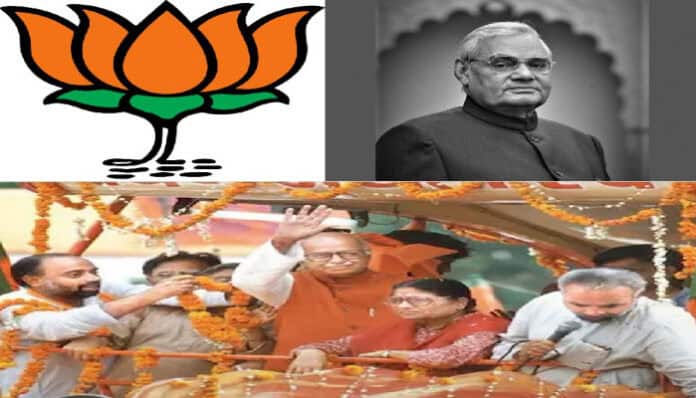
Atal Bihari Vajpayee, the BJP’s founding president, was the party’s most persuasive public face and its most important early ideological framer. A poet of genuine distinction, an orator of extraordinary power, and a politician of catholic instincts who had built personal relationships across party lines throughout his career in the Jana Sangh, Vajpayee represented the possibility of a cultural nationalism that was confident rather than anxious, inclusive rather than exclusionary, and capable of engaging the full complexity of India’s plural society.
Vajpayee’s founding formulation of the BJP’s ideology ‘positive secularism’ as distinct from the Congress’s ‘pseudo-secularism’, ‘Gandhian socialism’ as distinct from Marxist class struggle, and ‘integral humanism’ as the philosophical foundation inherited from Deendayal Upadhyaya was an attempt to occupy a broad ideological space rather than a narrow one. The party’s founding document explicitly rejected communalism and casteism and positioned the BJP as committed to national integration through affirming India’s composite cultural heritage.
This ideological positioning was, in some respects, a response to the central criticism directed at the Jana Sangh during the Janata experiment: that its RSS connection and cultural nationalist agenda made it incompatible with India’s constitutional secularism. Vajpayee’s BJP sought to show that a party could be proudly Hindu in its cultural orientation while remaining genuinely committed to democratic pluralism and the rights of all citizens……….”
Read the full article at MyIndMakers.
