


“The Wake-Up Call: Analysing the BJP’s 2024 Lok Sabha Setback in Uttar Pradesh and the Lessons Drawn Part 28”, MyIndMakers, 18 Sep 2026.
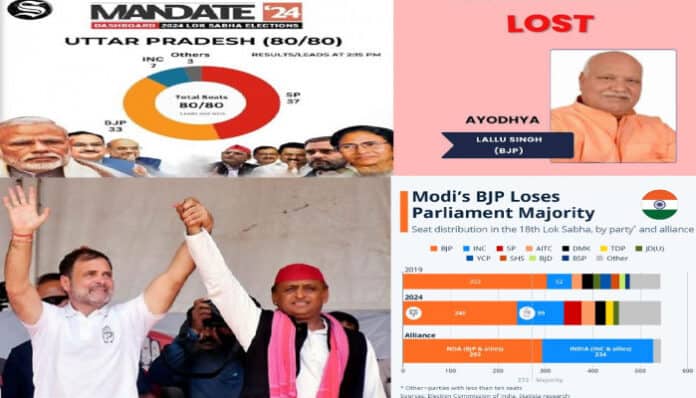
“The results of the 2024 Lok Sabha elections in Uttar Pradesh delivered what the national media greeted with barely concealed delight as a humbling for the BJP and a political resurrection for the Samajwadi Party. The BJP, which had won 62 of UP’s 80 Lok Sabha seats in 2019, fell to 33 in 2024, while the Samajwadi Party surged from 5 seats to 37. The NDA’s combined tally, including its allies, stood at 36 seats against the SP-Congress INDIA Alliance’s 43. The BJP’s vote share in UP fell from 49.6 per cent in 2019 to about 41.4 per cent in 2024 — a decline of eight percentage points that, through the first-past-the-post system’s amplification effect, translated into the loss of nearly half its UP Lok Sabha seats. For a party that had swept 71 of 80 UP seats in 2014 and 62 in 2019, the 2024 result was a serious setback that demanded honest introspection rather than defensive rationalisation. The nationalist movement’s maturity is measured, in part, by its capacity for exactly this kind of self-examination — and the BJP’s response to 2024 in UP has demonstrated that capacity.
The Structural Explanation: PDA and the Opposition’s Coalition Mathematics
The most analytically significant feature of the 2024 UP result was the effectiveness of the SP-led INDIA Alliance’s ‘PDA’ (Pichhadey, Dalit, Alpsankhyak — OBC, Dalit, Minority) coalition strategy. Akhilesh Yadav, having learned from the SP’s repeated failure to build beyond its M-Y (Muslim-Yadav) base, systematically courted non-Yadav OBC communities through candidate selection, alliance arrangements with smaller OBC-centric parties, and targeted messaging that positioned the BJP as an upper-caste party engaged in ‘Manuvadi’ politics….”
Read the full article at MyIndMakers.
