


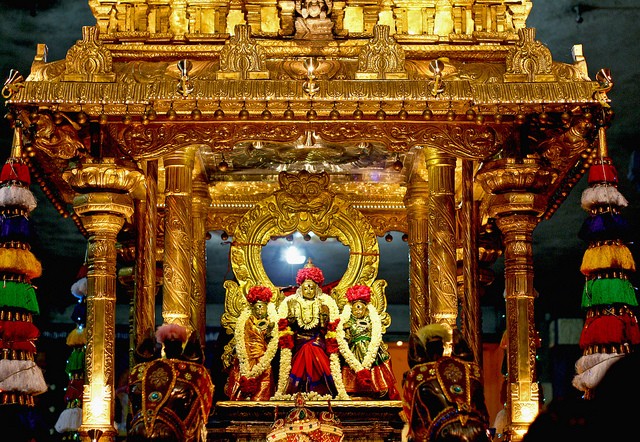
Mangadu (around 25 KMs from Chennai, Tamil Nadu) is revered as the place where Goddess Parvati performed rigorous penance (tapas) before reuniting with Bhagwan Shiva. The shrine of the Goddess in this place is known by the name Kamakshi. Kamakshi means the Goddess whose compassionate eyes fulfil the sincere wishes of her devotees.
Legend
According to legend, once upon a time Goddess Parvati playfully closed Bhagwan Shiva’s eyes, which resulted in plunging the universe into darkness. To atone for this act, she descended to earth. She chose a dense forest of mango trees, which gave the area the name Mangadu. The term Mangadu means “Mango Forests or Mango Groves”. The Goddess performed intense penance amidst the Panchagni (five fires), standing on one leg with a rosary (Japamala) in her hand to meditate on Bhagwan Shiva. The Goddess stood near the central agni gundam keeping her left leg toe in the fire while keeping her right leg on her left thighs. She kept her left hand on her navel, while holding a japa mala in her right hand over her head. She undertook her deep penance with eyes closed for the reunion with the Bhagwan. Pleased with her devotion, Bhagwan Shiva advised her to proceed to Kanchipuram, where their sacred marriage took place. This makes Mangadu an Adi Kamakshi Sthala (the primordial site of penance).
Sri Ardhameru Chakra
After the Goddess left for Kanchipuram, the intense residual heat of the Panchagni made the surrounding region unbearable and uninhabitable for living beings. During his pan India travel the sage Adi Shankaracharya visited Mangadu. To calm the scorching divine energy and restore peace to the land, he installed the Sri Ardhameru Chakra (a powerful Tantric yantra made of special herbs) in the sanctum sanctorum. The Artha Meru Chakra in the temple was installed by Acharya Sankara having 43 Trikonas-triangles. This is made of eight herbals called Astagandham. Hence no abhishek (water ablutions) is offered the Chakra. The pujas for the chakra are performed with sandal and other cosmetic powders and archana with kumkumam. On the Vijayadasami day, last day of Navarathri, this Chakra is covered with gold, while on other days, it is covered with silver. Sri Chakra occupies great importance in the temple. This Artha Meru Sri Chakra is revered as Raja (Royal status) Yantra. The base is of Koorma (tortoise) design. There are three steps above the base. It is further built with 16 Lotus petals and 8 petals of Lotus still above. The Sri Chakra is drawn on this peeta-seat. It is decorated with a 9-yard sari. The Ardhameru Sri Chakra consecrated at the Kamakshi Temple in Mangadu, Tamil Nadu, is historically celebrated as one of the largest and most unique traditional Sri Chakras installed in an ancient Indian temple sanctum.
Ardha Meru Sri chakra is a hemispherical, three-dimensional representation of the sacred Sri Yantra geometry. Sacred Geometry: It features a dome-shaped or half-elevated (“ardha”) base instead of a steep, full pyramid peak. Shiva and Shakti: It symbolizes the divine union of pure consciousness (Shiva) and cosmic energy (Shakti). The Bindu: The central point of the dome represents the Bindu, the primal source of all creation.
Architecture
The temple structure reflects traditional Chola architecture. The grand seven-tiered Raja Gopuram (main gateway) facing south is a recent addition. In later years, Sri Kanchi Paramacharya installed an additional Murthi of Goddess Kamakshi holding a sugarcane and a parrot, alongside a Panchaloha (five-metal) Murthi of Adi Kamakshi, turning it into a peaceful, benevolent energy hub. Mangadu also finds a unique place amongst worshippers of the Tantric sect as well.
As one enters the Temple, one can find the Ganapati Shrine to the left of the main entrance. From the Main Hall of the temple the pilgrims can proceed to the Sanctum where one can see the ” Ardha Meru Maha Yantra ” and an Murthi of Goddess Kamakshi in the Main Shrine. The Ardhameru Sri Chakram is the chief divinity in this temple. At the back of the sanctum the Shrine of “Tapas Kamakshi” can be seen which was installed at the behest of Sri Kanchi Paramacharya. From the mandapam, devotees can witness the Goddess in four forms: the Sri Chakra, Adi Kamakshi, the Murthi of Tapas Kamakshi (in penance posture), and the Eternal Lamp (Nithya Deepam).
One can also see the various deities like Bhagwan Surya and others in the outer courtyard. A mango tree is also present in the complex. While doing the circumambulation around the Temple, one can see Sapta Matrikas installed right behind in the Main outer courtyard before walking through to the Dwajastambha installed in the Eastern side.
Bhagwan Vishnu’s Role in Kamakshi’s Marriage
Vaikunta Perumal Shrine is located approximately 500 meters away from the Kamakshi temple. At this shrine, Bhagwan Vishnu is depicted in a seated posture, accompanied by his two consorts, Sridevi and Bhoodevi. A significant detail in his depiction is a ring held in his palm, symbolizing the ring he brought for the marriage of his sister, Goddess Kamakshi. This is a small temple with separate shrines for Goddess Lakshmi, Sri Andal and Bhagwan Hanuman.
The Kamakshi temple draws large crowds on Tuesdays, Fridays, Sundays, full-moon days, and during major Devi festivals such as Navaratri and Aadi celebrations.
Major Festivals
Navaratri
Navaratri is one of the most important Devi festivals, marked by special worship, alankaram, and large gatherings of devotees.
Aadi Fridays
Fridays in the Tamil month of Aadi (i.e., Ashada masam, July-August) are especially sacred for Goddess worship and draw many devotees to the temple.
Aadi Pooram
Aadi Pooram is an important festival for the goddess (birth anniversary of Goddess Andal) and is celebrated with special devotion.
Pournami worship
Full-moon days are significant for Devi and Sri Chakra worship, and many devotees visit the temple on these days.
Thai Fridays
Fridays in the Tamil month of Thai (i.e., late Pushya mas and early Magh mas, Jan-Feb) are observed with special devotion to the Goddess.
Special Poojas
Sri Chakra Pooja
Worship of the sacred Sri Chakra is a defining feature of the temple’s ritual importance.
Kumkum Archana
Devotees offer kumkum archana to Sri Kamakshi Devi seeking blessings for welfare, marriage, prosperity, and protection.
Friday Goddess worship
Fridays are especially important for Goddess worship, with many devotees offering flowers, lamps, and archana.
A well-known devotional practice at Mangadu involves visiting the temple for six consecutive weeks and offering prayers to Kamakshi Devi. The devotee who has some prayer or wish can choose any one day of the week and visit the temple along with 2 lemons, of which one will be retained at the temple and the other one has to be taken back home. Again, the following week, on the same day, he or she has to carry the old lemon from home along with 2 other fresh lemons. Likewise, if one visits on the same day for six weeks continuously, it is believed that the Goddess grants the wishes of the devotee. The temple is administered by the Hindu Religious and Charitable Endowments Department of the Government of Tamil Nadu.
How to Reach
By Road
Mangadu is accessible by road from Chennai through Porur, Poonamallee, Kundrathur, and nearby suburbs. City buses, taxis, and cabs are commonly used.
By Rail
Visitors can reach nearby Chennai suburban railway stations and continue by road to Mangadu.
By Air
The nearest major airport is Chennai International Airport, from where Mangadu can be reached by road.
Reference:
