


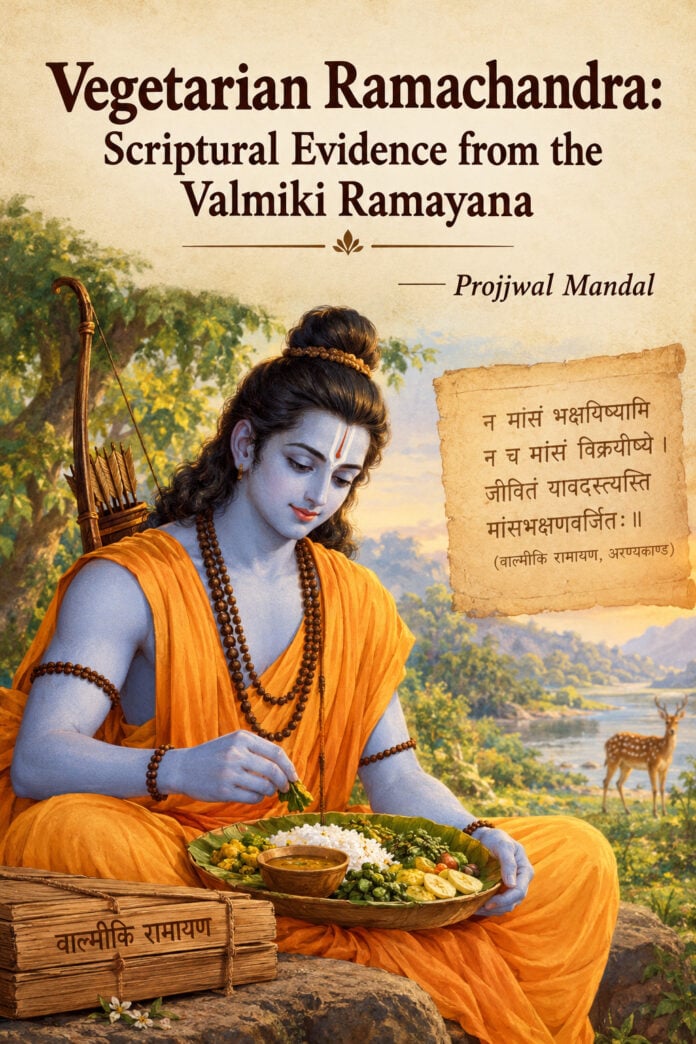
In the Sanātana Dharma, Bhagawan Shri Ramachandra is a symbol of truth, righteousness, renunciation, and self-restraint. Several verses from the Valmiki Ramayana are especially relevant when discussing his diet. By considering what Shri Rama ate during his exile and what the text says about abstaining from meat, one can present an argument in support of the view that he lived as a vegetarian.
In the Sundara Kanda of the Valmiki Ramayana, a commonly circulated reading says that Hanuman, while telling Sita Devi about Shri Rama’s condition, makes an important statement about his diet:—
“Na māṃsaṃ Rāghavo bhuṅkte na cāpi madhu sevate |
Vanyaṃ suvihitaṃ nityaṃ bhaktam aśnāti pañcamam ||”
The first part of this verse means: “Rāghava, Shri Rama, does not eat meat, nor does he partake of honey or intoxicating drink.” The following part speaks of his eating food from the forest. In particular, the phrase “na māṃsaṃ Rāghavo bhuṅkte”—“Rāghava does not eat meat”—is regarded as important evidence in support of the view that Ramachandra was vegetarian, since it directly states that he abstained from meat.
Some commonly cited shlokas of the Ramayana about Shri Ramachandra’s life in the forest also describe him living on roots, tubers, and fruit. One such verse is:—
“Caturdaśa hi varṣāṇi vatsyāmi vijane vane |
Kandamūlaphalair jīvan hitvā munivad āmiṣam ||”
— “I shall dwell in the uninhabited forest for fourteen years, living on tubers, roots, and fruit, and giving up meat like a sage.”
The reference to munivat, “like a sage,” is particularly significant. The lives of sages were founded on renunciation, austerity, and self-restraint. The association of that way of life with eating roots, tubers, and fruit highlights the disciplined character of Shri Rama’s life in exile. The idea that he gave up royal comforts and lived on forest produce can be presented as an argument for his vegetarian way of life.
Another verse commonly cited in connection with the exile is:—
“Pitrā niyuktā bhagavan pravekṣyāmas tapovanam |
Dharmam evācariṣyāmas tatra mūlaphalāśanāḥ ||”
—“By our father’s command, we shall enter the hermitage in the forest, and there we shall practise righteousness, eating roots and fruit.”
This passage clearly connects life in the forest with a diet of fruit and roots. Living on roots and fruit while practising righteousness in a forest hermitage is consistent with the idea of Shri Rama’s restrained diet. Thus, descriptions of this kind are relevant to arguments in support of a vegetarian Ramachandra.
Among the cited passages, the statement “na māṃsaṃ Rāghavo bhuṅkte” from the Sundara Kanda carries particular weight in making the case for Shri Ramachandra’s vegetarian way of life, because it directly says that he did not eat meat. The descriptions of living on tubers, roots, and fruit during the exile provide additional support concerning his diet in the forest. Considered together, these two kinds of statements can be used to argue that Shri Rama abstained from meat and ate fruit and other plant foods during his exile.
In conclusion, the commonly cited Sundara Kanda statement “na māṃsaṃ Rāghavo bhuṅkte,” together with descriptions of living on tubers, roots, and fruit during the exile, forms the main basis for discussion of Shri Ramachandra’s vegetarian way of life.Therefore, in explaining the restrained way of life of forest exile in light of vegetarian ideals, the relevance of a careful reading of Valmiki’s Ramayana is immense.
