


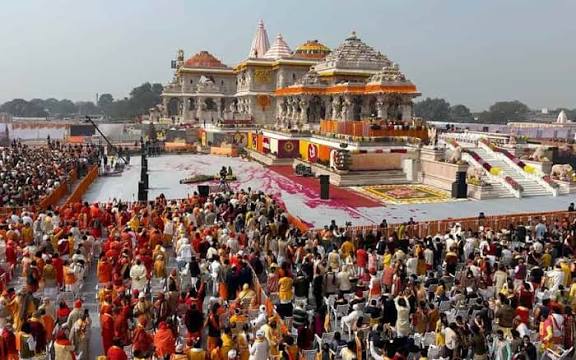
Ayodhya, located in Uttar Pradesh, has long been known for its religious importance. However, following the consecration of the Shri Ram Temple in January 2024, the city has witnessed a historic economic transformation. The study titled “The Economic Renaissance of Ayodhya” conducted by the Indian Institute of Management Lucknow presents detailed data explaining how this transformation unfolded.
The research highlights how religious infrastructure, when supported by policy planning and investment, can reshape an entire urban economy.
Tourism Boom:
Before the temple’s opening, Ayodhya received approximately 170,000 visitors annually. In contrast, within just six months after the consecration ceremony, nearly 110 million visitors arrived in the city.
The study projects that annual footfall may stabilize between 50 and 60 million visitors in the coming years, placing Ayodhya among India’s major pilgrimage destinations.
This dramatic increase has significantly expanded economic activity across sectors.
Rise in Small Business Income:
Before 2024, small shopkeepers earned around ₹400–₹500 per day. After the tourism surge, daily earnings rose to approximately ₹2,500 or more.
Spending on religious items, food products, souvenirs, garments, and devotional materials has multiplied, directly benefiting local traders.
Growth in Hospitality and Services:
Restaurants increased from about 200 in 2021 to more than 2,000.
Hotel room capacity rose from around 3,500–4,000 to over 5,000 rooms. Future projections suggest a need for 8,500–12,500 rooms.
More than 1,000 families now earn income through home-stay facilities, creating inclusive growth opportunities.
Expansion of MSMEs:
Approximately 6,000 micro, small, and medium enterprises have been newly established or revived.
Tailoring units, sweet shops, handicraft production, tourist guide services, and transport services have expanded significantly.
Employment Growth:
The study estimates the creation of over 120,000 direct and indirect jobs in the coming years.
Opportunities have increased in transport, hospitality, construction, retail, logistics, and tourism services.
Tax Revenue Impact:
Tourism-related tax revenue has already crossed several hundred crore rupees. Projections indicate that annual tax revenue may reach several thousand crore rupees in the near future.
This contributes significantly to the state’s overall economic growth.
Infrastructure Development:
Development projects worth approximately ₹85,000 crore are underway. These include airport expansion, railway modernization, road widening, sanitation upgrades, and urban beautification.
Improved connectivity has made Ayodhya more accessible nationally and internationally.
Real Estate Growth:
Property prices across the city have increased by 25–40 percent. Near the temple, prices have multiplied several times, attracting investors and developers.
Lifestyle Transformation:
Household incomes have improved. Families are investing more in education and healthcare. Youth migration has reduced as local employment opportunities have expanded. Women have entered small-scale entrepreneurial activities.
A Sustainable Development Model:
The IIM Lucknow study presents Ayodhya as a model of temple-led economic development. It shows how religious tourism, supported by structured planning and infrastructure investment, can generate sustainable growth.
| Indicator | Before Temple Opening | After Temple Opening |
| Annual tourist footfall | Approx. 170,000 visitors | 110 million in first 6 months; projected 50–60 million annually |
| Daily Income of Small Traders | ₹400 – ₹500 | ₹2,500 or more |
| Number of Restaurants | Around 200 | More than 2,000 |
| Hotel Room Capacity | 3,500 – 4,000 rooms | Over 5,000 rooms; projected need 8,500 – 12,500 |
| Home-Stay Participation | Minimal | 1,000+ families involved |
| MSMEs | Limited presence | 6,000+ new or revived enterprises |
| Employment | Limited; high outward migration | 120,000+ direct and indirect jobs expected |
| Property Prices | Stable or moderate growth | 25–40% increase; multiple-fold rise near temple |
| Women’s Economic Participation | Limited | Increased through home enterprises and services |
| Financial Inclusion | Mostly cash-based transactions | Increased bank accounts and digital payments |
| Urban Infrastructure | Basic facilities | Upgraded roads, airport, railway station, sanitation |
| Youth Employment Pattern | Migration to larger cities | Reverse migration and local entrepreneurship |
| Civic Identity | Small pilgrimage town perception | Nationally prominent and emerging economic hub |
All figures approximate; sourced from IIM-Lucknow analysis and independent reporting: https://www.academia.edu/156998695/The_Economic_Renaissance_of_Ayodhya_India_A_Case_Study_on_Sri_Ram_Mandir
Conclusion:
The opening of the Shri Ram Temple has acted as a catalyst for Ayodhya’s economic renaissance. Tourism growth, expansion of businesses, employment generation, infrastructure investment, and rising incomes have collectively transformed the city’s socio-economic landscape.
Ayodhya now stands not only as a spiritual center but also as a growing economic hub with long-term development potential.
