


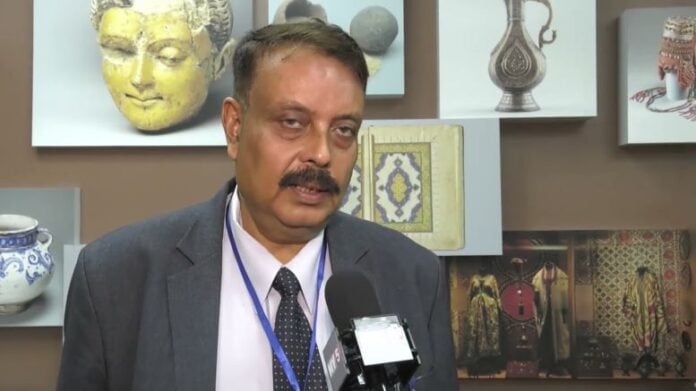
Dr Buddha Rashmi Mani has been honoured with the Padma Shri in the “Others (Archaeology)” category for Uttar Pradesh this year. The award recognizes a long career spent at the junction of field excavation, museum stewardship and scholarship, and it highlights the contemporary importance of archaeology in interpreting Bharat’s layered past.
Dr. Mani’s archeological journey
Born in 1955 at Gun Hill, Mussoorie, Dr. Mani forged an early relationship with history and ancient cultures. He completed his master’s degree in Ancient Indian History, Culture and Archaeology at Banaras Hindu University, where he stood out academically and went on to earn a Ph.D. (1976–1980). That scholastic foundation shaped a career that combined rigorous academic enquiry with the practical demands of large-scale archaeological projects and museum administration.
Dr. Mani’s fieldwork record is extensive. He has directed excavations at numerous sites across Bharat, more than twenty major digs by some accounts, bringing to light material evidence that has helped refine understanding of ancient urbanism, religious practice and cultural exchange. Among those excavations, his involvement in work at Ayodhya has been the most publicly visible and debated. Leading teams in complex, politically sensitive contexts called for not just archaeological skill but also careful public communication and administrative leadership.
Beyond trenches and trowels, Dr. Mani has been a steady presence in Bharat’s museum world. He has served in senior capacities within the Archaeological Survey of India (ASI) and later moved into roles overseeing museum curation and site interpretation. In 2016 he was appointed to a leadership role at the National Museum, which is a testament to his curatorial experience and his ability to link scholarly research with public-facing storytelling. Under his stewardship, museum projects emphasized better display of archaeological finds, contextual interpretation, and the modernization of exhibition access. These are efforts that help move artifacts beyond cabinets to conversations about identity, continuity and heritage.
His scholarly works
Scholarship has been another pillar of Dr. Mani’s contribution. His bibliography includes books and edited volumes on Kushan-era history, Buddhist art and early historical archaeology. Titles such as studies on Kushan civilization and compilations on Buddhist art reflect a scholar equally at home with coins, pottery, sculptural typologies and inscriptions. These publications have served both specialists and a wider readership keen to understand how material culture maps onto textual and religious histories across the subcontinent.
What makes this Padma Shri particularly fitting is the arc of Dr. Mani’s career which has been a blend of boots-in-the-field archaeology, institution-shaping museum work and steady publication. In a country where heritage is often contested, his work demonstrates how disciplined archaeological practice can generate evidence that enriches historical narratives without flattening their complexity. Recognitions like the Padma Shri not only honour individual achievement but also underline the public value of archaeology as a discipline that recovers and preserves the textures of everyday life from remote centuries.
Colleagues and students frequently point to Dr. Mani’s capacity to mentor younger archaeologists and to translate technical findings into accessible museum displays and public talks. That dimension, training new generations to read the stratigraphy of a site or to catalogue finds with meticulous care, extends his impact beyond any single excavation. It also ensures that regional and religious histories retain a sense of nuance rooted in material evidence, rather than being reduced to simplistic narratives.
As Bharat moves forward with an expanding portfolio of heritage projects, the recognition of practitioners like Dr. Buddha Rashmi Mani is a reminder that preserving the past requires both academic rigor and institutional imagination. The Padma Shri will hopefully renew interest in his writing and in the sites he helped bring to light, while also encouraging wider public engagement with archaeology as an active, democratic practice of discovery. For students, museum visitors and fellow researchers, Dr. Mani’s career is a model of how careful excavation and clear communication can together illuminate centuries of lived experience buried beneath the soil.
(Featured Image Source: YouTube)
