


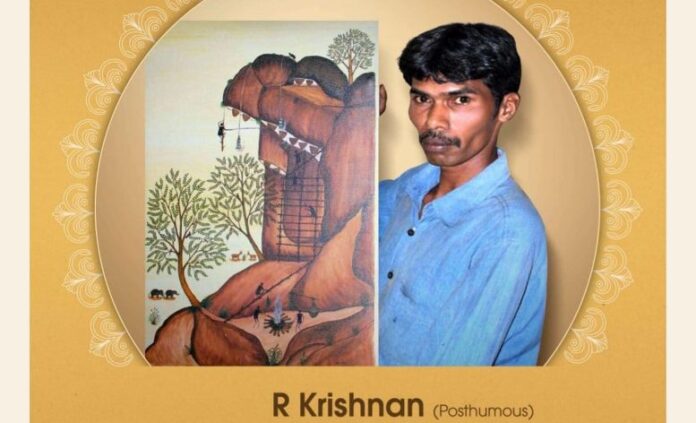
Bharat’s cultural wealth is deeply rooted in its Vanvasi traditions which have survived for centuries despite the pressures of modernization. R. Krishnan, an artist from Tamil Nadu’s Alu Kurumba Vanvasi (tribal) community, is among those remarkable individuals who dedicated their lives to preserving this rich heritage. He was popularly known as Kitna. In recognition of his extraordinary contribution to the preservation and promotion of indigenous art, he was posthumously awarded the Padma Shri earlier this year.
The Journey of Alu Kurumba Artist R. Krishnan
R. Krishnan hailed from Vellaricombai, an ST (Scheduled Tribe) settlement in Tamil Nadu’s Nilgiris district. Born into the Alu Kurumba community, he grew up surrounded by forests, traditional knowledge systems, and a rich artistic heritage. The Alu Kurumbas are one of the indigenous tribes of the Nilgiri hills, known for their close relationship with nature, honey gathering, and traditional medicinal practices. From an early age, Krishnan developed a deep interest in the artistic traditions of his community and learned the craft from his grandfather.
What made Krishnan’s work exceptional was his effort to transform ancient Vanvasi rock art into a contemporary artistic medium without losing its authenticity. The Nilgiris region contains several prehistoric rock art sites, including those at Vellaricombai and Eluthu Paarai. Inspired by these ancient paintings, Krishnan recreated their motifs and stories on cloth and canvas, making them accessible to wider audiences while preserving their cultural significance.
His paintings reflected the daily life, beliefs, and traditions of the Alu Kurumba people. Themes such as honey collection, Alu Kurumba Vanvasi rituals, local deities, wildlife, and community celebrations frequently appeared in his work. Through his art, Krishnan documented aspects of Vanvasi culture that might otherwise have faded away with time. His paintings served not merely as artistic expressions but also as valuable records of a living cultural tradition.
One of the most distinctive features of Krishnan’s work was his commitment to traditional techniques. Rather than relying on commercial paints, he used natural pigments obtained from the forest. Different colours were derived from plant leaves, tree resins, bark, and charcoal. This approach maintained continuity with the methods practiced by earlier generations of Vanvasi artists and reinforced the intimate connection between art and nature that characterizes indigenous traditions.
Despite his artistic talent, Krishnan’s journey was not easy. Like many Vanvasi artists in Bharat, he faced economic challenges and often worked as a daily wage labourer to support his family while continuing his artistic pursuits. Yet he remained dedicated to preserving and promoting Kurumba art. His determination demonstrated that cultural preservation is often driven by passion and commitment rather than financial rewards.
Beyond creating art, Krishnan played a crucial role in transmitting traditional knowledge to future generations. He trained members of his community and encouraged younger artists to learn and practice Kurumba painting. Through workshops, exhibitions, and community engagement, he ensured that the artistic traditions of his people would continue to thrive. His efforts transformed him from an individual artist into a cultural ambassador and guardian of Vanvasi heritage.
Over the years, Krishnan’s work attracted attention from art lovers, researchers, and cultural organizations. His paintings helped bring national visibility to a relatively lesser-known Vanvasi art form. His adaptation of traditional motifs to canvas while preserving their original spirit, helped him create a bridge between Vanvasi communities and mainstream audiences. His success demonstrated that indigenous art can remain authentic while reaching new platforms and markets.
Legacy & Accolades
Sadly, R. Krishnan passed away in March 2025. His death was a significant loss to Bharat’s Vanvasi art community. However, his legacy continues to resonate through the artists he trained, the artworks he created, and the cultural traditions he helped preserve. Recognizing the importance of his lifelong contribution, the Bharatiya Government conferred the Padma Shri on him posthumously in 2026. The honour acknowledged not only his artistic achievements but also his role in safeguarding Bharat’s intangible cultural heritage.
The story of R. Krishnan is a powerful reminder that cultural preservation often depends on individuals who dedicate themselves to protecting traditions that may otherwise disappear. His life exemplifies how art can serve as a medium for education, identity, and historical continuity. By preserving the visual language of the Alu Kurumba people and sharing it with the wider world, Krishnan ensured that an ancient artistic tradition would continue to inspire future generations.
Today, R. Krishnan is remembered not only as a gifted Vanvasi artist but also as a custodian of indigenous knowledge and culture. His Padma Shri is an apt tribute to the enduring value of Vanvasi art and to the countless communities whose traditions form an essential part of Bharat’s diverse cultural landscape.
(Featured Image Source: ETV Bharat)
