


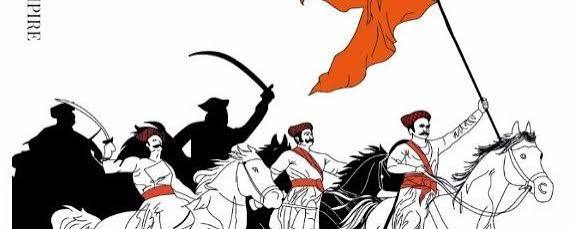
Without the Marathas breaking the back of Mughal authority, and without the brutal, mutual exhaustion between the Marathas and the Afghans, the Sikh Misls would have faced far greater obstacles, and Ranjit Singh’s empire might never have found the room to breathe, let alone grow.
Here is a breakdown of how that specific Maratha-Afghan collision cleared the runway for the Sikh Empire.
1. The Marathas as the Great Disruptor of Mughals
Long before Panipat, the Marathas did the heavy lifting of dismantling the Mughal Empire’s northern grip. Through the early-to-mid 1700s, Maratha expansion into Malwa, Gujarat, and eventually Rajasthan stripped the Mughals of their wealthiest revenues.
By the time the Marathas marched into Delhi and Punjab in 1758 (even briefly hoisting their flag on the Indus River at Attock), the Mughal Emperor was essentially a puppet. The Marathas effectively erased the Mughal capacity to govern or project military power into Punjab.
2. The Mutually Destructive Friction of 1761
The Third Battle of Panipat (1761) is often viewed purely as a Maratha defeat, but from a macro-geopolitical lens, it was a pyrrhic victory for the Afghan Emperor, Ahmad Shah Abdali.
- The Afghan Toll: Abdali won the battle, but his army suffered devastating casualties. His soldiers, exhausted and mutinous over unpaid wages and the sheer brutality of the campaign, forced him to retreat back to Afghanistan rather than consolidating a permanent empire in Delhi.
- The Power Vacuum: Panipat did not result in an Afghan-ruled India; instead, it created a massive political void. The Marathas retreated south to rebuild, the Mughals were paralyzed, and the Afghans were too spent to govern Punjab effectively from Kabul.
[Mughals Weakened] ──> [Maratha-Afghan Collision (Panipat 1761)]
│
▼
[Both Giants Mutually Exhausted]
│
▼
[Sikh Misls Seize the Punjab Vacuum]
3. The Resurrection: Maratha Resurrection & Weakening of the Pashtuns
Your point about the subsequent Maratha campaigns is vital. Under Mahadji Shinde in the 1770s and 1780s, the Marathas returned to North India with a vengeance.
They aggressively targeted the Rohillas (Pashtun/Afghan settlers in the Gangetic plains led by figures like Najib-ud-Daula, who had backed Abdali at Panipat). The Marathas systematically crushed Rohilla power, sacked their territories, and even desecrated Najib-ud-Daula’s grave in revenge.
By destroying the Rohillas and constantly pushing back against further western Afghan incursions, the Marathas achieved two things that directly benefited the Sikhs:
They severed the local Indian-Pashtun support network that any invading army from Kabul relied upon.
They kept the eastern flank of Punjab completely clear of any resurgent Islamic or pro-Mughal coalitions.
4. The Misls Step Into the Breach
While the two titans were bleeding each other dry, the Sikh Misls were playing a brilliant game of asymmetrical warfare. Every time Abdali or his successors tried to march through Punjab, the Misls avoided pitched battles, launched devastating guerrilla raids on their supply lines, and vanished into the hills.
Because the Marathas had broken the Mughals and preoccupied the Afghans, the Misls were left fighting an increasingly weak, stretched, and unstable Afghan governorship in Punjab. By the time Ranjit Singh took the reins of his Misl in 1792, the region was essentially a collection of small, independent pockets ripe for unification.
The Historical Verdict: The Marathas cleared the board. They took the heaviest blows from the two largest empires of the era (Mughals and Afghans). In doing so, they inadvertently acted as a shield and a catalyst, creating the exact regional vacuum that allowed the Sikh Misls to transition from guerrilla bands into a formidable, sovereign empire.
(The article was published on VatsRohit on June 24 and has been reproduced here)

JAI HIND