


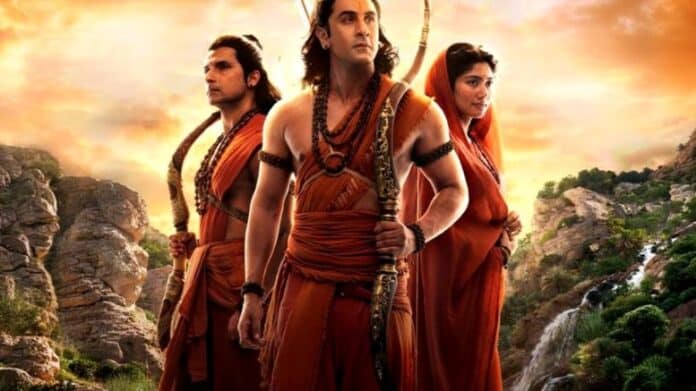
Creative Liberty is a term thrown around casually these days to justify misinterpretation of Hindu Granthas and Itihas to propagate one’s agenda. The latest case in point being Namit Malhotra and Nitesh Tiwari’s Ramayana movie.
The Misuse of Creative Liberty
There are two versions of Ramayana that have been released worldwide. The Hindi version is available across the globe but the English version is not available in Bharat. It is almost as if they didn’t want people to know what narrative they’ve set in the English version (not that they can keep it hidden forever in today’s Social Media times).
I’ve relied on Shan Prasher’s review of the English version of Ramayana along with videos available on Social Media posted by Western audiences regarding their impression and takeaways from the movie. The review highlights how ‘things have been lost in translation’ and the core message and importance of Ramayana has been diluted to sell the movie to Western audiences. If this is not intellectual dishonesty, then I don’t know what is!
The makers knew what they were doing and yet, they chose to go ahead with it because their intention was probably only to profit by selling their digital products globally and tap into the Hindu sentiments running high within Bharat. In the English version they have cut scenes that not just presents Ravan as an anti-hero but also ‘humanizes’ Surpanakha who was a lustful Rakshasi. Is this creative liberty or deliberate distortion? In fact, in the name of creative liberty they have even introduced feminism which is a completely alien concept in Hindu Dharma.
Leftist concepts like socialism and communism have been subtly introduced by presenting Ravan as one fighting for the rights of his people ‘banished’ and ‘oppressed’ by the Devas (Gods). They have gone a step ahead and taken the liberty of cutting out all those scenes that define Prabhu Sri Ram’s character, convey key details or important emotions and act as a bridge between various happenings. These changes may seem small and insignificant but they deviate completely from the original Grantha’s intent and message.
That the message has been completely distorted is clear from the above video where the Western audience is saying all Ravan wanted was liberation for his people. The makers have turned him into someone fighting for justice than the lustful tyrant he really was. However, it is not just the English version that is problematic but the Hindi one also highlights how creative liberty distorts and destroys the original intent of the Grantha.
In both versions, besides humanizing him they have taken out the lustful nature of Ravan and replaced it by showing him as one who ‘respects’ women and even lectures his brother-in-law on ‘respecting women’! Nalkuber and Devi Punjikasthala would certainly question this kind of ‘creative liberty’.
This is not to give a free pass to Adipurush but this movie is doing more damage than Adipurush due to its subtle subconscious tuning in the name of creative liberty. Think of Adipurush as the Islamic sword that can be seen and the threat recognised while this Ramayana movie is the similar to Christian Missionaries working in the background by planting narratives that were never intended in the original Grantha.
As more and more people started calling out these narratives, the movie’s defenders came up with the ‘this is a great visual experience’ narrative to urge people to watch the film. In a movie like Ramayana, the story matters more than the visual effects. Good graphics are only to enhance the viewing experience and lose their meaning if the story fails to stay true to its Dharmic roots.
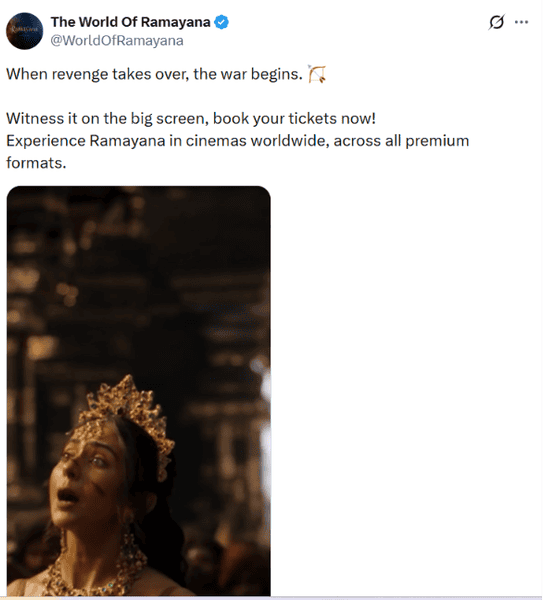
More importantly, the makers themselves are marketing this movie as a ‘revenge story’ than a Dharmic one. This is not just diluting but taking away the soul of the original.
Ramayana is not just another story. It is a complete manual on how to lead life. It doesn’t need the kind of ‘creative liberty’ the makers have taken to make it palatable or acceptable.
Defenders of the film have come up with the argument of rising ‘intolerance’ among a section of Hindus (just because we refuse to accept the narratives set by the makers). This argument doesn’t hold because there have been numerous versions of Ramayana that have retold Prabhu Ram’s story.
The ‘Numerous’ Ramayanas
Every Sampradaya and even religion has its version of Sri Ram’s story. From regional folklore to Buddhist, Jain and even Islamic versions of Ramayana exist. Despite these versions, Valmiki Ramayana has an authenticity, owing to being the original and contemporary work, that no other version can supersede. In case of conflicts, Valmiki Ramayana overrules every other rendition.
Also, the existence of these versions in no way justifies any degree of creative liberty taken by the makers. When a movie says it is an adaptation of Srimad Valmiki Ramayana then it has the responsibility to stay true to the original Grantha.
Is Srimad Valmiki Ramayana too ‘Dark’ to be Adopted?
Another argument being pushed by the movie’s defenders is that Srimad Valmiki Ramayana is too ‘dark’ to be adopted as it is. I am not buying this argument for two reasons. The Srimad Valmiki Ramayana renditions are already popular in the form of Ram Lila among citizens and the story is being narrated by Kathavachaks without any ‘creative liberty’ filtering out necessary and important details. The second, and most important, reason being younger generations have a right to know the contents of our Granthas without any filters. Keeping truth hidden from Hindu youth has taken them away from Dharma and even took away Kshatriyata from our Samaj.
Dark or not Srimad Valmiki Ramayana must be narrated as it is not by infusing concepts alien to it. Creative liberty can wait for other non-Dharmic projects.
