


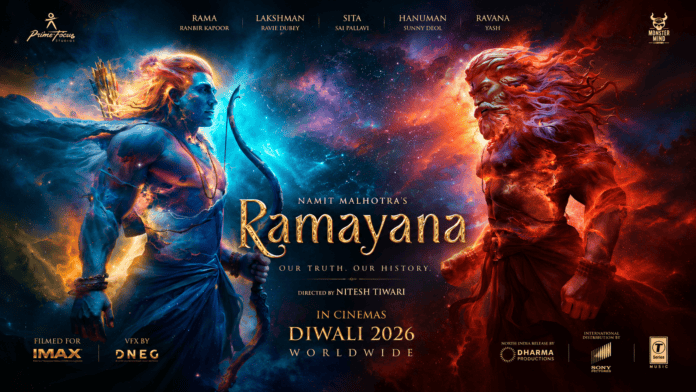
The much-anticipated cinematic adaptation of the Ramayana offers an ambitious visual experience, bringing one of Bharat’s most revered epics to the big screen. The film deserves considerable appreciation for its technical execution, visual presentation, dialogues and dubbing. However, when a story of such immense religious, cultural and civilisational significance is adapted for cinema, its treatment of characters, philosophical foundations and narrative interpretation inevitably deserves closer examination.
Having watched the film, my assessment is that it succeeds remarkably well as a cinematic production, but certain creative decisions regarding characterisation and narrative presentation leave room for serious discussion.
Cinematic excellence: A visual spectacle
The film is undoubtedly impressive in its visual execution. The cinematography, visual effects, production design and overall presentation are extraordinary. The dialogues are powerful, and the dubbing deserves special appreciation. The voice delivery adds considerable depth to the characters and enhances the viewing experience.
The visuals deserve a 10/10. The overall technical presentation is top-notch, and the filmmakers deserve credit for attempting a production of this scale. The casting works well for most characters. However, I felt that the casting of Sita did not quite match my expectations of the character. This is a subjective observation, but when portraying someone who holds such an extraordinary place in our cultural and spiritual imagination, the visual representation matters.
Nevertheless, the film’s technical achievements and cinematic ambition deserve genuine appreciation.
Rama and Parashurama: A question of character consistency
Despite the film’s visual brilliance, a few scenes made me question whether the characters were being portrayed in accordance with their traditional descriptions.
One such instance is the encounter between Parashurama and Rama.
When Parashurama becomes aggressive, Rama’s tone also shifts noticeably. This was something I found slightly uncomfortable. The Rama we have traditionally understood is an embodiment of composure, humility, restraint and dignity. His greatness is not merely in his physical strength or ability to defeat opponents but also in his extraordinary control over his emotions.
Rama is not someone who needs to raise his voice to establish his authority. Even in the face of aggression, his defining qualities are patience, composure and adherence to Dharma. This is one of the most admirable aspects of Rama’s character. His strength lies as much in his restraint as in his valour.
I am not suggesting that Rama cannot express firmness or displeasure. However, there is a difference between demonstrating authority and mirroring the aggression of another person. I felt that the Parashurama episode could have retained Rama’s characteristic composure while still conveying the intensity of the confrontation.
Such details are important because they contribute to the identity of Rama as Maryada Purushottama.
Sita and Shurpanakha: Does strength need to be demonstrated through a sword?
Another scene that deserves discussion is the encounter involving Shurpanakha, in which Sita takes up a sword to defend herself.
I understand the filmmakers’ intention to portray Sita as a strong and courageous woman. However, the manner in which her strength is demonstrated felt somewhat awkward to me.
Sita is traditionally revered as Bhoomija, the daughter of Bhoomidevi. She represents extraordinary inner strength, dignity, spiritual power and resilience. Her strength is not something that needs to be established through the possession of a physical weapon.
The traditional narrative itself offers a remarkable illustration of her strength. During her encounter with Ravana, the episode involving a blade of grass conveys her defiance and spiritual resolve. Even something as insignificant as a blade of grass becomes a powerful expression of her refusal to submit to Ravana.
This is the Sita we know: a woman whose strength is rooted in her character, conviction and spiritual stature.
Therefore, I felt that the scene could have been conceptualised differently. There is nothing wrong with portraying Sita as courageous or physically capable. However, making her wield a sword to establish her strength seemed unnecessary when her traditional character already embodies immense power. Her strength does not need to be reinvented; it needs to be understood and represented appropriately.
Ravana: Revenge or desire? A significant narrative distinction
Ravana’s character receives considerable prominence in the film. His strength, personality and conflicts occupy an important place in the narrative.
One aspect that particularly caught my attention was the apparent emphasis on revenge for Shurpanakha’s humiliation as the primary motivation behind Sita’s abduction.
This deserves closer examination because the traditional accounts present a more complex sequence of events. Shurpanakha’s humiliation, the killing of Khara and other Rakshasas, and Ravana’s subsequent involvement are important developments. However, Ravana’s desire for Sita is also central to the traditional narrative.
There is a significant difference between explaining the circumstances that led to an action and changing the moral nature of that action.
By placing greater emphasis on revenge, the film appears to shift the audience’s understanding of Ravana’s motivation. This risks presenting his actions primarily as retaliation rather than acknowledging the lust, desire and adharma that form an essential part of his traditional characterisation.
Ravana was undoubtedly a powerful ruler, an accomplished scholar and a great devotee of Bhagwan Shiva. His knowledge of the shastras and his extraordinary capabilities are recognised in our traditions.
However, these qualities cannot be used to justify his conduct towards Sita. His abduction of Sita and his persistent attempts to possess her against her will remain central to understanding his character. We can acknowledge Ravana’s scholarship without glorifying his wrongdoing. We can appreciate his devotion without overlooking his adharma. Understanding the complexity of Ravana does not require us to whitewash his actions.
Devas, Asuras and the misinterpretation of Puranic narratives through caste
Perhaps one of the more important aspects worth discussing is the recent interpretation of the Deva–Asura conflict on social media. The movie opens with a confrontation between the Devas and Asuras, in which the Asuras are defeated. Subsequently, Ravana enters the narrative and defeats Indra. These sequences establish the conflict and the strength of the respective characters.
However, what caught my attention was not necessarily the cinematic portrayal itself, but the way certain people on Instagram and other social media platforms have attempted to interpret these episodes through the lens of contemporary caste politics. The conflict between Devas and Asuras is being presented by some as a struggle between oppressors and the oppressed, with attempts to associate these Puranic characters with present-day caste identities. This is where I strongly disagree.
The genealogies and relationships described in our Puranic traditions are far more complex than such simplistic interpretations suggest. Consider Hiranyakashipu and Indra. Hiranyakashipu belonged to the Asura lineage, while Indra was a Deva. Both are connected through the broader genealogical traditions associated with Kashyapa. Their conflict cannot simply be interpreted as a caste-based confrontation.
Similarly, the genealogies of Rakshasas and Asuras are distinct and should not be casually conflated. Ravana himself comes from an interesting lineage. His father, Vishrava, was descended from Pulastya, while his mother, Kaikasi, belonged to a Rakshasa lineage. His ancestry further illustrates the complexity of the genealogical relationships described in our traditional accounts.
Therefore, equating Devas with an oppressive caste and Asuras or Rakshasas with historically oppressed communities is an oversimplification that has no straightforward basis in these traditional genealogies. We must distinguish between genuine historical and social discussions and interpretations that selectively use our scriptures to advance an ideological position. Our epics deserve to be understood through their actual narratives, not through convenient social media narratives.
The Ramayana is Rama’s journey, not merely Ravana’s story
Another important consideration is the balance of the narrative itself. The Ramayana is fundamentally the story of Rama’s life and the path he follows. It is his physical journey from Ayodhya to Lanka and back, but more importantly, it is his journey through Dharma, duty, relationships, sacrifice and righteousness.
Ravana is an essential character in this journey. His scholarship, strength, devotion, arrogance and eventual downfall contribute significantly to the larger philosophical meaning of the epic.
However, Ravana is not the central protagonist. By character, Ravana was a cruel, lustful and adharmic ruler who abducted women, violated their dignity and repeatedly pursued his desires over Dharma. The Ramayana should not become a narrative in which Rama’s character and the philosophical essence of his journey are overshadowed by an excessive focus on Ravana.
There are numerous episodes in the epic that could have been explored to communicate powerful messages to contemporary society.
One particularly beautiful episode is Rama’s meeting and friendship with Guha, traditionally associated with the Nishada community. This relationship represents affection, mutual respect and friendship that transcends social distinctions. It is an excellent example of how the Ramayana can communicate social harmony without requiring contemporary ideological reinterpretation.
A meaningful portrayal of Rama and Guha’s friendship could have positively influenced society and reinforced the values of dignity, respect and human relationships. Why overlook such powerful episodes when our own scriptures provide so many opportunities for meaningful storytelling?
Creative freedom must coexist with responsibility
Adapting every incident of the Ramayana into a cinematic sequence is undoubtedly a Herculean task. No sensible viewer expects every verse, episode or philosophical discussion to find a place in a film. Creative freedom is essential to filmmaking. Certain additions, omissions and interpretations are inevitable when a vast epic is translated into a cinematic experience.
However, there is a distinction between creative interpretation and altering the fundamental character of a narrative.
When filmmakers choose to portray the Deva–Asura conflict through contemporary social frameworks, modify the motivations of central characters, or compromise the defining qualities of Rama and Sita, audiences have every reason to question those decisions.
The dialogues, particularly in certain pivotal scenes, could have been much more powerful and impactful, with stronger expressions and sharper word choices. The exchanges involving the Asuras, in particular, offered scope for more commanding and contextually appropriate language that could have elevated the intensity of the narrative.
Lack of emotional depth in Sita’s characterisation
The scenes depicting Sita’s abduction by Ravana lacked the emotional intensity and distress one would expect from such a defining moment in the Ramayana. Similarly, the news of Jatayu’s death could have evoked a much deeper emotional response from Sita. These moments are profoundly significant in the epic, and I felt their emotional weight was not adequately conveyed on screen.
The responsibility of taking our epics to future generations
Our Ramayana and Mahabharata are extraordinary repositories of philosophy, history, literature, art and civilisational memory. They deserve large-scale cinematic adaptations, and Bharatiya filmmakers have an opportunity to introduce these narratives to audiences across the world.
However, cinema reaches millions of people in a single release. Its influence extends far beyond that of individual lectures, books or cultural programmes. Once a particular interpretation becomes embedded in popular culture, correcting misunderstandings among present and future generations can become an enormously difficult task.
This is why filmmakers must approach our sacred narratives with adequate research, cultural sensitivity and intellectual honesty. There is immense cinematic potential in our Dharma. The stories, characters and philosophical ideas are rich enough to create commercially successful productions while remaining faithful to their underlying essence.
Overall review
Overall, the film is a technically brilliant and visually spectacular cinematic production. The dialogues, dubbing and visual presentation deserve extraordinary appreciation. The filmmakers have demonstrated the possibilities of presenting our civilisational heritage on a grand cinematic scale.
However, certain aspects of characterisation, particularly the portrayal of Rama’s composure, Sita’s strength and Ravana’s over exaggeration, could have been handled with greater sensitivity to the traditional narratives.
The opening Deva–Asura conflict and its broader narrative implications also deserve closer examination, particularly when contemporary caste-based interpretations risk being superimposed on our Puranic traditions. I strongly believe that our scriptures deserve more ambitious cinematic representations.
But grandeur should not come at the cost of authenticity, and creative freedom should not become an excuse for compromising the philosophical integrity of our traditions.
Our epics deserve cinematic excellence, but they also deserve intellectual integrity.
