


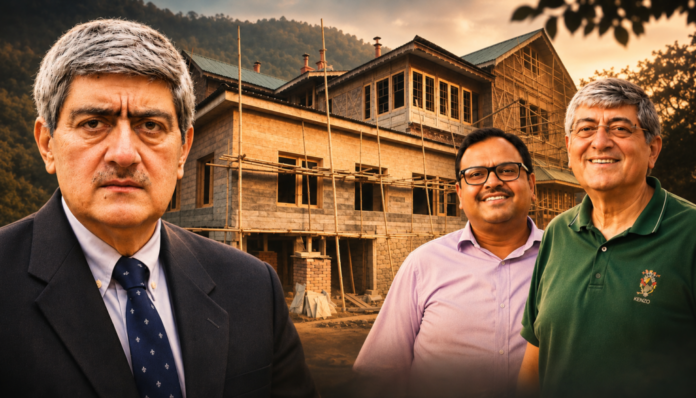
Summary: SK Kaul, who retired from the Supreme Court in 2023, now has some uncomfortable questions to answer. His family’s Srinagar property, Pratap Villa, was rebuilt as a luxury hotel in 2022 while he was still a Supreme Court judge, and it is now run by his son-in-law’s company. According to documents from whistleblowers, every outside lender to that company, the firm that paid its alleged builder and the client named on its architect’s contracts all trace back to Sahul Agarwal, a Dubai-based businessman who is reportedly a Grenadian citizen. His wife controls the company that owns Hyatt Regency Delhi. Kaul’s daughter appeared for that company in nearly 300 court orders from 2021, Supreme Court hearings among them, while her father sat on the same court. Chapter 1 Magazine, which reports all this, says more is to follow.
Why it matters: A retired Supreme Court judge who used his memoir to call a former CJI “too deferential to the government”, and who has lately lectured the nation on judicial independence, is now asked who funded the hotel built on his family’s Srinagar property while he sat on the bench, at a time when his daughter was appearing in the same court for a company linked to the apparent funder. The report adds that he never published his assets as a Supreme Court judge, though several colleagues did; the court made publication mandatory only in April 2025, after he had retired. This is Delhi’s judicial elite at its most self-righteous: demanding accountability from everyone else while the Collegium lets judges appoint their own brother judges and, after striking down Parliament’s NJAC law in 2015, keeps elected representatives out of the process. Few democracies, if any, run their judiciary as such a closed club.
“Hotels in Kashmir, Dubai businessman and Justice Sanjay Kishan Kaul: The financial web” — Chapter 1 Magazine, 3 Nov 2026
There are some secrets that are known but often unspoken. Not because those who know don’t want to speak about it, but because the price they may pay for breaking the omerta is too high, the consequences too serious. Corruption in the judiciary is one such subject. We often convince ourselves that judges are pristine, incorruptible, and virtuous because acknowledging corruption in the high judiciary essentially means that justice, that people so desperately seek, is often turned into a tradeable commodity by those sworn to righteousness…
Read the full article at Chapter 1 Magazine →
