


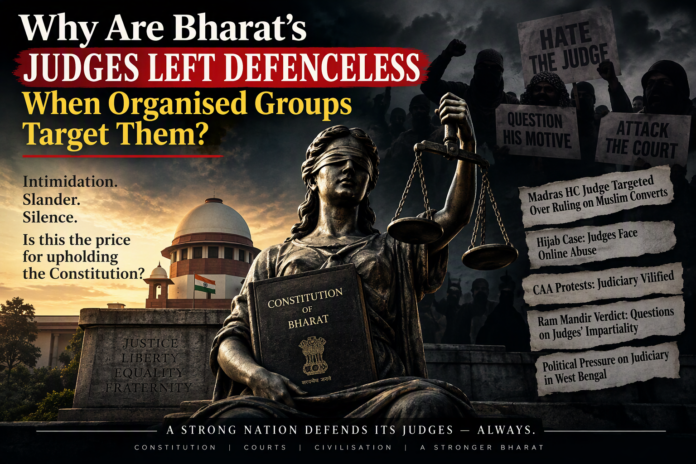
The recent targeting of a Madras High Court judge following a ruling denying reservation benefits to Muslim converts is not merely another controversy. It is a test of whether Bharat still possesses the institutional courage to defend judicial independence when the pressure comes from organized religious or political interest groups. A judge does not cease to be a judge because his verdict displeases a particular community. Yet, whenever a judgment touches sensitive religious questions, sections of organized activism increasingly abandon constitutional methods and resort to public intimidation, vilification, and pressure campaigns.
This trend has become disturbingly familiar. Whether it was the hijab controversy, the Citizenship Amendment Act (CAA) litigation, or the Ram Janmabhoomi dispute, judges have often found themselves subjected not merely to criticism of their reasoning but attacks on their integrity, motives, and legitimacy. Legal disagreement is the lifeblood of democracy. Personal targeting of judges is an attack on democracy itself. A society governed by constitutionalism cannot allow verdicts to be determined by which group can create the greatest pressure outside the courtroom.
Some specific instances
The Hijab Litigation (2022)
After the Karnataka High Court upheld the uniform policy and held that wearing hijab was not an essential religious practice in the context before it, judges faced severe online criticism and allegations of prejudice from activist circles. Disagreement quickly moved beyond legal debate into attempts to delegitimize the bench.
Citizenship Amendment Act (CAA) Litigation
During the nationwide controversy surrounding the CAA, judges and courts dealing with connected matters routinely came under political and ideological scrutiny. Public commentary often focused less on legal reasoning and more on perceived political implications.
Justice S. Muralidhar Transfer Controversy (2020)
Regardless of one’s political views, the intense public campaign surrounding the transfer of Justice S. Muralidhar highlighted a growing tendency to treat judges as political actors rather than constitutional adjudicators.
West Bengal Judicial and Constitutional Confrontations
Repeated confrontations between constitutional authorities and political actors in West Bengal, including criticism of courts and central institutions whenever decisions proved inconvenient, contributed to a climate in which institutional authority was frequently questioned through partisan lenses.
Threats to Judges in Various Sensitive Cases
Over the years, judges handling terrorism-related cases, communal-riot cases, and politically sensitive matters have required enhanced security due to threats. This underlines the fact that judicial intimidation is not a theoretical concern but a real challenge.
Dangerous message to society
What is particularly striking is the silence of institutions that are otherwise remarkably alert to many other forms of public misconduct. The higher judiciary has, on numerous occasions, demonstrated its willingness to take cognizance of controversial statements, social media abuse, and fringe online activities. Such vigilance is welcome and necessary. However, many citizens cannot help but notice a recurring pattern: when judges themselves become targets of organized intimidation for delivering legally reasoned judgments, institutional responses often appear hesitant, muted, or altogether absent.
The message this sends is dangerous. If judges are expected to adjudicate contentious issues without fear or favour, they must also know that the constitutional system stands firmly behind them. Judicial independence cannot exist only on paper. It must be actively protected. Otherwise, a precedent is created where pressure groups learn that intimidation is a viable political strategy. Over time, this corrodes the authority of courts and weakens public confidence in the rule of law.
The larger issue, however, extends beyond any single verdict or any single community. It concerns the growing asymmetry that many Hindus perceive in Bharat’s public life. For decades, the Hindu majority has repeatedly demonstrated extraordinary faith in constitutional institutions. Even when judgments have been disappointing, controversial, or emotionally painful, the overwhelming response has generally remained within democratic and legal boundaries. Hindus have accepted electoral defeats, adverse judicial decisions, and policy outcomes through constitutional means rather than through sustained campaigns of institutional delegitimization.
Yet, despite this consistent faith in the constitutional order, many Hindus increasingly feel that they are expected to tolerate standards that would be considered unacceptable if applied to any other community. Their concerns are frequently dismissed as majoritarian anxieties. Their grievances are often subjected to moral scrutiny that is rarely applied elsewhere. Their restraint is interpreted not as civic maturity but as a reason to further ignore their concerns.
This perception is reinforced whenever state institutions appear more responsive to the sensitivities of organized pressure groups than to the sentiments of the civilizational majority. Equal citizenship cannot mean that the majority alone bears the burden of institutional restraint while minorities, activists, or political organizations are permitted greater latitude in challenging constitutional authorities. Equality before law demands a single standard for everyone.
The question therefore is simple. If targeting judges is unacceptable when done by one group, why should it be tolerated when done by another? If institutions rightly act against threats, harassment, and intimidation in one context, why should they remain passive in another? Constitutional principles derive their legitimacy from consistency. Selective enforcement inevitably breeds distrust.
Concern of Hindu society
For many Hindus, the issue is no longer merely about one judgment or one controversy. It is about a broader feeling that the community which has historically shown the greatest respect for Bharat’s institutions often receives the least institutional empathy in return. The Hindu taxpayer funds the state. The Hindu citizen obeys the courts. The Hindu majority repeatedly places faith in constitutional mechanisms even when outcomes are unfavorable. Yet, there is a growing perception that this trust is neither acknowledged nor reciprocated.
A confident republic cannot operate on such contradictions. Bharat’s judiciary deserves protection not because judges are infallible, but because the rule of law is non-negotiable. Every citizen has the right to criticize judgments. No citizen or organization has the right to intimidate judges. The moment constitutional authorities are left vulnerable to organized pressure, the Constitution itself becomes vulnerable.
The real challenge before Bharat is therefore not merely preserving judicial independence, but preserving a culture where constitutional institutions are defended with equal conviction regardless of who attacks them. If the judiciary is to remain fearless, the state and its institutions must demonstrate that attacks on judges will invite the same seriousness, the same urgency, and the same institutional response irrespective of the identity of the perpetrators.
Until that consistency is visible, many Hindus will continue to ask an uncomfortable question: why is the community that exhibits the deepest faith in Bharat’s institutions so often made to feel like the last constituency those institutions are willing to defend?
Conclusion
The fundamental issue is not whether one agrees with a particular judgment. Courts exist precisely because citizens will disagree about difficult questions. The issue is whether Bharat will permit organized pressure, religious mobilization, or ideological intimidation to become alternative appellate mechanisms. A nation governed by law cannot allow judges to look over their shoulders before delivering a verdict. Yet many citizens increasingly perceive that institutional outrage is selective: swift when fashionable causes are involved, hesitant when judges themselves become targets. For a large section of Hindu society, this reinforces a growing belief that the community which has historically shown the greatest faith in the Constitution, the courts, and the democratic process often receives the least institutional consideration in return. Whether that perception is entirely justified or not, Bharat’s institutions can no longer afford to ignore it. The defence of judicial independence must be absolute, uniform, and free from political calculations. Otherwise, public faith in both justice and institutional neutrality will steadily erode.
