


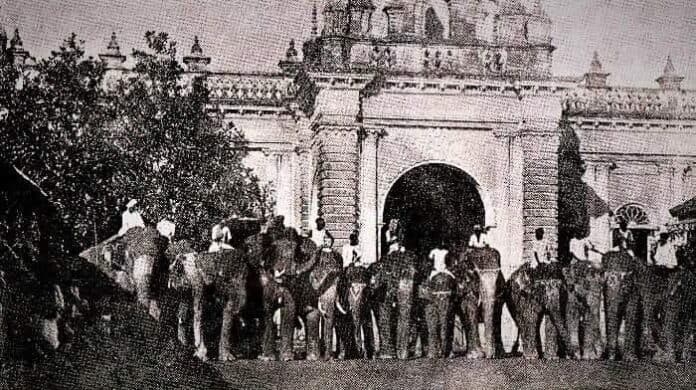
Located on the western edge of Mymensingh district in Bangladesh, about ten miles from the district headquarters, Muktagacha—once known as Binodbari—stands today as a quiet township. Yet in earlier centuries, it was the center of a vast and influential zamindari estate where authority, culture, and administration were closely intertwined.
Historically known as the Alapsingh or Alapshahi Pargana, this region extended over an impressive expanse—from Dewanganj to Bhairab in Kishoreganj, stretching northward toward the border of present-day Meghalaya in India and southward to the Bhawal Pargana of Valuka. At the heart of this extensive territory, Muktagacha evolved as the administrative hub.
The history of this estate is closely associated with Shreekrishna Acharya Chowdhury, a trusted official in the revenue department during the reign of Nawab Murshid Quli Khan, widely regarded as the first independent Nawab of Bengal. In 1727, he obtained the lease of the Alapshahi Pargana from the Nawab. However, he was unable to settle permanently within his estate and passed away in 1734 in Jhakra, in present-day Bogura district.
Following his death, his four sons—Ramram, Hareram, Shibram, and Bishnuram Acharya Chowdhury—moved to Alapshahi Pargana and established their residence there. On the banks of the Ayman River, a tributary of the Brahmaputra, they constructed four separate homesteads and began managing the estate from those locations.
The Muktagacha zamindari was organized into sixteen shares, forming a structured system of administration. Among the notable divisions were the Greater Share, Middle Share, Smaller Share, Atani Bazaar, and Dari Char Ani Bazaar. The four brothers divided these shares among themselves, creating a coordinated framework for governance and management.
In 1734, the Atani Zamindar House was established, which is now known as the Muktagacha Rajbari. Over time, additional structures developed around it, several of which still exist as historical landmarks. The building adjacent to the Rajbari, currently used as a college, once served as the residence of Zamindar Hareram. The present Muktagacha Sub-Registry Office was formerly the home of Zamindar Ramram, while the site of the current Armed Police Battalion once functioned as the residence of Zamindar Shibram.
No visible remains of Zamindar Bishnuram’s residence survive today. However, his legacy is preserved through the large Vishnusagar pond situated in front of the Rajbari, which remains one of the area’s most significant historical features.
Over time, the zamindars of this estate were honored with titles such as Raja, Maharaja, and Rai Bahadur, reflecting their elevated social status and administrative influence during that period.
Today, Muktagacha no longer serves as a center of landed authority, but its architectural heritage, landmarks, and surrounding landscape continue to reflect a rich and layered past. The transformation from Binodbari to Muktagacha represents a notable chapter in the history of Bengal’s rural estates—one that remains an enduring part of the broader historical narrative of the region.
