


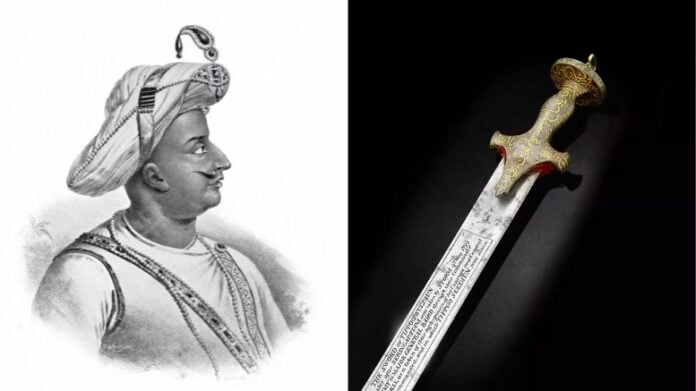
Tipu Sultan, the ruler of Mysore in the late 18th century, is often portrayed as a great hero who “fought the British colonial forces”. However, the truth is that his legacy is filled with numerous accounts of brutality and religious persecution. Especially in the Karnataka coast, Mysore, and Malabar regions, Tipu Sultan’s reign was known for its ruthless enforcement of Islamic conversion policies and violent suppression of local Hindu populations. His actions in these regions earned him a reputation as a tyrant rather than a liberator, with a legacy of bloodshed and terror that has left deep scars on history of southern part of Bharat.
A YouTube video by Sushant Sinha, Consulting Editor with Times Now Navbharat, has gone viral in recent days, despite being two years old. In the video, Sinha highlighted the cruelty and brutality of Tipu Sultan, referencing several historical books that document these atrocities. Among these sources are the “Malabar Manual,” the “Mysore Gazetteer,” and works by authors like Kate Brittlebank, “The Life of Tipu Sultan”. The video draws attention to how former British officials and historians have detailed Tipu Sultan’s primary aim of forcibly converting Hindus to Islam. These accounts paint a starkly different picture from the often-glorified version of Tipu Sultan, shedding light on his violent campaigns and religious persecution.
Now comes the problematic part. It came to light that the inscription on the handle of Tipu Sultan’s sword read: “My sword is shining for the blood of infidels.” This chilling inscription underscores the brutal and fanatical zeal with which Tipu Sultan conducted his campaigns. Despite this stark evidence of his bloodthirsty nature, political agendas have often sought to whitewash his legacy. For years, the Congress party engaged in the politics of appeasement, obscuring such crucial information and failing to present an accurate account of history in our schools. This manipulation of historical narratives not only distorts our understanding of the past but also dishonors the countless victims of Tipu Sultan’s reign of terror. The true story of Tipu Sultan’s atrocities, marked by forced conversions, massacres, and cultural destruction, needs to be told to rectify the historical record and honor those who suffered under his rule.
Tipu Sultan’s Sword: Symbol of Genocidal cruelty
The inscriptions on Tipu Sultan’s sword reflect his zealous commitment to his faith and his hostility towards non-Islamists or Kafirs. The words praise Haidar, the god of the Faith, for the destruction of unbelievers and express a sense of divine mission in Tipu’s military campaigns. Islamists often refer to non-believers as “kafirs,” a term used to denote individuals who do not adhere to Islam. Historically, the treatment of kafirs has varied, but in the context of figures like Tipu Sultan, it included forced conversions, massacres, and severe punishments. Tipu’s campaigns were marked by brutal methods to convert Hindus and Christians to Islam, as seen in his mass circumcisions, forced consumption of beef, and the destruction of temples and churches.
Tipu Sultan’s genocidal campaigns against Hindus
Tipu Sultan was a ruthless jihadi who invited foreign invaders to Islamize Bharat. His atrocities against Hindus, including Brahmins, Nairs, and Thiyyas, were horrific and included beheadings with heads displayed on stakes, kidnappings of nobles, forced circumcisions, and the feeding of beef to convert Hindus to Islam. His genocidal campaign forced the Hindus of Malabar to seek help from the British. Over 30,000 Hindus fled to Travancore for refuge from Tipu’s terror.
In South Malabar, Raja Rama Varma led a revolt against Tipu’s tyranny, enraging him to the point where he sent his army to annihilate the Nairs. Tipu Sultan forcibly converted 400,000 Malabar Hindus to Islam through circumcision and forced beef consumption. His reign of terror left a lasting scar on the region, with countless lives lost and cultures disrupted.
When the Kodava Hindus revolted, Tipu captured over 50,000 Coorgis to convert them forcibly, leading to the slaughter of thousands, including women and children. He humiliated them for their matrilineal customs. Tipu’s extreme cruelty was evident when he ordered his soldiers to circumcise even the corpses of Coorg’s Hindus. These heinous acts demonstrate that Tipu was not a freedom fighter but a genocidal terrorist who committed unspeakable atrocities against his own countrymen in the name of religion.
The destruction of Hindu temples
During his reign, Tipu Sultan was responsible for the destruction of numerous Hindu temples as part of his campaign to Islamize the regions under his control. Significant examples include the destruction of the Sri Ranganathaswamy Temple in Srirangapatna, the pillaging of the Guruvayur Temple in Kerala, and the razing of the Thaliparamba Temple in Kannur. These actions were part of a broader pattern of religious persecution that included forced conversions and the desecration of Hindu religious sites, contributing to his controversial legacy.
Three activists from the Social Democratic Party of India (SDPI) were arrested for obstructing an Independence Day Rath Yatra and demanding the installation of a portrait of Tipu Sultan in Kabaka Gram Panchayat, near Puttur town in Mangaluru district. The protest erupted when the yatra, featuring portraits of freedom fighters including Veer Savarkar, began. The SDPI members raised slogans against Savarkar and the gram panchayat.
Hindu Post recently reported multiple instances where the Karnataka government has started celebrating Tipu Jayanti, his birth anniversary. During Islamic religious celebrations, Islamists erected huge cutouts of Tipu Sultan and displayed his flags around the city of Shivamogga. This clearly shows how Islamists are promoting Tipu’s legacy, despite his history as a jihadi and murderer.
Tipu Sultan’s countless contributions to destroying temples and churches are well-documented, yet he is portrayed as a hero in school textbooks, which often omit his acts of cruelty. Times Now Navabharat aims to shed light on the reality of Tipu Sultan’s reign, countering the shadow of historical revisionism that paints him in an undeservedly positive light.
Recently, a movie titled “Tipu” was announced, aiming to showcase the true face of Tipu Sultan. The film seeks to portray the historical figure not as a hero, but as a ruthless jihadi whose legacy includes countless atrocities against Hindus and Christians. Despite the historical evidence of his actions, treating Tipu Sultan as a hero overlooks the harsh reality of his persecution of Hindus and Hindu religious sites.

Tipu Sultan was an iconic hero who fought against the British like a Royal Bengal tiger, but he failed miserably to take Hindus & Muslims at par. He forgot that Hindus were also his subject. His cruel persecution of Hindus is a sad part Tipu’s history of heroism.