


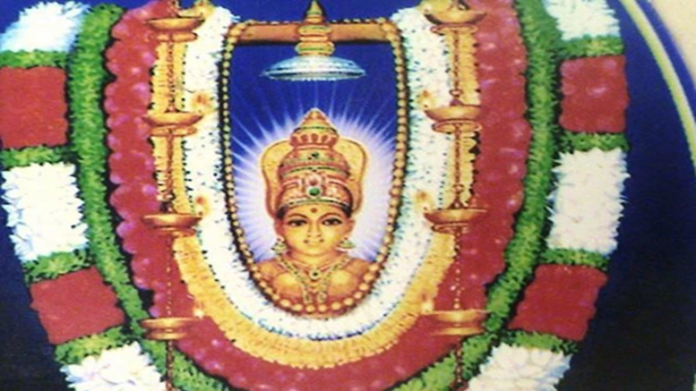
The Meenkulathi Bhagavathy Amman Mandir is located in Pallassana, a village in Kerala. Meenkulathikkavu is one of the oldest Mandirs in Pallassena, Kerala. Ma Meenkulathi is considered to be an aspect of Madurai Meenakshi Amman, and since she contains fish-like eyes, hence the deity in this temple came to be known as Meenkulathi Bhagavathy Amman Temple.
The structure is built in the Kerala style. It is constructed in such a way that the shadow of the wall never falls on the ground. There are two entrances, one in the north and the other in the west. The temple tank is next to the western entrance.
Navarathri, Karthigai, Mandala Vilakku, Maasi Thiruvizha, Pallivettai and Bhairava Pooja are the most celebrated events in the temple. The eight-day maasi festival includes Ottamthullal and Kathakali programs depicting scenes from the Ramayana and Mahabharata. It is customary that the deity’s sword and lamp are taken in procession by the descendants of the youths who stood guard over the valuables and the palm leaf umbrella.
Meen kolathi means “She who has a tank of fish”. This is a temple of Meenakshi and is situated in the Pallassana village of Palakkad District on the road connecting Palakkad and Kollengode.
This Mandir was established by the family of Mannadiars. This family originally belonged to Chidambaram in Tamil Nadu. After losing all their business assets, they decided to migrate to Kerala. They went to the Meenakshi Temple in Madurai, which was their family deity, before coming to Kerala. The eldest member of the family took a stone from Madurai while coming further.
He was offering worship to the stone daily. In earlier years he used to visit Madurai temple every year. One day, in his old age, he kept his umbrella and the divine stone on the shore and got into the pond to take a bath. While bathing he cried because he would not be able to go to Madurai again due to his old age, When he finished his bath and came out, he could not lift both the Umbrella and the stone from there. They had got fixed to the land.
When they called astrologers and conducted Deva Prasanam (asking questions to God), they found out that the stone that was fixed to the shore was Devi Meenakshi of Madurai herself. After 400 years, the Mannadiyar family built a temple for Devi Meenakshi at the same spot. They consecrated the Ashta Durgas (Brahmini, Kaumari, Maheswari, Indri, Vaishnavi, Narasimhi and Varahi) around the sanctum sanctorum.
Nobody is permitted to go around the sanctum sanctorum. The main festivals of the temple are Navarathri, Karthiga, Mandala Vilakku, foundation day and palli vettai and vaira poojai. On festival days, the sword and lamp are taken in procession. People believe that all sickness will vanish if people bathe in the pond opposite the Mandir.
The Mandir is open from 05:30 AM to 12:30 AM on Sunday, Tuesday and Friday and during the other days between 05:30 AM to 10:30 AM. In the evening it is open between 05:30 PM to 08:00 PM. In the Mandir, there are separate sub-temples for Ganapathi, Nagar (snake god) and Bhairava.
Chandattam to remove problems from enemies is performed during the first Tuesday of certain months in this temple. Separate pooja reciting Bhagya suktham and Eikamathya suktham are also done in this temple. In the May – June month (Vaikasi Edavam), the thol pavai Koothu (shadow play using dolls made of leather) is conducted for ten days. They sing and enact the story of Ramayana during this time. On the last day, the arrow of Sri Rama is kept in front of the Devi and worshipped.
Once in 12 years during the full moon day of the same month, a festival called Palli pana is celebrated. Firewalking is one of the highlights of this festival which is celebrated for four days. On the fourth day, the demon called Daruka is killed by the Devi.
In the eastern and western parts of the Mandir, there are two agraharas (villages where Brahmins reside) In the east side village there is a Shiva temple and in the west side village there is a Vishnu temple. The effect of pilgrimage to Meen kolathi is considered very fruitful if one visits these two temples also.
“OM SRI MEENAKSHI MEENKULATHI MEENAMMA NAMO NAMAHA”
–R. HARISHANKAR
