


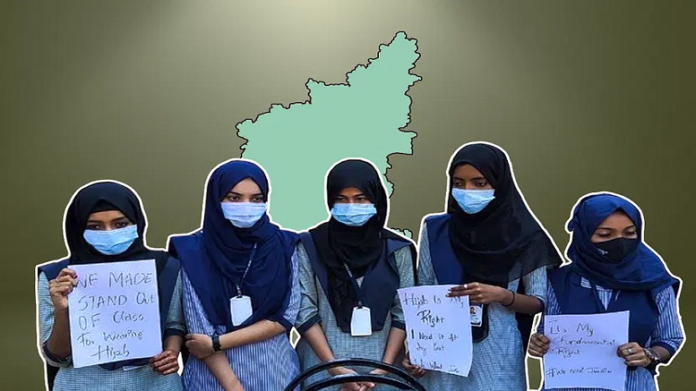
The Congress-led Karnataka government has reignited a major controversy after revoking the 2022 hijab restriction order introduced during the previous BJP administration. Chief Minister Siddaramaiah clarified that while hijabs and certain existing religious symbols would now be permitted in educational institutions, saffron shawls would continue to remain banned. His remarks have triggered sharp political reactions and reopened debates around secularism, equality, and religious expression in schools.
As per Asianet Suvarna News reports, under the revised guidelines, students will be allowed to wear “limited traditional and faith-based symbols” alongside prescribed uniforms. These reportedly include the hijab, janeu (sacred thread), rudraksha beads, Shivadhara, and turbans. However, Siddaramaiah firmly stated that saffron shawls would not be allowed under any circumstances, saying that “nothing new can be introduced” in schools and colleges.
The statement has drawn severe criticism from BJP leaders and several Hindu organizations, who accused the Congress government of pursuing selective appeasement politics. How one visible religious symbol could be permitted while another associated with Hindu identity was specifically prohibited. Many argued that if educational institutions are expected to remain secular spaces, then the rules should apply equally to all religious displays without discrimination.
The original hijab row in Karnataka had erupted in 2022 after Muslim students were denied entry into classrooms for wearing hijabs, leading to statewide protests and nationwide debates over religious freedom and institutional discipline. The controversy eventually became one of the most politically charged social issues in the country, with courts, political parties, activists, and religious groups all taking strong positions on the matter.
The Siddaramaiah government’s latest decision is being viewed as a complete reversal of the earlier BJP government’s stand on uniformity in educational institutions. Supporters of the move claim it protects individual rights and accommodates long-standing religious practices. However, opponents fear that selectively permitting some symbols while banning others could deepen communal divisions and create fresh tensions within campuses.
The controversy has now evolved beyond dress codes into a broader debate over constitutional equality, state interference in religious matters, and whether governments should decide which faith-based expressions are acceptable in classrooms. With the matter still emotionally and politically sensitive, Karnataka once again finds itself at the center of a national ideological battle over religion, identity, and education.
How can a Chief Minister who claims to uphold secularism decide on matters related to the Janeu and Hindu religious symbols, which have a history spanning thousands of years, while the hijab issue itself emerged much more recently and is still under consideration before the Supreme Court regarding its use in schools and colleges? Who is above the law? How can a minister make statements or take decisions that appear to override a matter that is still pending before the Supreme Court?
