


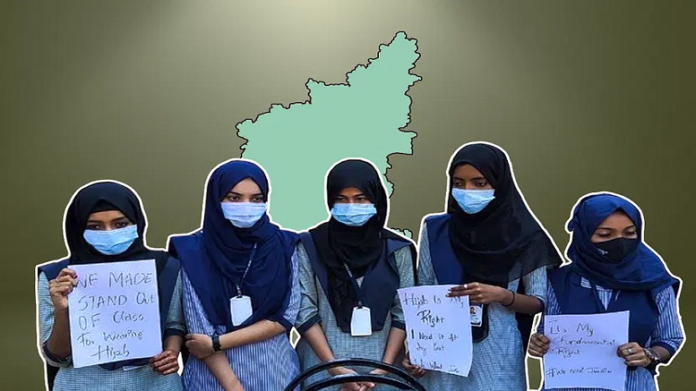
The Karnataka government has officially revoked the controversial 2022 hijab ban in schools and colleges nearly 4 years after legal battles, protests, and nationwide debate. Under the new directive, students will now be permitted to wear the hijab, along with religious symbols such as kalava, rudraksha, and janeu, within educational institutions, provided they continue to follow institutional discipline and prescribed academic norms.
As per Bhaskar English reports, the original ban was introduced in February 2022 by the then BJP-led Karnataka government, which made it compulsory for students in government pre-university colleges to adhere strictly to prescribed uniforms. The order declared that any form of clothing or religious attire that could disturb “equality, unity, and public order” would not be allowed inside classrooms. Following the notification, several institutions across Karnataka denied entry to Muslim girls wearing hijab, triggering widespread outrage and protests.
How the hijab controversy began in Karnataka
The controversy had begun earlier, in December 2021, when six Islamic students in Karnataka’s Udupi district were barred from attending classes while wearing hijab. Their protest soon escalated into a state-wide confrontation. In response, students affiliated with Hindu organizations started attending colleges wearing kesari shawls.
As tensions intensified and incidents of unrest emerged across Karnataka, the state government imposed a blanket restriction on all visible religious attire in educational institutions. The decision ignited massive protests, counter-protests, political mobilization, and intense national debate over constitutional rights, secularism, women’s education, and religious freedom. The opposition Congress party argued that the ban disproportionately targeted Muslim girls and risked pushing many students out of classrooms.
Court battle and supreme court split verdict
The matter eventually reached the Karnataka High Court, which in March 2022 upheld the government order. The court ruled that wearing hijab had not been conclusively established as an “essential religious practice” in Islam. However, the judgment was immediately criticized and challenged before the Supreme Court of Bharat. In October 2022, a two-judge bench of the apex court delivered a split verdict. Justice Hemant Gupta supported the Karnataka High Court ruling and upheld the ban, while Justice Sudhanshu Dhulia strongly opposed it, arguing that a girl child’s education and personal choice should take precedence over restrictive dress codes.
Because of the split verdict, the case was referred to a larger constitutional bench. However, despite the passage of several years, no final hearing or conclusive judgment emerged from the Supreme Court. In the absence of a definitive ruling from the apex court, the Karnataka High Court judgment technically remained operational, allowing the ban to continue in practice across many institutions.
The Congress government reverses the policy
After nearly four years of prolonged legal uncertainty and political controversy, the Congress government in Karnataka has now chosen to reverse the policy administratively.
The Karnataka government’s latest decision has once again sparked a broader debate over the limits of state interference in religious and cultural matters, especially given that the core issue remains pending before the Supreme Court of Bharat. Symbols such as the janeu, rudraksha, and kalava have remained deeply embedded in Hindu traditions, customs, and civilizational practices for centuries, particularly among Brahmin communities and various sects of Hindu Dharma. These are not newly asserted political identities but longstanding cultural and spiritual expressions that have existed naturally in society without requiring state endorsement or administrative validation.
Equating such traditional civilizational symbols with the hijab controversy creates an artificial equivalence between inherited cultural practices and externally imposed religious dress codes that became the center of institutional conflict only in recent years. The original hijab dispute had already triggered widespread unrest, campus polarization, and legal battles across Karnataka, eventually reaching the highest court of the country. Despite the matter still awaiting final constitutional clarity before the Supreme Court, the Congress government has now chosen to intervene administratively and reverse the earlier order, raising serious questions over constitutional propriety and political intent.
This direct political intervention into an issue still under judicial consideration argues that the state government has attempted to bypass the unresolved legal process for electoral and ideological reasons. Opponents of the decision claim that instead of ensuring neutrality and protecting educational institutions from religious polarization, the government has reopened a deeply sensitive issue that had already divided campuses and communities across Karnataka.
The controversy has therefore moved beyond uniforms and dress codes and entered a much larger debate about secularism, selective political appeasement, constitutional authority, and the extent to which governments should interfere in religious matters while judicial proceedings remain unfinished.
