


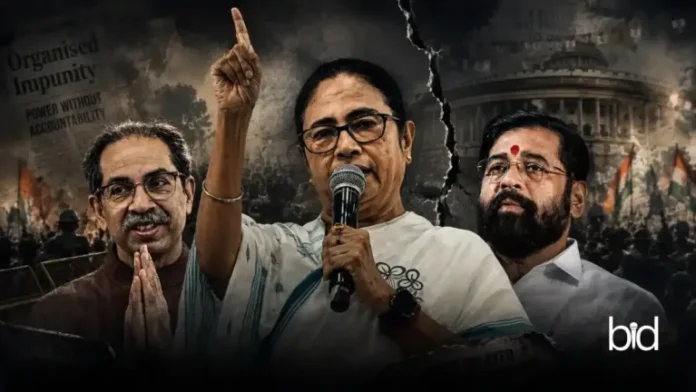
The Verdict That Changes the Question
When the Bharatiya Janata Party swept West Bengal’s assembly elections in May 2026, winning 207 of 293 declared seats and reducing the Trinamool Congress to 80, it did not merely end fifteen years of Mamata Banerjee’s rule. It transformed a speculative question about political fragility into an empirical one. The analytical puzzle is no longer whether the TMC would eventually crack under the weight of its own structural contradictions. It is why the crack came from outside rather than within, and what that tells us about a distinct and underexamined variety of party organisation, one that achieves internal cohesion not through ideological conviction, but through the institutionalisation of coercive impunity.
To understand the significance of what happened in Bengal last week, one must first understand what kind of party the TMC actually was, and why it survived so long without the anchors that hold most political formations together.
The Shiv Sena Template: Ideology as a Double-Edged Sword
The most instructive comparative lens is not the Congress, whose decay was slow and systemic, nor the regional parties of the Hindi belt, whose caste arithmetic provides a different kind of structural logic. The most revealing comparison is with the Shiv Sena: a party that, like the TMC, was built around a single dominant personality, relied heavily on grassroots muscle, and operated in a political culture where organisational violence was a routine instrument.
The split in the Shiv Sena between Uddhav Thackeray and Eknath Shinde emerged from a contradiction between ideological inheritance, political adaptation, and the question of legitimacy. The Sena, despite its aggressive regionalism and considerable flexibility over decades, still carried a recognisable organisational memory rooted in the persona and doctrine of Bal Thackeray. Once the post-2019 alliance with the Congress and the NCP appeared to many cadres as an unconscionable departure from that inherited political line, dissent acquired a moral vocabulary. The rebellion was not merely about power-sharing or ministerial portfolios. It was framed as a struggle over the soul and legitimate ownership of the “real” Shiv Sena.
This is the peculiar double-edged quality of ideological conviction in party politics. It stabilises a party through shared identity and normative commitment, but it also equips internal dissidents with the tools needed to mount a legitimate insurgency when leadership is perceived to have deviated. The ideological inheritance that binds cadres in ordinary times becomes the constitutional grammar through which schism is articulated and justified before the cadre, the courts, and the public.
The TMC’s Institutional Psychology: Personality Over Principle
The Trinamool Congress presented a fundamentally different institutional psychology. Since its inception under Mamata Banerjee, the party functioned less as a cadre-bound ideological formation and more as a personality-centric electoral vehicle with a deliberately fluid doctrinal identity. Its coherence derived not from shared conviction but from proximity to power and the singular authority of its founder. In such structures, dissent rarely matures into ideological rebellion because there exists no stable normative benchmark against which leadership can credibly be accused of deviation. There is no foundational text, no doctrinal inheritance, no moment of political purity to which dissenters can appeal.
The party’s ideological portfolio was so expansive and contradictory as to be effectively meaningless as a constraining framework. Secularism, regional nationalism, welfare populism, aggressive minority outreach, soft-Hindutva signalling, anti-BJP mobilisation, and transactional coalition opportunism coexisted without any coherent doctrinal hierarchy. This created tactical adaptability, that is, the ability to occupy whichever political space the electoral moment demanded, but also a kind of internal normative hollowness. Leaders and cadres alike understood that the party stood for winning, and for proximity to whoever was winning.
What, then, held it together with such apparent solidity for fifteen years?
The Coercive Architecture: Beyond Patronage, Toward Organised Impunity
Yet ideological hollowness alone does not explain the TMC’s long resistance to fragmentation. A party built on such doctrinal fluidity should, in theory, have been highly vulnerable to factional rupture far earlier than it was.
A more structurally important, and analytically underexamined, factor was the party leadership’s cultivation of communally organised violence as both an electoral instrument and a mechanism of internal coercion. This was not merely incidental or the product of organisational laxity. Over time, it became embedded in the party’s governing method.
The TMC leadership systematically nurtured networks of Muslim strongmen and politically aligned criminal syndicates, particularly in districts with high Muslim concentration such as Murshidabad, Malda, Birbhum, and parts of North and South 24 Parganas, as an integrated component of its electoral and social architecture. These networks served multiple simultaneous functions: the mobilisation and consolidation of Muslim bloc votes; the physical intimidation of opposition political workers; the suppression of internal dissent within the party’s own lower-level structures; and the maintenance of a climate of fear that made organised rebellion impractical rather than merely inadvisable.
The consequence was that TMC defections tended to be individual and stealthy rather than collective and declarative. Leaders crossed to the BJP or returned to the TMC fold not over irreconcilable ideological disputes but over access to patronage, personal protection from criminal exposure, or simple survival calculations. The party’s internal ecosystem was simultaneously transactional enough to absorb most contradictions and coercive enough to make organised opposition physically dangerous. This is a qualitatively different mode of party cohesion than either ideological solidarity or conventional machine-politics patronage. It is cohesion underwritten by credible threat.
The Electoral-Coercive Feedback Loop
Over time, these coercive arrangements fused with the TMC’s electoral strategy in ways that became mutually reinforcing. The relationship between Muslim political mobilisation and coercive social control within the party’s system increasingly operated as a self-sustaining loop.
The party’s near-total identification with Muslim community interests, expressed through welfare schemes, administrative appointments, and tacit protection for local strongmen, generated consistent and decisive electoral dividends in a state where Muslims constitute approximately 27 percent of the population. This electoral dependency, in turn, gave local Muslim political operatives a structural leverage that the party leadership had both incentivised and formalised.
The result was that coercive capacity became institutionalised at the grassroots. Booth management in sensitive constituencies was often effectively delegated to local syndicate networks. Political violence during elections, documented extensively by election observers, journalists, and opposition parties, was not a breakdown of party control but frequently an expression of it. The systematic post-election violence against BJP workers after the 2021 assembly elections, the long-documented culture of syndicate dominance over construction, sand mining, and transport, and the organised intimidation that characterised bypoll campaigns across rural Bengal were not aberrations from the party’s organisational logic. They were integral to it.
The TMC had, in effect, constructed a party whose internal discipline relied not on conviction or conscience but on the same instruments it deployed externally against opponents: patronage above, fear below.
Why This Forestalled Schism, And What It Could Not Prevent
This coercive infrastructure explains something that pure electoral analysis cannot: why potential rebel leaders within the TMC historically calculated that the costs of organised internal dissent were prohibitive. In the Shiv Sena, ideological dissidents could organise, travel, and make public appeals; they could build a counter-coalition because the terrain of political competition was ultimately normative and open. Within the TMC’s political geography, particularly in rural Bengal, the terrain of potential rebellion was not merely political but physically dangerous. Potential defectors had to contend not only with loss of ministerial access or constituency funding, but with the possibility of violence against themselves, their families, and their local supporters.
The absence of a moral anchor in the party did not, therefore, simply create a vacuum. It created a space that was deliberately filled by organised coercive power. The two phenomena are related: it is precisely because the party offered no ideological home that loyalty had to be secured through other means.
Yet coercive architectures of this kind carry an inherent structural vulnerability. They are calibrated for a specific environment, one in which the party controls the state apparatus, and can therefore guarantee the protection and impunity that makes its intermediaries functional. The moment the party loses state power, the entire logic inverts. Local strongmen empowered as instruments of party discipline have no ideological reason to remain loyal to an opposition party. Their loyalty was always to power and protection, not to a cause. Strip away the state, and the coercive network dissolves, or worse, realigns with whoever now controls the patronage.
The BJP’s Victory and the Limits of Coercive Cohesion
The May 2026 result brought into view the inherent limits of a political order sustained through decentralised coercive control. The TMC’s coercive infrastructure, formidable within the state, proved ultimately unable to withstand a different kind of institutional pressure applied from above. The BJP’s path to power in Bengal was not simply a matter of superior electoral mobilisation or Hindu consolidation, significant as both were. It also ran through a deeply contested Special Intensive Revision of electoral rolls: a nationwide exercise that arrived in West Bengal with consequences that became politically explosive, particularly in Muslim-majority districts where voter deletions were alleged to be disproportionately high and where transliteration inconsistencies between Urdu, Bengali, and English spellings became a matter of public controversy.
Whether one interprets the SIR process as necessary administrative correction, as the BJP and the Election Commission maintained, or as a politically consequential intervention that disproportionately affected the TMC’s social base, as the party alleged before courts and in public, the structural irony remains noteworthy. The process was subjected to sustained judicial scrutiny, including hearings before the Supreme Court, and the BJP repeatedly argued that the deletions largely concerned deaths, migration, duplicate entries, or individuals unable to establish documentary eligibility. The party also contested the claim that higher deletions translated straightforwardly into TMC collapse, pointing to constituencies where the TMC remained electorally competitive despite substantial revision activity. Also, the split among Muslim votes in some constituencies hit TMC hard, as it never imagined losing those seats.
Yet even without treating the SIR exercise as electorally determinative, the broader political contrast remains analytically significant. A party that had long relied on domination of local electoral terrain, through patronage networks, social intimidation, and organisational muscle, found itself confronting forms of institutional oversight and electoral management operating beyond the reach of its own coercive infrastructure. The irony lay less in any proven act of institutional malpractice than in the fact that a system built around mastery of ground-level control proved unable to shape the wider institutional environment within which the election was ultimately conducted.
There is a further irony in the community dimension. The TMC instrumentalised West Bengal’s Muslim population as simultaneously a vote bank to be consolidated and a coercive force to be deployed. It offered this community material benefits and political protection in exchange for bloc loyalty, and used the community’s strongmen as the enforcers of its internal discipline. That community’s political centrality to the TMC’s electoral coalition then became entangled in disputes over the electoral rolls process itself, with the TMC alleging disproportionate effects on Muslim-majority districts and the BJP rejecting both the allegation and its electoral significance. The party that built its machine around the political consolidation of this constituency ultimately proved unable to shield it from the wider institutional contestation surrounding the election.
The Succession Scramble Arrives
The structural consequences of this model become clearest at the moment of defeat. Once Mamata Banerjee’s authority weakened decisively, the absence of institutional morality did not prevent fragmentation; it accelerated an unstructured scramble instead.
A party that derived its cohesion from proximity to state power has lost state power entirely. The patronage networks that substituted for ideology are severed from their source. The local intermediaries – the syndicate bosses, the strongmen, the booth managers – have no doctrinal reason to wait in loyal opposition for a party comeback. Unlike cadres of ideologically grounded parties, who can sustain themselves through shared conviction and organisational memory during years in the wilderness, the TMC’s grassroots infrastructure was always transactional. Its activists were structurally oriented toward access to power rather than attachment to a sustaining ideological project. The returns on that investment have collapsed.
What follows will not resemble the Shiv Sena split, which was messy but constitutional, fought out through party symbols, legislative numbers, and rival claims to ideological legitimacy. The TMC’s post-defeat fragmentation, if it comes, will be more chaotic and less principled, because the instruments available for organising political succession in the TMC were never normative. They were transactional and coercive, and those instruments now have no central authority to direct them.
Conclusion: Impunity as a Political Model and Its Reckoning
The comparison between the TMC and the Shiv Sena ultimately reveals a broader truth about the varieties of party cohesion in Indian regional politics, and about what happens when those varieties encounter their structural limits.
Ideological conviction may destabilise parties in moments of doctrinal crisis, but it gives dissent a constitutional form, a language, and a legitimating narrative. It provides parties with something to fall back on when state power is lost: a community of believers, an organisational memory, a claim to continuity. The Shiv Sena, whatever its post-split confusion, retains identifiable factions each claiming an ideological inheritance. That inheritance is something to organise around.
The TMC, in losing power, has lost everything, because everything it was rested on having power. Fifteen years of governance built through patronage, personality, and organised coercive impunity have left behind no ideological sediment, no institutional memory separable from the state apparatus, and no moral architecture within which a loyal opposition can sustain itself.
The BJP’s Bengal victory is therefore not simply an electoral landmark. It is the empirical resolution of a structural argument: that a party built on coercion rather than conviction, on control rather than commitment, achieves remarkable short-term durability but is ultimately more brittle than it appears. The very absence of internal schism that marked the TMC’s years in power, so often misread as organisational strength, turns out to have been the concealed form of its deepest weakness. A party that never split on principle never developed the capacity to survive on principle. When the coercive ecosystem lost its state backing, there was nothing underneath.
What West Bengal inherits from this political settlement, i.e., a traumatised opposition, a community that was instrumentalised within competitive electoral politics, and a civic culture long habituated to organised violence as normal political currency, is a separate and sobering question. The BJP will govern a state whose democratic habits have been corroded by years of impunity, and whose newest rulers arrived through an electoral process that itself became the subject of intense institutional and political contestation. The reckoning with organised impunity in Bengal is not over. Whether the new dispensation alters these entrenched political habits or reproduces them remains an open question.
— Dr. Yashwant Singh
