


“Bangladesh’s instability has sharpened India’s ‘Chicken Neck’ challenge”, First Post, July 21, 2026
“Recent conflict in the Persian Gulf and adjoining Arabian Sea has thrown up many lessons. The lessons from the conflict are not limited only to the two countries involved (Iran and Israel) but also to other resident nations of the Indian Ocean region, India especially being the largest and possibly most powerful in the region. Our interest is in lessons:
-
- Hard and brute naval combat power alone need not bring the desired outcome.
- A visibly less powerful nation can offset its weakness by taking advantage of geography.
- There is a common saying: where a needle works, a sword is of little use. Simply put, if smaller and threat-specific platforms can achieve assured results, larger and more powerful platforms run out of options.
- There must be room for diplomacy to cease the devastation and look for possible options.
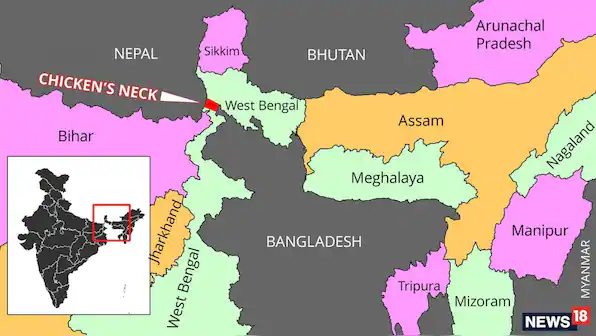
Now let’s superimpose this situation and possible lessons over a brewing situation over land, in India’s context, on the Siliguri Corridor, which has been in the news for the wrong reasons recently.
India’s basic premise that the creation of Bangladesh was the result of the sacrifice of Indian soldiers, and therefore the regimes will remain well disposed towards our security concerns, has evaporated after 50 years. During these five decades, India’s connectivity triggered much development in the Northeast (which has land connectivity through a narrow choke point, the Siliguri Corridor). This narrow neck has a complex geography. States of Bihar, West Bengal, Assam, and Meghalaya internally and Bangladesh and Bhutan (therefore, China) externally. As long as a friendly government ruled Bangladesh, peace on the eastern seaboard was assured. But then India-Bangladesh relations have largely been dependent on which Begum’s party was in power……..”
Read full article at firstpost.com
