


On September 24, 1932, twenty one year old Pritilata Waddedar led the attack on Chittagong’s Pahartali European Club. After the successful completion of the attack on the European Club, leader Pritilata committed suicide by chewing a capsule of potassium cyanide, but she was not caught by the British. On the day before her martyrdom, Pritilata, in a letter to her mother, wrote:
“O mother, don’t cry out in that way. See, I am going to die for the sake of truth, for the sake of freedom. Don’t you find joy in it? What else can we do? The country is in bondage! The people of our country are tormented due to foreign oppression.”
Chittagong didn’t get a place on the map of Bharat where Pritilata sacrificed her life with the dream of an independent Bharat. Seeing the current picture of ongoing Hindu atrocities in Chittagong, the question comes to mind: did she sacrificed her life to see this type of Chittagong?
Satyendranath Dutta, who is renowned as the “wizard of rhymes,” in his Bengali poem ‘Kon Deshe’ mentioned that in which country we find the tone of Chandidas and Ramprasad, which is Bangladesh. In Chandidas-Ramprasad’s Bengal, Hindus today are more fearful! Masterda Surya Sen and Pritilata’s Chittagong minority Hindus and Buddhists are now in a very critical situation.
Let’s see through statistics how the number of Hindus in Bangladesh has consistently decreased. According to the census report from the British period on the eve of independence, the Hindu population of Bangladesh in 1901 was about 9.5 million, which was 33 percent of the total population of Bangladesh at that time. According to the census report published after the formation of independent Bangladesh in 1974, the total Hindu population of Bangladesh dropped significantly from 33 percent to just 13 percent. According to Bangladesh’s census 2022, Hindus are around 7.95% of the total population, that is, a little over 13 million. Other minorities such as Buddhists and Christians comprise less than 1% of the country’s 165 million people. A study by a research organization says that between 1964 and 2013, about 10 million Hindus left Bangladesh. Accordingly, about 230,000 Hindus leave Bangladesh every year. During the Bangladesh War of Independence in 1971, more than 7 million refugees migrated from East Bengal to India, 95 percent of whom were Bengali Hindus. The rapid decline of the Hindu population in Bangladesh and the exodus from the country clearly show the condition of the Hindus there.
In Bangladesh, on the one hand, Hindus are forced to flee to India, and there are also incidents of infiltration. I think it should be mentioned here that the Union government was responding to a 2022 public interest litigation (PIL) filed by a person in Jharkhand, alleging that the Scheduled Tribe population in Santhal Pargana was reducing because “illegal infiltrators from Bangladesh” were settling in the area and marrying into ST families to gain land and influence. In its affidavit, filed on September 12 through an undersecretary in the Ministry of Home Affairs, the Centre supported population data on Scheduled Tribes submitted by some of the petitioners, saying that data from the Office of the Registrar General of India showed that the share of STs in Santhal Pargana’s population was 44.67% in 1951 and 28.11% in 2011. (Source – The Hindu) However, the claim that infiltration from Bangladesh is the only reason for the decline in population has not been proven yet, But it is suspected that this is one of the main reasons.
When we talk about Bangladesh, an image now flashes in our mind: the barbaric image of atrocities against minorities, such as Hindus and Buddhists. But how was Bangladesh during the time of Rabindranath Tagore? In a letter written to his niece Indira Devi from Shelaidaha, Bangladesh, in 1888, Rabindranath wrote, “In Calcutta, one forgets how truly beautiful the world is. The sun sets every day among the peaceful trees by the small river, and the silent rising of a hundred thousand stars every night over this endless gray desert—what a wonder in the world! It is understandable if the great event is here.” (Translation by Author)
It is known that Rabindranath wrote many of his works while sitting in Shelaidaha. Rabindranath is incomplete if Shelaidaha, Bangladesh, is excluded; but how are the Hindu Bengalis situation in Bangladesh now?
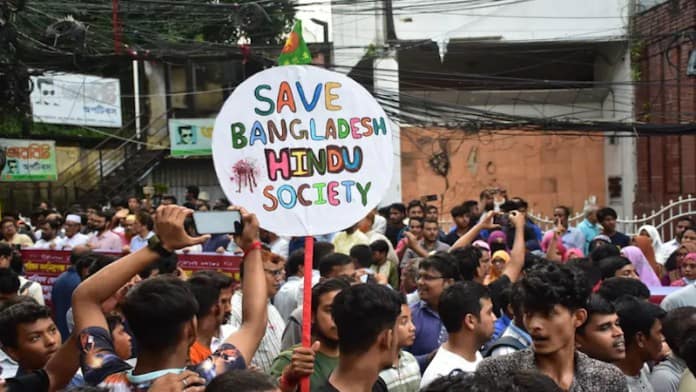
It is very unfortunate that the ‘Shonar Bangla’ of Rabindranath’s time has turned into a land of terror for Hindus today. Although atrocities against Hindus and the soft targeting of Hindus based on changes in government are not new, this pattern has been ongoing for a long time. Since the fall of Hasina’s government, incidents of persecution and attacks on Hindus have started again. According to various news reports, starting August 5, there have been 205 instances of attacks against Hindus in Bangladesh in just 3 days.
At least 49 teachers belonging to minority communities were forced to resign in Bangladesh after the fall of the Sheikh Hasina-led government on August 5, according to a minority organisation in the violence-hit nation. The Bangladesh Chhatra Oikya Parishad, the student wing of Bangladesh Hindu Buddhist Christian Oikya Parishad, said this at a press conference on 31 August, The Daily Star newspaper reported.
Living as a Hindu Bengali in present-day Bangladesh has become a challenging experience. No, this is not a fabricated story; by keeping an eye on the news from the international press, it is possible to realize how real this situation is. “Many families in Khagrachhari and Rangamati have fled, leaving behind burning houses and businesses,” writes a report from Reuters on September 21. It is very clear from this report what the condition of the minority community in Bangladesh, namely Hindu Buddhists, is.
Swami Vivekananda said unequivocally from the stage of the World Parliament of Religions in Chicago on September 11, 1893, that religious narrowness is an obstacle to the development of a healthy society. Swamiji strongly condemned those who persecute other religions in the name of religion and oppress people. At the end of that historic speech on September 11, he said, “Sectarianism, bigotry, and its horrible descendant, fanaticism, have long possessed this beautiful earth. They have filled the earth with violence, drenched it often and often with human blood, destroyed civilization, and sent whole nations to despair. Had it not been for these horrible demons, human society would be far more advanced than it is now.”
Bangladesh is a separate country right now, but our history and past traditions have a deep connection with this Bangladesh because this country was once a part of India. Swami Pranabananda, historian Ramesh Chandra Majumdar, and Mahanambrara Brahmachari were born in Faridpur, Bangladesh; Prafulla Chandra Ghosh and Prafulla Chandra Roy were born in Khulna; Sir Jadunath Sarkar was born in Rajshahi; revolutionary Bagha Jatin was born in Kushtia; revolutionary Praful Chaki was born in Rangpur; in Chittagong, Masterda Surya Sen and Pritilata were active; Hemchandra Ghosh was in Dhaka; Madhusudan Dutta and the ancestors of Rabindranath Tagore were in Jashore; Jibanananda Das, Narayan Gangopadhyay, and the first female doctor, Kadambini Gangopadhyay, were in Barisal. The history of the famous Dhakeshwari temple is associated with the naming of Dhaka, which is still the capital of Bangladesh. It must be remembered that the name of the college where Swami Vivekananda gave his speech on March 19, 1901, was ‘Jagannath College.’ So, if you look back, you will see that the history of Bangladesh 75 years ago is actually the history of ‘Akhand Bharat.’
It is true that this part of Bharat has been separated as a result of historical machinations, but these histories should not be forgotten. We must not forget that the foot dust of our ancestors is mixed in this Bangladesh. We must remember the words of Bankimchandra: the misery of a nation without history is infinite.
The famous philosopher Milan Kundera, in his book ‘The Book of Laughter and Forgetting,’ wrote something similar:
“The first step in liquidating a people is to erase its memory. Destroy its books, its culture, its history. Then have somebody write new books, manufacture a new culture, invent a new history. Before long the nation will begin to forget what it is and what it was.”
Today, the time has come to study the correct history. Today, Hindu Bengalis should not forget their history and we should study our own history, we should know our ancestors. This is what Swami Vivekananda said in his speech on 31st March 1901, in front of an audience of about 3,000 in the open ground of Pogose School, in Dhaka, Bangladesh. We have to remember Swamiji’s words: “In the remote past, our country made gigantic advances in spiritual ideas. Let us, today, bring before our mind’s eye that ancient history.”
