



The past decade has seen a notable rise in global interest in Bharatiya culture, but this fascination has often crossed into the realm of cultural appropriation—where elements of Bharatiya tradition are borrowed, commercialized, or misrepresented without acknowledgment or respect for their origins. From luxury fashion houses to global celebrities, these incidents have sparked debate and, at times, outrage within Bharat and its diaspora. Below is a detailed analysis of seven significant incidents between 2016 and 2025, with commentary from a Hindu perspective.
1. Prada’s Kolhapuri Chappal Controversy (2025)
At Milan Fashion Week in June 2025, Prada unveiled open-toe leather sandals closely resembling Kolhapuri chappals, a traditional handcrafted footwear from Maharashtra. Initially, Prada made no mention of the sandals’ Bharatiya origins or the artisans behind them, pricing their version at around ₹1.2 lakh ($1,400)—far above the ₹1,000–₹4,000 range in Bharat. The lack of acknowledgment and the commodification of a Geographical Indication (GI) protected craft led to widespread criticism and anger among over 20,000 Kolhapuri artisans. Prada eventually issued a statement recognizing the inspiration and promised to engage with Bharatiya artisan communities.
Kolhapuri chappals are not merely footwear; they represent generational craftsmanship, regional pride, and a living tradition. Appropriating such heritage without credit or benefit to its custodians is seen as a violation of dharma (righteous conduct), which emphasizes respect and gratitude toward one’s sources and teachers.
2. Kim Kardashian and North West’s Nath at Paris Fashion Week (2022)
In July 2022, Kim Kardashian and her daughter North West wore nose rings (nath) at Paris Fashion Week. The nath, with roots in 9th–10th century Bharat, holds deep symbolic value, especially in Hindu weddings, where it signifies marital status and is imbued with spiritual meaning. Critics argued that wearing it as a mere fashion accessory, without acknowledging its cultural context, reduced it to a transient trend.
The nath is intertwined with samskara (rites of passage) and is often blessed in religious ceremonies. Its casual use by celebrities, stripped of meaning, is perceived as a disregard for the sanctity of Hindu traditions.
3. Gucci’s “Kaftan” Kurta (2021)
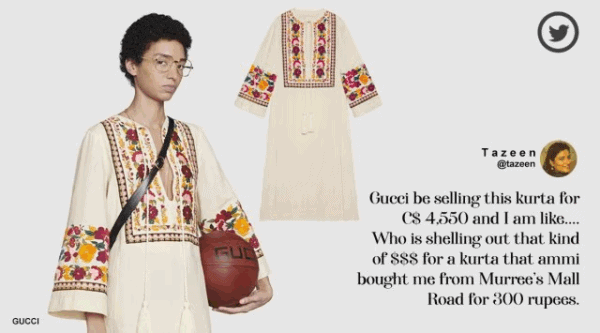
In June 2021, Gucci launched a garment described as a “floral embroidery organic linen kaftan” priced at $3,500. The design, however, closely resembled the Bharatiya kurta. Gucci’s mislabeling and lack of acknowledgment for Bharatiya origins led to accusations of cultural appropriation and profit without collaboration with Bharatiya artisans.
The kurta is worn across Bharat in both religious and secular contexts. Its misrepresentation and commercialization, without crediting its roots, undermines the value of authenticity and the livelihoods of Bharatiya craftspeople.
4. Kim Kardashian’s Maang Tikka at Church (2019)
On April 5, 2019, Kim Kardashian wore a maang tikka—a traditional Bharatiya hair ornament—paired with a white gown to church. The maang tikka is deeply rooted in Hindu culture, worn during weddings and festivals, symbolizing the union of masculine and feminine energies. Its use as a mere fashion accessory, particularly outside its cultural context, drew backlash for trivializing a sacred symbol.
The maang tikka is not just jewelry; it is a spiritual symbol placed on the ajna chakra (third eye), representing wisdom and spiritual awakening. Its casual use is seen as a dilution of its spiritual significance.
5. Coldplay’s “Hymn for the Weekend” Music Video (2016)
Coldplay’s 2016 music video, “Hymn for the Weekend,” was filmed in Bharat and featured vibrant Holi colors, temples, and traditional clothing. While visually stunning, the video was criticized for using Bharatiya culture as an exotic backdrop, reinforcing colonial stereotypes, and lacking genuine representation or context for the religious imagery it displayed.
Hindu festivals like Holi are not mere spectacles but are rooted in mythology and spiritual significance. Using them as visual props without context is seen as a form of aesthetic exploitation.
6. Selena Gomez’s Bindi at MTV Movie Awards (2013, referenced in recent debates)
Although occurring in 2013, Selena Gomez’s use of the bindi during a performance continued to be referenced as a touchstone for debates on appropriation throughout the decade. The bindi, symbolizing the ‘third eye’ and spiritual insight in Hinduism, was worn as a fashion accessory, drawing criticism for disrespect and insensitivity.
The bindi is a visible marker of Hindu identity and spirituality. Its misuse is seen as a disregard for Hindu beliefs and the sacredness of religious symbols.
7. Appropriation of Yoga and Ayurveda
Yoga and Ayurveda, with deep roots in Hindu, Buddhist, and Jain traditions, have been commercialized and rebranded in the West as fitness routines and wellness fads. Western companies have patented Ayurvedic herbs and treatments, profiting without credit or benefit to the Bharatiya communities of origin. The spiritual and philosophical core of yoga has been replaced by trends like “Christian yoga,” “goat yoga,” and branded merchandise, with the US Patent Office issuing thousands of yoga-related trademarks and patents.
Yoga and Ayurveda are not just practices but are integral to Hindu philosophy and lifestyle, aiming at self-realization and holistic well-being. Their commodification and detachment from their spiritual roots are seen as a form of cultural erasure and a loss of the teachings’ true essence.
Conclusion
From a Hindu perspective, these incidents are not just about fashion or trends—they represent a deeper issue of respect, acknowledgment, and reciprocity. Bharatiyan culture, with its profound spiritual and artistic heritage, deserves to be engaged with thoughtfully and ethically, honoring the communities and philosophies that sustain it.
Source: Seven Incidents of Indian Cultural Appropriation (From year 2016 to 2025)
