


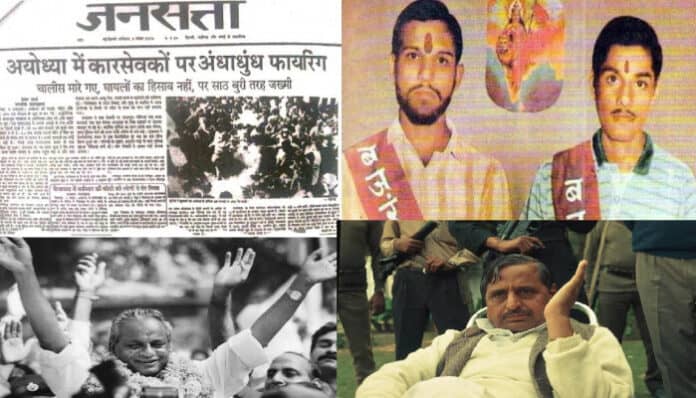
“The Dark Chapter of 1990: The Massacre of Ram Devotees under the Mulayam Singh Government Part 12”, MyIndMakers, 28 Aug 2026.
“October 30, 1990, is a date that is seared into the collective memory of Hindus across Uttar Pradesh and India — though the mainstream secular establishment has done its best to ensure that it remains in historical obscurity. On that day, in the city of Ayodhya, thousands of unarmed Hindu Karsevaks — volunteers who had gathered to perform symbolic service (kar seva) at the Ram Janmabhoomi site — were fired upon by the Uttar Pradesh Police acting under the explicit orders of Chief Minister Mulayam Singh Yadav. The death toll remains disputed to this day: the official government figure was a handful; eyewitnesses and community organisations counted the dead in the dozens, some claiming over a hundred. Whatever the precise number, the moral reality of what happened at Ayodhya on October 30 and November 2, 1990, is unambiguous: unarmed citizens exercising their democratic right to peaceful assembly were killed by their own government for the political benefit of a Chief Minister who had decided that their lives were an acceptable price for retaining his Muslim vote bank.
The Mulayam Singh Government: Context and Character
Mulayam Singh Yadav had come to power in UP in December 1989, leading a Janata Dal government supported from outside by the BJP and the BSP. His ascent represented the culmination of the Yadav political mobilisation that had been building since the 1960s: the son of a small farmer from Etawah district, with no formal education beyond high school, Mulayam had constructed his political career through a combination of physical courage — he had been a wrestler — organisational tenacity, and skill at building the Yadav community’s political consciousness.
Mulayam’s political identity was defined by its opposition to what he called ‘Manuvadi’ — the ideology of Brahminical upper-caste dominance — and by his cultivation of Muslim support as a counterweight to Hindu nationalist mobilisation. His political strategy was simple and, for a time, highly effective: consolidate the Yadav vote through community solidarity, secure the Muslim vote through demonstrative opposition to the BJP and the Ram Mandir movement, and use this M-Y (Muslim-Yadav) coalition as the social base for political dominance……..”
Read the full article at MyIndMakers.
