


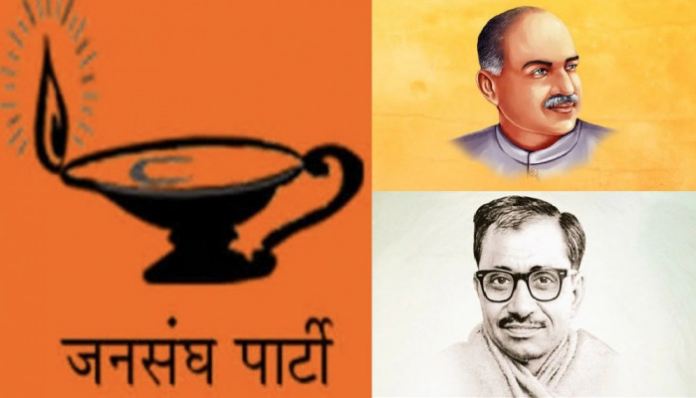
“Ideological Foundations: The Emergence of the Bharatiya Jana Sangh in Uttar Pradesh Part 4”, MyIndMakers, 17 Aug 2026.
“The founding of the Bharatiya Jana Sangh in 1951 by Dr Syama Prasad Mookerjee was one of the most consequential events in post-independence Indian political history. However, its significance would not be fully apparent for decades. In Uttar Pradesh, the Jana Sangh found particularly fertile ground: a state with deep roots in Hindu civilisation, a politically conscious population with legitimate grievances against Congress governance, and an RSS organisational network that could serve as the backbone of a new political movement. The story of the Jana Sangh’s emergence in UP is how an ideological tradition the Congress had tried to marginalise found institutional expression and began the long march that would eventually bring its inheritors to power.
Syama Prasad Mookerjee and the Founding Vision
Dr Syama Prasad Mookerjee was among the most intellectually formidable political figures of his generation. A former Vice-Chancellor of Calcutta University, a member of Nehru’s first cabinet as Industry Minister, and a leader of the Hindu Mahasabha, he resigned from the government in 1950 to protest the Nehru-Liaquat Pact, which he believed betrayed Hindus’ interests in East Pakistan. His resignation was not merely a political gesture; it was an ideological declaration that the Congress’s model of secularism, which he characterised as a policy of systematic appeasement of the Muslim minority at the expense of the Hindu majority, was incompatible with genuine national interest.
Mookerjee’s founding vision for the Jana Sangh was distinctive: a political party that would be democratic, nationalist, and explicitly rooted in Indian cultural tradition, without being communal in the narrow sense of promoting discrimination against minorities. His formulation of ‘one country, one people, one culture’ was meant to be integrative rather than exclusionary—an insistence that India’s civilisational heritage provided the foundation for a unified national identity, not a pretext for minority persecution………”
Read the full article at MyIndMakers.
