


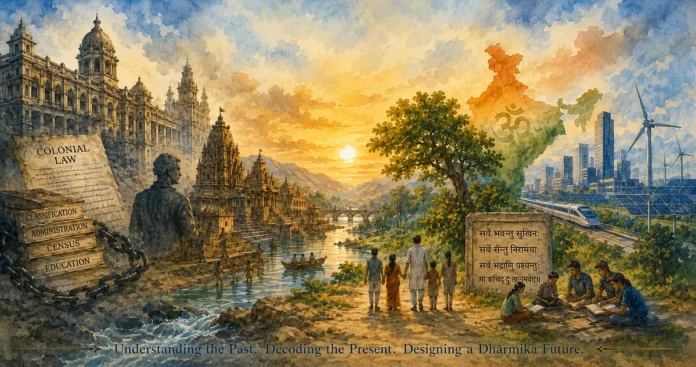
“A Systemic Analysis of Social Problems in India – Part 4: The Way Forward”
“Introduction
This is the final essay in this series of deliberations on a systemic analysis of all things Indian and how we can start looking at our past, present and future through a more systemic lens than being beholden to the contemporary political landscape. Here is Part One, Part Two and Part Three.
Any serious attempt to understand the contemporary condition of Indian society must move beyond surface-level political analysis and engage the deeper systems that have shaped its institutional, social, and intellectual life. Present-day conflicts over caste, welfare, state policy, social identity, and national vision cannot be adequately interpreted as isolated developments of the current moment. Rather, they are outcomes of long historical processes involving colonial lawmaking, the restructuring of public administration, the transformation of knowledge systems, and the incomplete reconfiguration of inherited institutions after independence.
A systemic approach reveals that social realities are not self-generating; they are produced, reinforced, and transmitted through systems of governance, classification, pedagogy, and cultural memory. From this perspective, the Indian present must be read as the cumulative effect of both colonial disruption and postcolonial continuity. At the same time, reflection on the past is meaningful only insofar as it contributes to a vision for the future. The question, therefore, is not merely how India arrived at its present condition, but what kind of knowledge architecture can guide its renewal…….”
Read full article at brhat.in
