


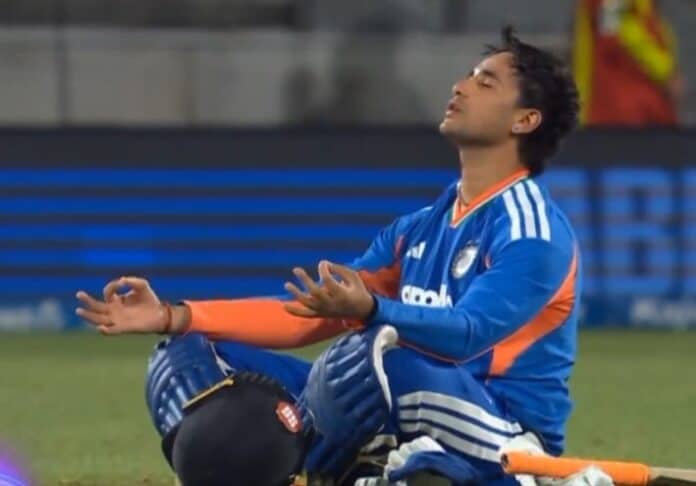
When Abhishek Sharma converted a blistering T20 century against New Zealand today into a moment of stillness on the pitch—dropping seamlessly into Padmasana and chanting Om Namah Shivaya—he did more than celebrate a milestone. He offered a masterclass in anchoring the digital-age mind. For a generation of youth navigating endless algorithmic traps, dopamine loops, and manufactured anxieties, seeing a premier athlete openly ground himself in Dharmic tradition provides a vital counter-narrative.
The neurobiological and psychological benefits of Dharmic practices are well-documented: pranayama and dhyana actively regulate the nervous system, lower cortisol levels, and enhance prefrontal cortex connectivity, supplying the exact neurological armor needed for sustained impulse control, emotional regulation, and razor-sharp focus under intense pressure.
Far from being passive rituals, these rigorous cognitive tools draw directly from the eternal well of Dharma. Elite Bharatiya athletes across disciplines anchor themselves in spiritual texts like the Bhagavad Gita, embracing its core philosophy of Nishkama Karma—focusing entirely on action rather than worrying about the outcome.
- Manu Bhaker: The double Olympic medalist shooter famously turned to the Bhagavad Gita to overcome her crushing disappointment from the Tokyo Olympics. Before her historic bronze-medal wins at the Paris 2024 Olympics, she kept Sri Krishna’s teaching running through her head: “Focus on your karma, not on the outcome.”
- Cheteshwar Pujara‘s legendary resilience and monk-like composure at the crease—famously wearing down world-class bowling attacks—stemmed from a deep grounding in the Bhagavad Gita. Guided by the principle to “be in the present,” he detached entirely from scoreboard pressure and outcome anxiety. Cultivated through rigorous childhood discipline, this internal anchor allowed him to enter a meditative, tunnel-vision zone where hours of resolute defense became an exercise in supreme focus.
- PV Sindhu: Practiced Heartfulness Meditation for over a year. She credits daily relaxation and meditation techniques for building the mental fortitude needed to secure her Olympic medals.
- VVS Laxman & Ishan Kishan: Introduced to the Bhagavad Gita’s Chapter 12 (Bhakti Yoga) by his paternal grandfather at a young age, the brilliant VVS Laxman drew heavy inspiration from its verses at critical junctures of his life and career – learning to focus on his efforts, surrender to the divine, and detach from anxiety. Similarly, after facing career uncertainty, explosive wicketkeeper-batsman Ishan Kishan restructured his daily routine to incorporate structured meditation and dedicated study of the Bhagavad Gita, catalyzing his dynamic return to form.
- Shreyas Iyer & Virat Kohli: Iyer has partnered with platforms dedicated to the Bhagavad Gita, listening to its teachings even during heavy workout sessions to retain composure during team leadership. Meanwhile, Kohli leans into spiritual grounding and regular visits to Vrindavan, practicing deep mindfulness and studying sacred Vedic literature like Srimad Bhagavatam to anchor his mental state away from global celebrity chaos.
It is a striking irony that while Indian Anglophiles often dismiss Dharmic traditions, even top-tier Western athletes are now drawing from this ancient well of Dharma, albeit dressed up in the secular Western garb of “mindfulness meditation.” Athletes worldwide use these Dharmic techniques to find a psychological state of “flow” and block out crowd anxiety:
- Novak Djokovic: A fierce advocate of mindfulness and Buddhist meditation, he spends hours in silent meditation to sharpen his absolute presence on the court.
- LeBron James & Kobe Bryant: James is renowned for closing his eyes and practicing breathing and mindfulness techniques directly on the bench mid-game, while the late Kobe Bryant meditated every morning—a habit introduced by legendary coach Phil Jackson—to curb anxieties and maintain emotional stability.
- Lewis Hamilton: The Formula 1 star dedicates seven to ten minutes every single morning to deep mindfulness meditation to detach from chaotic thoughts.
The Lutyens Allergy to Dharma
Naturally, this public display of Dharma by Abhishek would have sent waves of quiet revulsion through the drawing rooms of the Lutyens elite. Expect the usual flurry of snide posts/columns dismissing the act as “shallow posturing” or cynical careerism designed to curry favor with coach Gambhir, BCCI and Jay Shah. Left-liberal circles are also enitrely capable of manufacturing false equivalencies, claiming Abhishek’s celebration is similar to Pakistani cricketers performing namaz on the field – which is actually an act of submission to Allah, considered the ‘one true God’ in Islam, and a display infamously celebrated by Waqar Younis specifically because it was performed ‘in front of Hindus’.
For decades, the left-liberal cognoscenti have peddled the secular catechism that spirituality must be shoved into a polite, private closet. Their condescension towards any overt expression of Hindu identity is legendary. By incessantly pathologizing public Dharmic practices, they have long sought to engineer a guilt complex among Hindus, conditioning them to whisper their traditions while institutional culture favored sanitised rootlessness.
And while Hindu Dharma cannot be shoehorned into the rigid, dogmatic framework of a single book and ‘one true God’, the profound irony is that these entrenched and deracinated elites, soaked in Eurocentric conditioning and possessing a colonized consciousness, treat exclusive, monolithic faiths with utmost respect. They do so because those faiths are accepted as valid religions within the Western worldview, and a seat at the Western high table is what our domestic elites desperately crave.
The reality is that Hindu Dharma is not an unyielding creed demanding blind conformity; it is an empirical science of consciousness. Refined over millennia by rishis and rishikas, which has developed rigorous techniques to control and transcend the mind. Pranayama and dhyana are practical tools designed to master the senses, conquer fear, and steady the turbulent fluctuations of awareness.
Bringing Dharma into Sports Science and the Classroom
Modern sports science obsesses over physical conditioning, yet mental resilience remains an afterthought in standard curricula. In the past, Indian cricket teams have even turned to Western mental conditioning coaches – a tragedy reflecting how the BCCI and other sporting bodies have failed to invest in building a pool of trainers grounded in the Dharmic knowledge systems of yoga, pranayama, and dhyan, along with knowledge of modern sports science. These indigenous frameworks hold the key to generating the critical one-percent edge that divides winners and losers in international sports.
It is time to move past tokenistic nods to wellness and systematically integrate these living traditions into the everyday life of our youth. By introducing pranayama, dhyana, and regional variants of Dharmic mental conditioning into schools, we provide the youth of Bharat with robust armor against modern alienation and stress. Abhishek Sharma’s quiet moment on the turf reminds us that true mastery begins within—and no amount of elite disdain can dim the clarity of an anchored mind.
(This article was first published at Reverse The Gaze. If you believe in breaking away from Western lenses and building an authentic, homegrown understanding of our world, please subscribe to the substack and support this work)
