


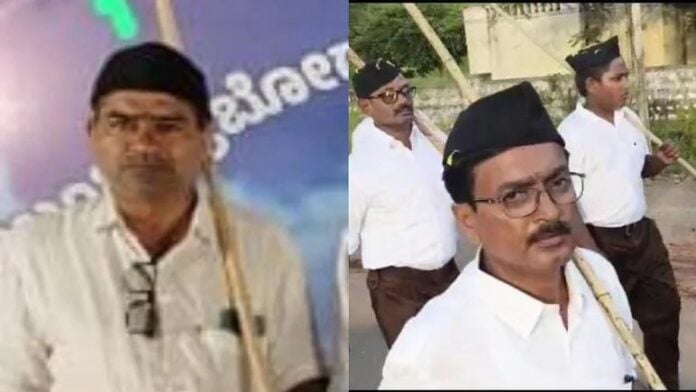
The Karnataka State Administrative Tribunal (KSAT) has delivered a significant interim setback to the attempt to equate participation in a Rashtriya Swayamsevak Sangh (RSS) program with political activity. The Kalaburagi Bench has stayed the suspension of a government school teacher who was proceeded against by the Karnataka government for attending an RSS program, observing that participation in an event organized by a non-political association could not, by itself, be treated as involvement in the activities of a political party.
According to the Organizer, the case concerns Gururaj, an assistant teacher at Government Girls High School in Hunasagi, who was suspended by the state government on August 20, 2026, pending a departmental inquiry. The proceedings arose from his participation in an RSS program held on October 12, 2025, which was a Sunday. Gururaj challenged the action, arguing that merely attending an RSS program did not amount to participation in political activity prohibited under the service rules applicable to government employees.
The Tribunal examined Rule 5 of the Karnataka Civil Services (Conduct) Rules, 2021, which places restrictions on government servants becoming members of or associating with political parties or organizations that take part in politics, as well as participating in or assisting political movements or activities. However, the Bench found that the material before it did not establish that Gururaj’s attendance at the RSS program amounted to a violation of the provision.

Significantly, the Tribunal recorded that the program had been organized by a non-political association and also noted that the Karnataka Government had not issued any specific order or notification prohibiting government employees from participating in such an event. This observation strikes at the core of the disciplinary action, making it clear that administrative authorities cannot automatically assume that every activity associated with the RSS constitutes political activity without establishing a violation of the applicable service rules.
The proceedings also exposed another weakness in the suspension order. The authorities had relied upon Rule 7 of the Conduct Rules while initiating action against the teacher, but the Tribunal noted that the particular provision cited by the authorities had already been omitted. The Bench therefore found that Gururaj had established a prima facie case warranting judicial protection and stayed the operation of his suspension until the next hearing.
The Karnataka proceedings also come against the backdrop of the Union Government’s July 2024 decision to remove the decades-old restriction on Central Government employees participating in RSS activities. The restriction, which originated in 1966, had remained in place for decades. Several states had also previously altered or removed similar restrictions concerning government employees and the RSS. However, the Tribunal’s decision in Karnataka rests specifically on the State’s own Conduct Rules and cannot simply be treated as an extension of the Union Government’s decision.
The broader issue is the distinction between the RSS as a social and organizational movement and political parties operating within the electoral system. The Sangh has historically functioned through shakhas, social service, community engagement, character-building, social harmony, and nation-building initiatives. Individual swayamsevaks may pursue careers in politics, administration, academia, the armed forces, and other professions, but an individual’s participation in such spheres does not automatically render every RSS program a political activity.
The KSAT order is, however, an interim order, and the main application remains pending; therefore, it is not a final determination on the legality of any government restriction on RSS activities. Nevertheless, the immediate message from the Tribunal’s intervention is significant: disciplinary action against a government employee cannot rest merely on an assumption that attending an RSS program is equivalent to engaging in partisan political activity. Any such restriction must be grounded in the actual conduct rules and supported by a clear legal or governmental prohibition.
The RSS has repeatedly been targeted in Karnataka, particularly by Home Minister Priyank Kharge, and this time, the court has responded to the government’s excesses. The Congress government should understand that targeting the RSS simply because of political hostility towards the organization can have legal consequences. If such actions continue without a sound legal basis, the government may face further judicial scrutiny and setbacks.
