


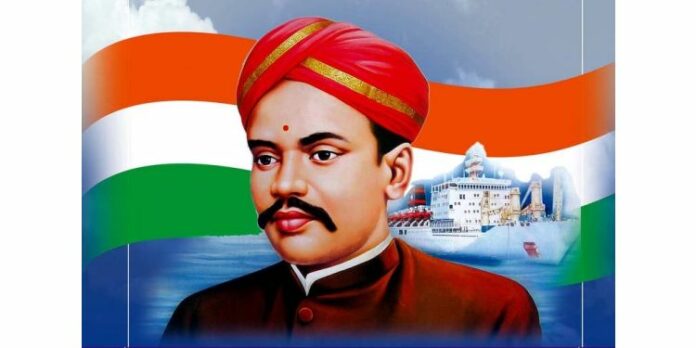
Bharat has produced many heroes — from brave rulers like Prithviraj Chauhan and Chhatrapati Shivaji Maharaj to those who fought against the British for independence. But not all freedom fighters have received the recognition they deserve. One such hero was V.O. Chidambaram Pillai, popularly known as VOC, who earned the title Kappalottiya Tamizhan meaning the Tamil native who steered the ship.
VOC started Bharat’s first indigenous shipping service, the Swadeshi Steam Navigation Company, which ran between Tuticorin and Colombo in Sri Lanka. He was a strong supporter of the Swadeshi Movement and a close friend of the Tamil poet and patriot Bharathiyar. VOC was deeply influenced by Swami Ramakrishna of the Ramakrishna Mission, who encouraged him to dedicate his life to serving the nation.
VOC was born on 5 September 1872 in Tuticorin district’s Ottapidaram. Following in his father’s footsteps, he studied law and became a barrister. However, unlike his father, who mostly took up cases for wealthy clients, VOC used his legal knowledge to help the poor. Once, the two even argued on opposite sides in a case — VOC not only defeated his father but also hurt his pride. In 1900, VOC moved to Tuticorin and began following the ideas of Bal Gangadhar Tilak by fully adopting the Swadeshi Movement.
The year 1906 changed VOC’s life. He found his true mission — one that would bring him both glory and suffering. Tuticorin was then a major shipping hub, controlled by people loyal to the British Raj. For a Bharatiya to start a shipping company was considered impossible. Yet, VOC took up the challenge and established the Swadeshi Steam Navigation Company, which operated between Tuticorin and Colombo. His real goal, however, was to revive Bharat’s maritime skills, open dockyards, and encourage self-reliance. This angered the British, who saw his actions as a direct challenge to their power.
VOC initially hired a ship named Shah Allum to transport goods between Tuticorin and Colombo and convinced local traders to use his company. Seeing the threat, the British government tried every possible way to force him to shut down, even pressuring the ship’s owner to withdraw. But VOC did not give up. He bought ships from abroad and proudly sailed into Tuticorin with flags bearing the words Vande Mataram, further enraging the British.
In 1908, another major event took place. When VOC was denied permission to hold a procession celebrating the release of Bipin Chandra Pal, he refused to leave the city as ordered. He was arrested, leading to violent protests in Tuticorin where public offices were burned. VOC was blamed for the unrest and charged with sedition. He was sentenced to two life imprisonments, later reduced by the Madras High Court to four years in jail and six years of exile. He was finally released on 12 December 1912.
When he came out, VOC found that his Swadeshi Steam Navigation Company had already been shut down in 1911. He was left poor and forgotten — a sad reminder of how quickly Bharat forgets its heroes. He lived in poverty until his death on 18 November 1936. One incident shows how badly he was treated: Bharatiyas in South Africa had collected money to help him and sent it through Gandhi, but VOC never received it despite writing letters and even meeting Gandhi in 1915 to discuss it.
Recognition came only long after his death. In 1949, C. Rajagopalachari inaugurated a ship named SS V.O. Chidambaram to Colombo in his honour. Statues were built, and the Tuticorin Port was renamed after him. A commemorative stamp was also released to celebrate this great nationalist. But what is the use of such honours when he was left to die in poverty? It is said that VOC spent his last days selling his law books and tutoring students — a tragic end for a man who was once a wealthy shipping magnate and respected lawyer.

It is high time Bharat moves beyond Gandhi-Nehru and recognizes other great freedom fighters. Humble tributes to this son of Bharat Mata on his death anniversary today.
