


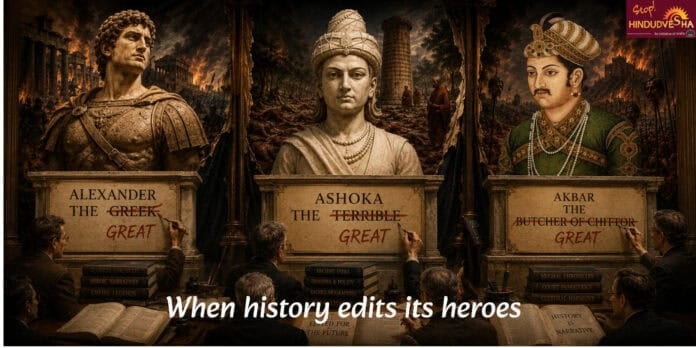
“The Great Fakes: Rethinking History’s Most Overrated “Greats””, StopHinduDvesha, 22 Aug 2026.
“Alexander, Ashoka, and Akbar are remembered as history’s quintessential “Great” rulers, celebrated for conquest, moral transformation, and religious tolerance. Yet their reputations also reveal how historical narratives are constructed and sustained. Drawing on primary sources, this article argues that each presided over large-scale killing and coercion that modern memory often minimizes. While Alexander’s image endured through centuries of repetition, Ashoka’s and Akbar’s reputations were consciously reshaped by twentieth-century political and intellectual projects that required symbols of non-violence and secular pluralism. The article does not deny their achievements. Instead, it argues that historical judgments should emerge from a balanced assessment of the complete record, not from honorifics or narratives that predetermine the verdict before the evidence is weighed.
“It is criminal to steal a purse, daring to steal a fortune, a mark of greatness to steal a crown. The blame diminishes as the guilt increases.” — Friedrich Schiller, German historian (1759-1805)
History is written by scribes, and scribes have always loved a good epithet. “The Great” is the grandest of these: a label that survives translation, outlives empires, and calcifies into unquestioned fact somewhere between the royal court, the schoolroom, and the popular imagination. Three names wear the epithet more comfortably than almost any others: Alexander, Ashoka, and Akbar. Between them, they are credited with founding a global civilization, inventing humane statecraft, and building a model of religious tolerance centuries ahead of its time.
Look past the epithet and into the primary sources, and a far less flattering picture emerges. All three men presided over mass killings on a staggering scale. All three enslaved tens of thousands of people. And in each case, the very policies for which they are lionized either came late, came selectively, or came at a catastrophic human cost that later narratives have been curiously reluctant to weigh against the praise.
In the cases of Ashoka and Akbar, in particular, it reflects a conscious political project. Twentieth-century historians, educators, and governments did not simply inherit these reputations; they elevated them because they legitimized a particular vision of India’s past and, by extension, its future. Ashoka became the moral face of the secular republic. Akbar became a testament to medieval India, being remembered primarily through the language of accommodation rather than conquest. The result was not fabricated history but selectively curated history, where inconvenient evidence steadily gave way to politically useful narratives.
This is not an argument that these men accomplished nothing. It is an argument that “Great” has been allowed to do too much quiet work, smoothing over bodies, sieges, and slave markets, and that, in at least two of these three cases, later generations consciously reinforced that reputation in service of narratives the full historical record does not entirely support………………………”
Read the full article at StopHinduDvesha.

Revisiting ‘The Great’ honorific suffix to these rulers to bring into focus their murderous and intolerant acts, which gets whitewashed, is actually quite overdue. Author Som Misha has highlighted few Bharat oriented rulers and we all agree that a balanced and rigorous historical view must be presented in academia.
It sounds ironical, but it seems thou that stophindudvesha.org and author Som Misha suffers from a serious affliction of ShramanDvesha!. Look at this brazen bigotry in this writing:
“Ashoka’s Buddhism also offered a homegrown Indian tradition that was not Hindu, elevated as a counter-narrative to a Hindu.
…
Ashoka provided a pre-modern, non-Hindu apostle of non-violence around whom a secular national identity could be built.”
First of all the term Hindu was applied to the people and religions of this region that Persian/Arabic outsiders referred to as Hindustan. The region was called India by Greeks and other Europeans. Therefore, the word Sanatan Dharm, Vedic Dharm and Hindu Dharm are not strictly equivalent.
Secondly, treating Shraman Dharm as some kind of secondary or a later Hindu Dharm offshoot part or even more incongruously as a “protest” offshoot against Hindu Dharm is not supported by any rigorous analysis. The word Hindu here is also treated interchangeable with Vedic and Sanatan.
If HinduPost is meant for Vedic/Sanatani Hindu people than, in my view it is okay as long as it is able to discern Vedic and Shraman sources and it’s writings are supported by objective, fact based references. But ShramanDvesha is never acceptable to all reasonable people of Bharat, nor should it be denied or whitewashed if present.