


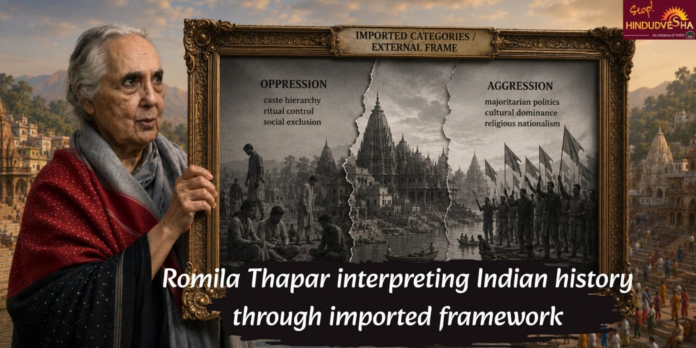
“Deconstructing Romila Thapar’s Narrative Framework on Hindutva”, StopHinduDvesha, 24 Aug 2026.
“Romila Thapar’s interpretation of Hindutva has profoundly shaped academic and public discourse on modern India. While her scholarship commands widespread respect, the framework underlying her narrative warrants closer scrutiny. Its principal weakness lies not in factual inaccuracies but in methodological selectivity, reflected in inconsistent analytical standards and systematic omissions. This essay argues that Western theoretical paradigms have significantly influenced her treatment of caste, temple destruction, civilizational memory, and Hindu self-assertion, and explains why these interpretations resonate strongly among sections of the Indian diaspora. It concludes that historical scholarship must be judged by methodological consistency, openness to competing evidence, and the equal application of evidentiary standards.
Propaganda seldom operates through crude falsehood alone. Its most durable form works through selection, proportion and strategic omission, amplifying those facts that sustain a preferred interpretation while pushing inconvenient realities to the margins. A narrative built from partial truths is almost always more persuasive than one built from invention, precisely because it feels recognizably anchored in the real.
Few contemporary interpretations of India’s caste structures, religious politics and the rise of Hindutva as a civilizational and electoral force illustrate this process more clearly than the commentary of Romila Thapar. [1] Her work has defined how entire generations of academic, media and diaspora audiences read India’s past and project its future. Understanding the architecture of that narrative, its structural omissions and the specific psychology it activates in NRI audiences, is essential to any serious engagement with contemporary Indian public discourse. And once that architecture is examined closely, an uncomfortable conclusion becomes unavoidable: the very intellectual vice Thapar has spent a career exposing in others lies at the center of her own public framework.
Thapar’s Framework in Her Own Words
Romila Thapar’s influence on Indian historiography is not in dispute. Her scholarly output over six decades has been formidable, covering ancient India from the Mauryan Empire to the early medieval period with methodological rigor that has earned her a genuine international standing. The Library of Congress awarded her the Kluge Prize. Oxford University Press published her collected essays. Her textbooks on ancient India shaped the education of millions of students. Her insistence that history must answer to evidence rather than sentiment is not an affectation but a deeply ingrained scholarly discipline, one she has practiced with considerable intellectual courage despite persistent political pressure. To understand her narrative, therefore, is not to caricature a minor polemicist but to engage one of the most accomplished scholars and institutionally influential voices in shaping the modern understanding of India’s past. [2]…………..”
Read the full article at StopHinduDvesha.
