


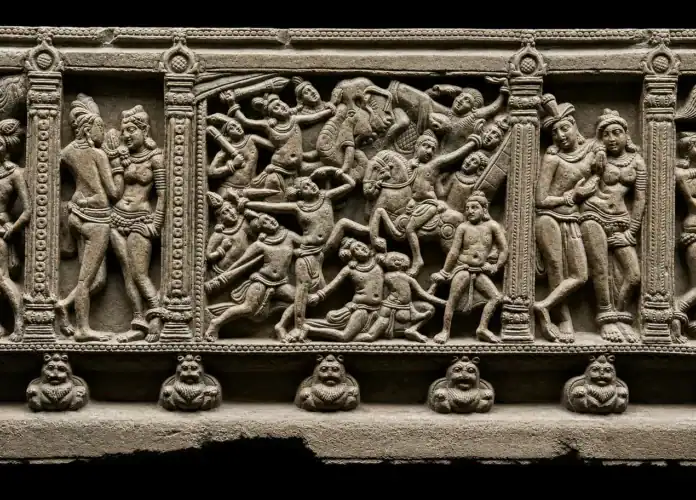
“The Cavalry of the End of Days”, cshc.substack.com, July 22, 2026
“In the seventy eighth year of a king remembered as the Great Moga, on the fifth day of the month Panemos, an official named Patika buried relics of the Buddha on the outskirts of Taxila and built a monastery over them. We know because he wrote it down. His scribe hammered the record into a sheet of copper, and the copper survived where the monastery did not.
That one document repays some staring. Panemos is a Macedonian month; Alexander’s calendar was still running in the Punjab three centuries after his soldiers left. The script is Kharoshthi and the language is Prakrit, the ordinary speech of the northwest. Patika’s father, Liaka Kusulaka, held the rank of satrap, which is a Persian office, and governed the district of Chukhsa for an overlord. The overlord is Moga, whom historians call Maues, and he was none of the above, neither Greek nor Persian nor Indian. He was a Scythian, a horse archer whose people had come down off the central Asian steppe within living memory, the first of them ever to rule an Indian city. And what the satrap’s son did with the family money, a generation or so into the conquest, was endow a Buddhist shrine. Nobody involved seems to have found any of this worth remarking on.
The keepers of the Sanskrit tradition would not have described the scene at Taxila so calmly. In their vocabulary a foreigner with no place in the four ranks of society was a mleccha, a barbarian whose speech sounded like babble, and a barbarian on an Indian throne was not politics at all. It was an omen, the kind of thing a chronicler recorded alongside failed rains and comets. In the Mahabharata the sage Markandeya tells Yudhishthira exactly what the reign of such people will mean. He is describing the arrival of the dark age itself……”
Read full article at cshc.substack.com
