


“The Battle of Buxar Through British Eyes: Lord Valentia’s 1803 Bihar Travelogue”, DharmaDispatch, 05 Oct 2026.
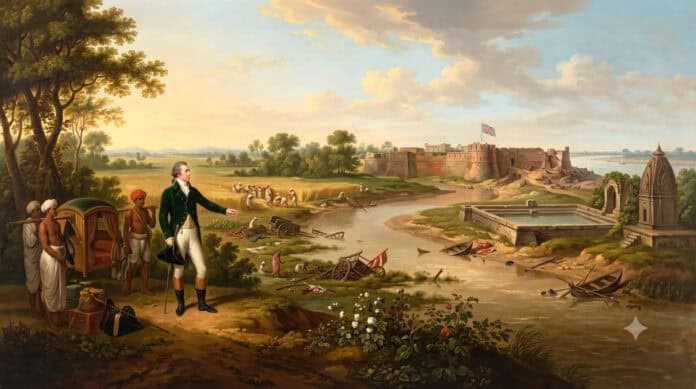
“AFTER AN EARLY DINNER on March 5, 1803, Valentia resumed his onward journey and when he awoke the next morning, he found himself in a “flat but highly cultivated country.” His sight is greeted by sprawling blankets of cotton plant and the “Ricinus communis” or castor, which grew “in the greatest possible luxuriance.” The English shopkeeper’s instinct inside him awakens; he rues over the fact that “till lately, the India Company was so uninformed” that it used to send castor oil, “the medicine,” all the way from Europe whereas it grew here so abundantly.
Some distance later, Valentia spots a panoramic scene of wheat harvesting and launches into a comparative analysis.
Then he arrives at a nullah—canal, a site of the decisive Battle of Buxar (1764). He is naturally exultant at the memory of the conclusive English victory over “the united forces of Suja ul Dowlah {Shuja-ud-Daula] and Cossim Ali Khan [Mir Qasim].” It was by all means an unequal battle—a force of fifty thousand plus a large train of artillery on the Muslim side against a twelve-thousand-strong force on the British side. But it was H.H. Munro’s decisive leadership and strategy that turned the battle. In Jadunath Sarkar’s memorable verdict, the battle “ended in the Wazir’s [Shuja-ud-Daula] crushing defeat at Buxar…and in the complete prostration of Oudh at the feet of the English. The derelict Emperor [Shah Alam II], who had been incited by Shuja before the battle of Buxar and abandoned after it, took shelter with the English.”
The nullah was, according to Valentia, the watery graveyard of the Muslim forces whose “flight was so rapid, that they did not stop at Buxar, but hastened to a nullah beyond, which, being then very full, thousands were drowned in attempting to pass it.” This is the famous Toran Nullah just outside the Buxar fort and town. H.H. Munro’s dispatches to the East India Company’s Council at Calcutta gives the detailed, eyewitness account of the carnage………”
Read the full article at DharmaDispatch.
