


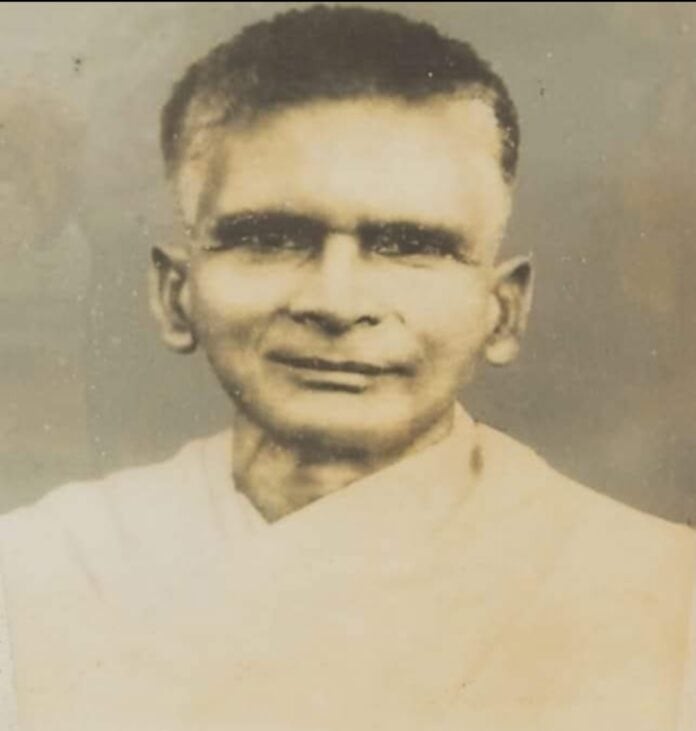
In the long and turbulent history of the Indian subcontinent’s freedom struggle, certain figures stand apart not merely for their political roles, but for the depth of their commitment to people. Purnendu Kishore Sengupta was one such leader—an organiser, social reformer and tireless advocate for workers and peasants, whose life traced the arc of resistance from colonial rule to post-partition realities.
Born in 1895 in Banar, Dhaka, into a respected family, Sengupta grew up in an environment shaped by law, intellect and civic responsibility. His father, Shyam Kishore Sengupta, was a well-known lawyer in the Sylhet Judge’s Court. Yet, rather than following a conventional professional path, the young Purnendu gravitated early toward activism, joining a revolutionary practice association in Sylhet inspired by Nagen Dutta.
His academic years at Dhaka University proved pivotal. Exposure to Acharya Prafulla Chandra Ray sharpened his political consciousness, while the Non-Cooperation Movement transformed his convictions into action. In a defining gesture of defiance, he boycotted his M.Sc. examinations—an early indication of a life that would consistently place principles above personal advancement.
Sengupta’s role in the freedom movement was both wide-ranging and deeply rooted in grassroots engagement. In 1922, he became associated with the Dhaka Abhoy Ashram and later took on editorial responsibilities at Vidyashram in Bikrampur. When floods threatened the institution, he relocated it to Sylhet, establishing the Rangirkul Vidyashram—an institution that would evolve into a vibrant centre for Gandhian thought, education and social mobilisation.
The 1930s marked an intense phase of activism. Sengupta took part in the Salt Satyagraha, endured imprisonment, and in 1932 helped establish the Sylhet Women’s Association—reflecting his commitment to inclusive social reform. His leadership of the Manipuri peasants’ satyagraha in the Bhanu Bil region was particularly significant, compelling colonial authorities to enact reforms recognising people’s rights.
Beyond political agitation, Sengupta’s humanitarian instincts were equally pronounced. During the devastating floods of 1929 in Sylhet and Cachar, he organised relief efforts. In the upheaval of World War II, he extended assistance to refugees fleeing Burma. His initiatives often blended culture and politics, as seen in the 1935 art exhibition marking the Indian National Congress’s Golden Jubilee.
With the end of British rule in sight, Sengupta transitioned into formal politics without abandoning his grassroots focus. Elected in 1946 to the Assam Managing Committee, he chose to remain in East Pakistan after partition—a decision that underscored his commitment to the region’s marginalised communities. His work among tea workers became a defining chapter of his later life.
On June 3, 1948, he founded the Sylhet Tea Workers’ Union in Kulaura, bringing together a workforce long deprived of basic rights. As its founding president, he helped shape what would later become the Bangladesh Tea Workers’ Union, laying the groundwork for organised labour in the sector.
His political career continued to evolve. In 1954, he was elected to the Pakistan Parliament from South Srihattha Sub-division ( presently Moulvibazar district) under the United Front banner, and a decade later secured a resounding victory from the Kulaura-Rajnagar constituency. Even under the restrictive rule of Ayub Khan—when his union was banned—Sengupta remained steadfast.
The Liberation War of 1971 brought new dangers. Targeted by Pakistani forces, he sought refuge in India, where he supported the cause of Bangladesh’s independence. After the war, he returned to a life of quiet service until his passing on November 17, 1978, at the Rangirkul Ashram he had nurtured.
Purnendu Kishore Sengupta’s legacy is not confined to political milestones. It lives on in institutions, in labour movements, and in the enduring idea that leadership is defined not by authority, but by service. His life stands as a reminder that history is often shaped not only by those in power, but by those who stand, unwavering, beside the people.
