


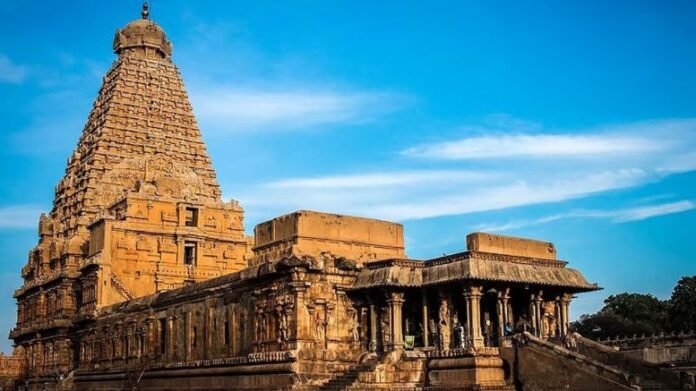
Gangaikonda Cholapuram (Chozhapuram) is in focus these days with PM Modi scheduled to visit the UNESCO heritage site on 27 and 28 July. The PM is set to participate in the thousandth anniversary of Ganga plain’s conquest by Parakesarivarman Rajendra Chola I.
PM Modi to visit Gangaikonda Cholapuram to celebrate Rajendra Chola I
Prime Minister Narendra Modi will visit Tamil Nadu (TN) for two days on 27 and 28 July. On 27, he will attend the Thousandth anniversary celebrations of Parakesarivarman Rajendra Chola I’s Ganga plains conquest at Gangaikonda Cholapuram in Ariyalur district. The TN government has been celebrating the Chola king’s birth anniversary since 23 July, with the main event taking place at the UNESCO World Heritage site of Brihadishwara Kovil (Mandir).
During the event, the Prime Minister is expected to release a commemorative coin. The Archaeological Survey of India (ASI) has also organized a photo exhibition highlighting Parakesarivarman Rajendra Chola I’s Ganga and Kadaram expeditions, as well as miniature sculptures related to Shaivism and the Chola dynasty.
On 28 July, the Prime Minister will inaugurate the newly modernized Thoothukudi airport. Originally built in 1992, the airport has undergone significant upgrades at a cost of ₹381 crore. Its runway has been extended from 1,350 meters to 3,000 metres, and it now features a parking bay that can accommodate up to five aircrafts simultaneously.
In addition to marking the Thousandth Ganga plains conquest anniversary of Rajaraja’s worthy heir, Rajendra Chola’s birth anniversary, Thousandth year of the completion of the Mandir, and completion of ten centuries since his South-East Asian conquests are the other three important occasions that will be celebrated in the presence of the Prime Minister. Shaivite Math heads will grace the occasion.
Unique features of Gangaikonda Cholapuram Kovil
The Chola kings were great Kovil/Mandir builders. They constructed huge stone Kovils/Mandirs filled with intricate carvings of Hindu Devis and Devatas. Rajakesari Rajaraja Chola I, the father of Rajendra Chola I, built the famous Brihadisvara Kovil in Thanjavur, about 50 km from Gangaikonda Cholapuram, between 1003 and 1010 CE. Like the Gangaikonda Cholapuram Mandir, it is dedicated to Bhagwan Shiva. In the central courtyard of the Thanjavur Kovil stands a massive statue of Nandi, Bhagwan Shiva’s sacred bull.
The Brihadisvara Kovil in Gangaikonda Cholapuram is a protected monument under the Archaeological Survey of India (ASI). After winning many battles in South Bharat, Parakesarivarman Rajendra Chola wanted to build a new capital using sacred water from the River Ganga. His army defeated several kingdoms along the way and brought back water from the sacred Ganga, which was then used to establish the new city, Gangaikonda Cholapuram. The Gangaikonda Cholapuram Mandir, dedicated to Bhagwan Shiva, is one of the largest in Bharat. Its main tower rises to a height of 55 metres. The grand structure is beautifully decorated with detailed artwork and sculptures, showcasing the rich heritage of the Chola era.
The Shivling here is the biggest in the world made out of a single stone/rock in the Dravida Mandir architectural style. The Garbhagriha (sanctum) of the Gangaikonda Cholapuram Mandir houses a massive Shivling (Shiva lingam), standing 13 feet tall with a base circumference of 59 feet. It must be mentioned that the Shivling was made first and then the Kovil was constructed around it due to the gigantic size of the Shivling.
An interesting fact to be noted is that the stones used in the construction of Gangaikonda is not available in the vicinity and had to be imported from hilly districts upstream. The manner in which the rocks were transported for the construction of the Kovil is even more interesting. The rocks were cut and floated down through the Kollidam river and a ramp was constructed to transport them to the Mandir site.
In addition to the huge Shivling, the Gangaikonda Cholapuram Kovil is known for its beautiful and detailed sculptures. Among its finest artworks are the bronze vigrahas of Bhogashakti and Subrahmanya, which are masterpieces of Chola craftsmanship. Another special feature of the Kovil/Mandir is the Saurapitha, or Solar Altar. The Saurapitha is a lotus-shaped platform with eight deities who are believed to bring good fortune.
Conquests of Rajendra Chola I
Iditurainadu (Raichur), Banavase (Vanavasi), Kollippakkai (north-east of Hyderabad), and Mannaikkadakkam (Manyakheta/Malkhed) were Rajendra’s earliest conquests which KA Neelakanta (KAN) Sastri believes were part of his military campaign as Yuvraj.
His campaign against Ila-mandalam (Ceylon) is said to have taken place in 1017-18 CE. Rajendra’s successful campaign brought the whole of Ceylon under the Cholas and made the island a Chola province. Twelve years before this, Rajaraja had taken advantage of the confusion that had arisen from a military revolt against Mahinda V and brought Ceylon (with the exception of the island’s remoter parts) under Chola’s reign.
The Tiruvalangadu plates provide information about Rajendra’s campaigns in Pandya and Kerala countries. “It may be doubted if by this campaign Rajendra added any new territory to his dominions. The Pandya and Kerala countries had been conquered by Rajaraja very early in his reign, and the many ancient islands towards its end”, opines KAN Sastri.
In 1021 and 1022 CE, the Chola ruler resumed the war against the Western Chalukyas under Jayasimha who had succeeded his brother Vikramaditya V. Though the Tiruvalangadu plates say that the Chola captured Rattapadi, Jayasimha managed to retain his territories up to the Tungabhadra if not beyond.
Rajendra then turned his attention northwards and his northern campaign was in quest of the Ganga. In this regard, the Tiruvalangadu plates note “The light of the Solar race (Rajendra), mocking Bhagirath who by the force of his austerities caused the descent of the Ganga, set out to sanctify his own land with the waters of that stream brought (thither) by the strength of his arm”.
It must be mentioned that the Tiruvalangadu plates explicitly mention that the expedition was led by one of the king’s generals who met Rajendra on his return somewhere on the banks of the Godavari. At the end of the expedition, Rajendra erected a jalamayam jayastambham (liquid pillar of victory) in his capital with Ganga water in the form of the Cholaganga tank.
It was customary for the Cholas to commission temples, mostly dedicated to Bhagwan Shiva, to celebrate their victories. The Gangaikonda Cholapuram Mandir was constructed to celebrate Rajendra’s conquest of the Ganga region.
(Featured Image Source: Wikimedia)
