


The caste system, though commonly used to refer to Hindus, was not originally a codified social system in Bharat. So how did the Hindu people, whose native language was neither Portuguese nor English, come to have “the caste system” as their social structure? This article (and the next few) answer a series of such questions on the caste system.
“Casta” in Portuguese
The word “casta,” though commonly known to be from Portuguese, has a connotation very different from “caste” as well-known today. “Casta” originally referred to lineage, stock, breed, or hereditary type, and was used in the context of animals—like breeds of horses.
A key early definition appears in Sebastião de Covarrubias, Tesoro de la lengua castellana o española (1611), one of the earliest Iberian dictionaries:
“Casta es el linaje noble, el origen sin mezcla.”
Casta is the noble lineage, origin without mixture.
So, the true meaning of “casta” was “without mixture.” A broader interpretation would be “purity of blood or descent”. So “casta” originated in the European world, not in India at all, and was not used in the sense of a formal, civilizational social system until it was applied in colonial contexts..
Hierarchal Structure of European Societies in 17th-19th centuries
In the medieval period to modern day (before the Industrial age), European societies existed as feudal and estate systems.
The British society operated under a hereditary hierarchy (aristocracy → gentry → commoners → laborers). This structure was codified in law through:
- Primogeniture (inheritance to firstborn sons)
- Peerage titles (passed by blood)
- Manorial hierarchy (lords vs. tenants vs. villeins historically)
Hierarchy was legal, inherited, and institutional—but never called “caste.”
Similarly, under the Ancien Régime, French society was divided into the Three Estates:
- Clergy (First Estate)
- Nobility (Second Estate)
- Commoners (Third Estate)
Each estate had birth-linked privileges and restrictions. Alexis de Tocqueville observed later in The Old Regime and the Revolution (1856):
“Among the nobles, inequality was a right by birth, preserved through law and custom, rather than wealth alone.”
Again, hereditary hierarchy, but not named caste.
So hierarchy based on birth was not only well-known in Europe, but institutionalized and legalized. They did not call it caste, but already had a social structure which was foundationally based on rights by birth.
Limpieza de sangre in Portugal and Spain
“Limpieza de sangre” referred to the Portuguese and Spanish ideas of purity of blood [1]. Before the word “casta” ever reached India, it took on a dark, social meaning in Spain during the 15th century. As Christian Spain reconquered territory from the Moors (Muslims), a deep suspicion of Jewish and Muslim converts to Christianity emerged.
The Spanish obsession with limpieza de sangre created a stratified society. Society was divided between “Old Christians” (those with “pure” blood) and “New Christians” (converts)[3]. The word casta began to be used to describe these different lineages. If you had Jewish or Muslim ancestors, you were considered to be of “impure casta,” which legally barred you from certain guilds, universities, and government positions.
Casta = lineage, breed, hereditary stock. They used the word to classify people as:
- Old Christians
- New Christians
- Jews
- Moors
- Africans
- Mixed converts
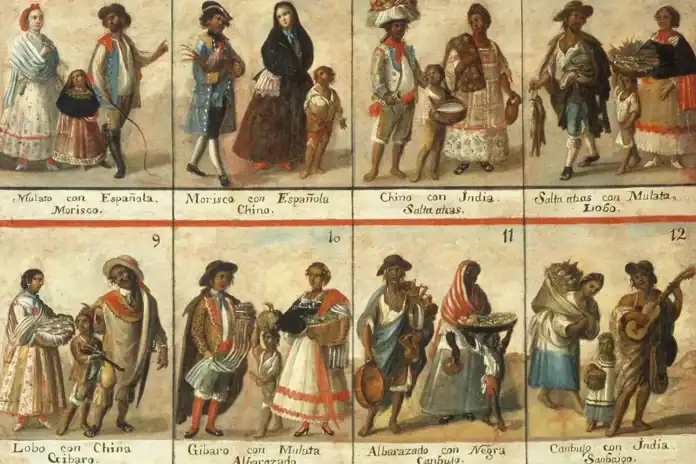
The spanish portrayed their “castas” through their Casta paintings, which denote different people in different, possibly unflattering, ways [2, 3, 4].
At the same time, Portugal needed a term to classify lineage categories domestically and in colonies. In Brazil, castas became formal racial categories:
- Branco
- Pardo
- Preto
- Mulato
- Mameluco
- Cafuzo
Each with different legal rights, marriage rules, and occupations. So “casta” transformed into a word classifying different races and converts.
When the Portuguese arrived in Bharat in 1498, they arrived with this specific worldview already in their heads—that society is divided by blood, lineage, and purity. Duarte Barbosa was a Portuguese scrivener posted in Kerala (Malabar Coast) [5]. He is one of the earliest to commit the word casta to paper when describing Indians. He observed the Nairs (warriors) and their refusal to touch or eat with other groups. He wrote that the Nairs form a separate “casta”—using the word in its Iberian agricultural sense: a “breed” or “lineage” that does not mix. At this stage, “casta” was just a descriptive adjective [6]. It was not yet a “system.” It was like saying, “this breed of people.” The word was thus introduced into the vocabulary of the Indian ethos, without any plan of developing it into a way to organize the society just yet.
Hierarchy as Natural Order of the Christian World
In the 17th-19th century, Christianity was not merely a religion, but was a political framework. In the Christian political imagination, hierarchy was cosmic, moral, and divinely justified. Inequality was not framed as a defect, but as a natural and God-ordained structure of civilization.
St. Thomas Aquinas, Summa Theologica (1265–1274), I-II, Q. 90:
“Law directs man to his proper order within society, according to divine reason.”
Aquinas treated social order as part of a greater metaphysical hierarchy.
Jacques-Bénigne Bossuet, French bishop, Politics Drawn from the Very Words of Holy Scripture (1709):
“God establishes kings, and through kings, the ranks of men; obedience is holy, rebellion is sin.”

This was one of the most influential political theology texts of early modern Europe. Its implications were clear:
- Hierarchy is sacred
- Obedience preserves civilization
- Birth determines place in order
- The system itself is not questioned
Europe’s social imagination leaned on a selective but powerful reading of the Bible, especially verses like:
Romans 13:1: “There is no authority except from God.”
Ephesians 6:5: “Servants, obey your earthly masters.”
These verses were routinely cited in sermons and governance philosophy to justify hereditary estates, monarchy, and obedience. No parliamentary procedure was needed for hierarchy—it was assumed as the default state of civilization.
Why Caste System in Bharat?
None of this, so far, relates to the Bhartiya society. The Hindu majority Bhartiya society in the 17th century comprised of thousands of jaatis and four varnas. Neither of these were “caste” as described so far. So why did the British call the Hindu organization system as “caste”?
As the British East India Company took over, they anglicized the Portuguese casta into “Caste.” The British colonizers had multiple reasons for enforcing the “caste system” on the Hindu people:
- Orientalist view: Colonizers believed that by “studying” the Orient (eastern worlds), they knew it better than the people living there did. This is a classic expression of Orientalist epistemology, where the East is treated as an object of knowledge and control. This orientalist world view led them to believe that they knew everything about the people they were ruling; they saw everything through a pre-existing lens of Christianity.
- Hurdles in Conversion: Christian missionaries routinely cited the Hindu varnas as one of the profoundest reasons for Hindus not converting to Christianity. The Brahmins were cited as the reason for not just non-conversion, but also rebellion towards the foreign rulers.
For eg, a key 19th-century missionary observer, Abbé J. A. Dubois, wrote extensively on Bhartiya religion and conversion. He singled out Brahmin authority as a reason why Hindus were resistant [7]:
“Brahmins … exercise such influence over their people that they repel all attempts at conversion.”
- Need of a social structure: In Britain, hierarchy and social structure was assumed and self-evident. Whereas they needed a “structure” to be able to rule the Bhartiya. Bharat was:
- Foreign
- Non-Christian
- Requiring explanation
- A subject of administration
- Priors on social structure: they assumed that Hindus needed their superior powers of administration to be a functional society (the orientalist view of Indians was that they were “uncivilized”), and codified their prior ideas of birth-based social hierarchy onto the Indian society, by mapping it with Hindu varnas.
- Othering of Hindus: In British colonial manuals (such as the District Gazetteers), officials frequently wrote that European society had “evolved” past its feudal stages, while India was “stationary.” By calling it a “Caste System” instead of “Feudalism,” they were documenting India as a society that was “stuck in the past” and therefore required British “management” and “reform.”
The “caste system” therefore took on a different shape and form altogether, and became the notorious social evil the Bhartiya society is riddled with even today.
Though they imposed the caste system onto the Hindu society, numerous accounts from British officials describe what Jaatis actually were like in the Hindu society. The next articles in the series will delve deeper into this.
References:
- Iberian Blood Purities by Rachel Burk
- The Paintings That Tried (and Failed) to Codify Race
- Rebecca Earle. (2016). The Pleasures of Taxonomy: Casta Paintings, Classification, and Colonialism. The William and Mary Quarterly, 73(3), 427–466. https://doi.org/10.5309/willmaryquar.73.3.0427
- Arcila-Valenzuela, M. (2025). Visualizing Taxonomic Reasoning: Casta Paintings and the Hierarchization of Bodily Differences. Critical Philosophy of Race 13(1), 1-23. https://muse.jhu.edu/article/951631.
- Duarte Barbosa, & Mansel Longworth Dames. (1918). The Book of Duarte Barbosa. Hakluyt Society.
- Deus Beites Manso, M.d. (2025). Jesuit Missions in the Malabar Province. In: Facilitating an Empire: The Jesuits in Portuguese Territories and Beyond (1540-1975). Palgrave Studies in Comparative Global History. Palgrave Macmillan, Singapore. https://doi.org/10.1007/978-981-97-7954-3_3
- Dubois, Jean Antoine. State of Christianity in India. India, Longman, Hurst, Rees, Orme, Brown and Green, 1823.
(The article was published by Arti Aggarwal on artiagarwal.substack.com on January 03 and has been reproduced here)
