


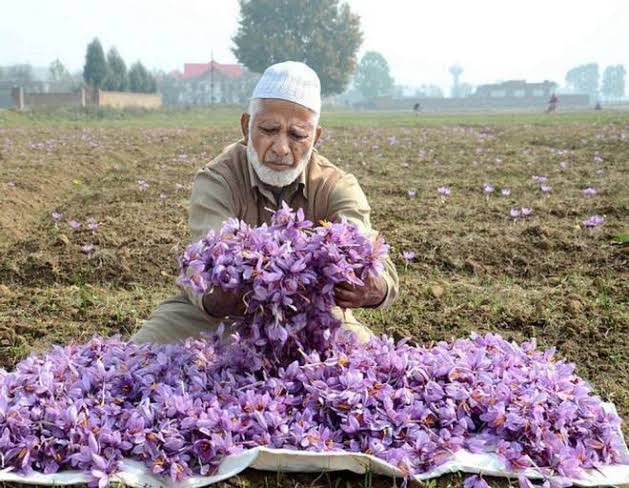
Saffron, known in Bharat as kesar, comes from the dried stigmas of the Crocus sativus flower. Kashmiris call it koung or kong, Hindi and Punjabi speakers call it kesar, Persian and Urdu draw on zafran, and classical Sanskrit used kum-kum or lohit. The number of names hints at how long the spice has moved through South Asian trade and culture, picking up a word in every language it passed through.
The economics of the crop explain its price. Each flower yields exactly three stigmas, picked by hand and dried before they become the spice that reaches a kitchen or a perfume counter. There is no way to mechanise this without destroying the product. Scarcity here is not a marketing line, it is a biological limit built into the plant itself.
That limit has earned Kashmir saffron the label “Golden Harvest,” a phrase that captures both its price tag and its place in the region’s agricultural identity. But the label raises a question the industry has not answered: can a crop this old still generate real income for the people who grow it, or has its value stopped at the level of reputation?
Pampore and the geography of saffron
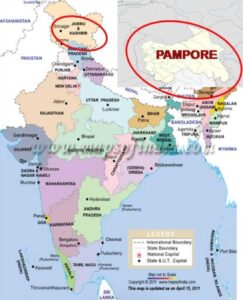
Pampore, in Pulwama district, is the centre of that reputation. Government estimates have put close to 90% of Kashmir’s saffron cultivation in and around the town, and it carries the name “Saffron Town of Kashmir” for good reason. Walk through Pampore in October and the fields turn a pale purple with the crocus bloom that makes the whole harvest possible.
Nearby, the Advanced Research Station for Saffron and Temperate Seed Spices at Dussu does the scientific work behind the crop: research into cultivation methods, yield improvement and long-term sustainability. Its presence is a sign that the state treats saffron as more than a heritage product to photograph. It is a crop that needs continued agronomic investment to survive changing growing conditions.
Kashmir’s saffron story is not confined to the Valley, either. In Jammu, Kishtwar has built its own saffron economy alongside its mineral wealth, earning the nickname “Land of Sapphire and Saffron.” That two very different parts of Jammu and Kashmir both grow the crop says something about its adaptability, and about how much of the region’s agricultural identity is tied up in a single flower.
None of this geography answers the harder question: whether tradition can turn into sustained income for the farmers who maintain it.
From Pampore’s fields to global markets
Kashmir saffron already reaches international buyers. The Agricultural and Processed Food Products Export Development Authority (APEDA) has documented Geographical Indication (GI)-tagged consignments to Saudi Arabia and the United Arab Emirates, and the state’s trade-promotion agencies list the United States, UAE and Qatar as priority export markets.
The GI tag itself, registration No. 635 and certificate No. 366, held by the Agriculture Production Department of Jammu and Kashmir, gives the spice legal protection that most crops grown in Bharat never get. In 2025, the Government of India noted that the Food and Agriculture Organization (FAO) includes the Saffron Heritage of Kashmir among the country’s Globally Important Agricultural Heritage Systems (GIAHS), alongside the Koraput and Kuttanad systems.
Put those together and Kashmir saffron holds something rare among Bharat’s agricultural products: a geographical identity, a cultural story and international recognition, all pointing the same direction. Few crops grown anywhere in the country can claim all three at once.
Recognition, though, does not set a farmer’s income. In 2026, saffron in the Pampore market has traded at around ₹350 a gram, or roughly ₹3.2 to ₹3.7 lakh a kilogram, depending on grade and purity. Those figures sound impressive until you ask how much of that price actually reaches the person who hand-picked the stigmas, rather than the processors, exporters and retailers further down the chain. The real measure of Kashmir saffron’s future is not how many kilograms the Valley produces. It is how much of the value created around each gram ends up with the farmer.
What’s actually holding the sector back
Water is the first constraint on that value. Saffron needs specific soil moisture at precise points in its growth cycle, and Kashmir’s rainfall has become harder to predict. A crop that has survived centuries of tradition can still be undone by a run of bad monsoons if irrigation does not keep pace.
Everything else compounds from there. Better irrigation and soil management would raise yields, but so would improved post-harvest handling, digital traceability that lets buyers verify authenticity, and packaging that reflects the price the spice commands. Much of that infrastructure is missing or underfunded today, which leaves growers of a genuinely valuable crop exposed to the same market pressures as growers of far less valuable ones.
The fix is not producing more saffron. Kashmir does not have a supply problem, it has a value-capture problem, and building the systems that let farmers keep more of what their crop is worth is a different project from expanding acreage.
Why the next generation matters more than the next harvest
The deeper problem is generational. Young people in Kashmir are leaving agriculture, and saffron is no exception. The labour is hard, the returns are uncertain, and other work looks more secure. That is a rational calculation for anyone weighing their options, but it also means the knowledge built into a centuries-old crop has fewer hands to pass to each year.
Fixing this will take more than encouraging young people to stay in the fields. There is room for a different kind of participation: in processing, in quality testing, in e-commerce, in the marketing that gets Kashmir saffron in front of a buyer in Doha or Los Angeles. A saffron economy that only offers cultivation jobs will keep losing young workers to other sectors. One that offers a business built around the crop has a better chance of keeping them.
Sustained research, stronger market linkages and a role for young entrepreneurs beyond the fields would do more for saffron’s long-term productivity than any single good harvest.
Kashmir saffron sits at an unusual intersection: a product with a stronger legal, cultural and export identity than most crops grown in Bharat, grown under increasingly uncertain conditions, by a workforce that is ageing out faster than it is being replaced. Whether it becomes a genuine global brand or a shrinking heritage product depends less on demand, which already exists, than on whether Kashmir builds the water systems, processing infrastructure and generational pipeline the crop needs to live up to its own reputation.
— Kanav Sharma, a Public Policy Researcher from Jammu & Kashmir, with a postgraduate degree in English Literature
