


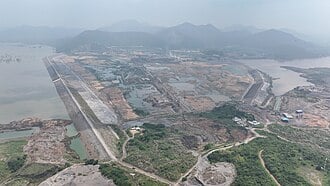
The Polavaram Irrigation Project is on the river Godavari near Ramayyapeta village of Polavaram Mandal, about 34 km upstream of Kovvur-Rajahmundry road-cum-rail bridge and 42 km upstream of Sir Arthur Cotton Barrage, where river emerges out of the last range of the Eastern Ghats and enters the plains in West Godavari District of Andhra Pradesh. This multi-purpose major irrigation project is intended for development of a gross irrigation potential of 4,36,825 ha. The project also envisages generation of 960MW of hydro power, drinking water supply to a population of 28.50 lakh in 611 villages and diversion of 80 TMC of water to Krishna River basin.
Benefits of Polavaram Project
- The Polavaram Project is designed to create a gross irrigation potential of about 10.80 lakh acres. In addition, it will stabilize irrigation in about 10.13 lakh acres of the Godavari Delta and 13.00 lakh acres of the Krishna Delta.
- Diverts and utilizes the surplus waters of Godavari River into Krishna and other rivers to make the state drought free forever, meeting the demands for irrigation, drinking water and industrial purposes. Every year 2,500 TMC waters of Godavari River go waste into the sea and the Polavaram Project is expected to divert 80 TMC of Godavari waters into Krishna River.
- Generation of 960 MW of hydel power.
- Has the potential to transfer the surplus waters of Godavari River to Cauvery through Krishna and Penna Rivers.
- Increase in agricultural production to the tune of 109 lakhs M.T. per annum.
- Inland water transport for the mineral and forest products and other agricultural and industrial products.
- Recreation facilities and pisciculture.
Damage to diaphragm wall
In August 2020, Godavari river witnessed massive floods with a flow of 21 lakh cusecs (cubic feet per second).The half-built upper coffer dam (built to divert water during the construction of the reservoir) was washed away causing huge scouring at two places in the diaphragm wall, constructed 90 ft deep in the river-bed for blocking the water and arrest seepage via foundation, on which the main earth-cum-rock-fill (ECRF) dam of 48 metres height and 1.75 km length was supposed to be constructed. The principal structural issue was not the concrete spillway but the diaphragm wall (D-wall), which is a deep underground reinforced concrete cut-off wall. It is an invisible but critical component of an earth-cum-rockfill dam, designed to prevent seepage beneath the dam.
The diaphragm wall is about 1.37 km long, extends roughly 100 metres below ground, and forms the seepage barrier beneath the future earth-cum-rockfill dam. According to the Government of India and the Central Water Resources Ministry The diaphragm wall had been completed. However, the upstream cofferdam, which was intended to protect it from river flows during construction, was only partially completed. During the 2020 Godavari floods, water overtopped/passed through the incomplete cofferdam. The resulting high-velocity flow caused severe erosion around the diaphragm wall, damaging substantial portions of it. The Government of India officially informed Parliament that the damage occurred because floodwaters passed through the partially built upstream cofferdam, leading to damage of the diaphragm wall. The consensus emerging from the technical reviews and investigations was that the principal problem was construction sequencing—that is, the diaphragm wall was exposed before adequate flood protection was in place—not that the wall failed because of defective concrete.
The Comptroller and Auditor General (CAG), in its 2025 Performance Audit, made an important observation, stating that the failure to adhere to the planned construction schedule, inadequate planning before the monsoon, and not completing critical protection works in time, these things resulted in the damage to the diaphragm wall. In other words, the audit largely attributes the damage to project planning and sequencing failures, rather than to material quality defects.
Consequences of the damage to the diaphragm wall
1. Reconstruction became necessary
Instead of simple repairs, experts recommended reconstructing the damaged diaphragm wall using revised designs approved by the Central Water Commission.
2. Cost escalation
Reconstructing the diaphragm wall added approximately ₹1,000 crore to the project cost, according to statements made by the Andhra Pradesh Government.
3. Delay in project completion
The damage delayed construction of the Earth-cum-Rock Fill (ECRF) dam because the diaphragm wall is its foundation. The project consequently lost several years.
As of April, 2026 the new 1,372-metre diaphragm wall has been completed and the State Government states that it has been built using revised designs. Construction has been approved through the Panel of Experts and the Central Water Commission, and work on the Earth-cum-Rock Fill dam has resumed. As of July 2026, the Polavaram Irrigation Project has entered its final major construction phase, but it is not yet complete. The project has made significant progress compared to its position in 2023–24, particularly after the reconstruction of the damaged diaphragm wall. Around 80% of the headworks (spillway, approach channel, stilling basin, diaphragm wall, etc.) have been completed. Construction is now focused on the remaining earth-cum-rockfill dam and associated structures. Construction of the main dam is progressing after completion of the new diaphragm wall. This is the most important remaining civil work before reservoir impoundment can begin.
The spillway and its radial gates are substantially complete and have already handled major flood flows in recent monsoon seasons. Remaining works relate mainly to integration with the completed dam structure. Rehabilitation of project-affected families remains one of the largest pending tasks. Completion of R&R (Rehabilitation & Resettlement) is essential before the reservoir can be filled to its full design level. The Andhra Pradesh Government has announced a target of October 2026 for completing the principal construction works. However, engineering experts note that commissioning of a large dam is a phased process. After civil construction is completed, the reservoir must be filled gradually while monitoring the dam’s behaviour, seepage, and structural performance.
From an engineering perspective the most serious technical setback—the damage to the original diaphragm wall—has been overcome through reconstruction. The project is now in its final execution stage, with the major challenges being completion of the earth-cum-rockfill dam, finishing ancillary works, and implementing rehabilitation and resettlement before full reservoir impoundment.
- 1. Full Reservoir Level (FRL): 45.72 metres (150 feet)
This is the maximum normal water level at which the reservoir is designed to operate. It is the officially approved FRL under the Godavari Water Disputes Tribunal (Bachawat Tribunal) Award and continues to be the approved design level.
- 2. Maximum Water Level (MWL): 48.00 metres
During extreme floods, the reservoir level may temporarily rise up to about 48.00 m, known as the Maximum Water Level.
However, the filling of the reservoir is planned in two phases:
- Phase I: Reservoir impoundment up to 41.15 m, allowing initial operation of the irrigation system while remaining works and rehabilitation continue.
- Phase II: Reservoir raised to the full approved FRL of 45.72 m (150 ft) after completion of all remaining works (i.e., completion of the Earth-cum-Rock Fill (ECRF) dam,) successful safety inspections and approvals, and the required rehabilitation and resettlement (R&R).
In April, 2026 the Polavaram Project Authority (PPA) has clarified that the project will be operated at the approved FRL of 45.72 m with a gross storage capacity of 194.60 TMC. This settles earlier speculation that the reservoir would be permanently restricted to 41.15 m. The 41.15 m level is an interim operational stage, whereas 45.72 m continues to be the sanctioned final operating level of the Polavaram Project.
Whether Polavaram Project will be a dead storage project?
In reservoir engineering Dead storage is the volume of water below the lowest outlet level that cannot be released by gravity for irrigation or water supply. Live (or active) storage is the usable water between the minimum operating level and the Full Reservoir Level (FRL). Every major reservoir has some dead storage to accommodate sediment deposition over its design life.
The CAG’s 2025 Performance Audit describes the approved Polavaram project as follows:
- FRL: +45.72 m (150 ft)
- Gross storage: about 194.60 TMC
- Live storage: 75.20 TMC
- Installed hydropower: 960 MW
Thus, the project has 75.20 TMC of live storage by design. A reservoir with 75.20 TMC of live storage cannot technically be described as a “dead storage dam.” This live storage is specifically intended for irrigation, Krishna basin diversion, drinking water, industrial water supply, and hydropower generation. Therefore, from a technical standpoint the statement “Polavaram is a dead storage dam” is not factually correct. The characterization of Polavaram as a ‘dead storage dam’ is not supported by the project’s approved engineering design. Official documents of the Polavaram Project Authority, Central Water Commission, and the CAG identify the project as a multipurpose storage reservoir with a gross storage capacity of about 194.6 TMC and a live storage capacity of 75.2 TMC at the approved Full Reservoir Level of 45.72 metres. While interim operation at a lower reservoir level has been proposed during the final stages of construction and rehabilitation, the sanctioned design continues to provide for operation at the full FRL, and the project cannot technically be classified as a dead-storage reservoir. In 2026, the Andhra Pradesh Government formally sought Central approval and funding for Phase II, and discussions have been held with the Ministry of Jal Shakti, indicating that Phase II funding is still pending.
One thing that is certain is that this project when fully completed in all aspects, will be an important milestone to turn the fortunes of Andhra Pradesh to catapult its agricultural economy to the next level. Let us hope that the Polavaram Irrigation Project is completed (including the rehabilitation and resettlement in a smooth manner) at an early date so that it benefits not only the state of AP but also pass on a share of that benefit to the other Southern States to put an end to the shortage of water and inter- state water disputes, through linkage of the major rivers in South India.
