


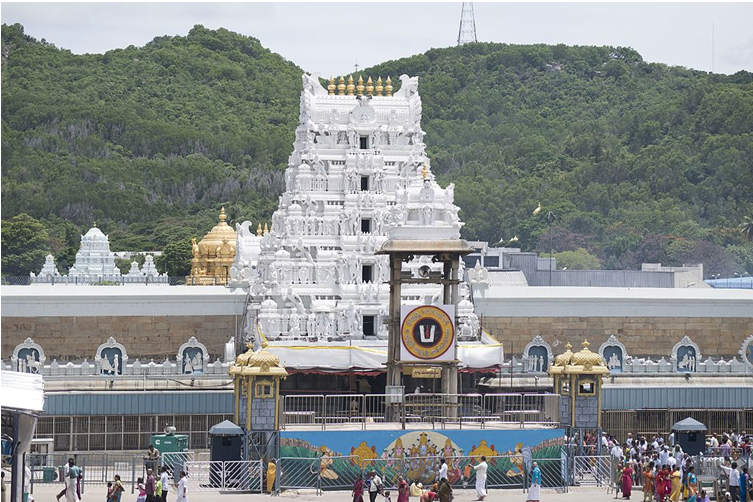
The recent suspension of Assistant Executive Officer (AEO) A. Rajasekhar Babu by the Tirumala Tirupati Devasthanams (TTD) has sparked significant discussion within the Hindu community. The action was taken after it was found that Rajasekhar Babu regularly attended Sunday church prayers in his hometown, Puttur, which was a violation of the TTD’s code of conduct for its employees. This incident raises important questions about the basic expectations from those who serve in Hindu religious institutions and the necessity of preservation of Sanatana Dharma within such organizations.
Background: TTD and Its Code of Conduct
TTD is the administrative body that manages the world-renowned Tirumala Venkateswara Temple and several other Hindu temples. Employees of TTD are expected to uphold and embody the values, traditions, and sanctity of the Hindu dharma. The code of conduct explicitly requires that staff members, especially those in positions of responsibility, refrain from participating in non-Hindu religious activities, as they are seen as custodians of the temple’s sanctity and the faith of millions of devotees.
The Incident
Complaints, supported by photographs and videos, were submitted to the TTD Vigilance Department alleging that AEO Rajasekhar Babu attended church prayers every Sunday in Puttur. The Vigilance Department conducted an inquiry and confirmed the allegations. The evidence included regular attendance at Christian prayer meetings, which was a breach of TTD’s religious code. On July 8, 2025, TTD released a statement confirming the suspension, citing a serious violation of institutional norms and the code of conduct expected from employees representing a prestigious Hindu religious body. Following departmental examination, disciplinary proceedings were initiated against Rajasekhar Babu as per rules, leading to his immediate suspension. This action was confirmed in a statement issued by the chief public relations officer of TTD, Tirupati.
Precedents and Wider Context
This is not the first time TTD has taken disciplinary action against employees for engaging in non-Hindu religious practices. In recent months, at least 18 employees, including teachers and officers, have faced similar action for participating in activities contrary to the institution’s religious ethos. TTD has reportedly transferred at least 18 other employees—ranging from teachers to nurses—for taking part in non-Hindu religious activities, indicating a pattern of strict enforcement.
The TTD has reiterated its commitment to restoring and maintaining the sanctity of its institutions, especially in the wake of several controversies and with the formation of the new state government. In a statement, TTD emphasized that employees are expected to “uphold the traditions and practices of the Hindu religious organisation they represent,” making Babu’s church attendance a direct violation of his professional obligations.
Rajasekhar – A Repeat Offender?
It is to be noted that the very same Rajasekhar Babu employed with the Sri Venkateswara (SV) group of temples and who was in charge of the Hundi counting department in the Tirupati Mandir was accused of being a Christian way back in 2020, despite the fact that officially he declared himself Hindu.
An inquiry was initiated by the TTD to probe this charge in April this year. Special grade deputy executive officer Shri R Rajendradu from Vijayawada was appointed to inquire into the case (reference Roc No. DA1/9968/2019 dated 20/4/2020).
The inquiry conducted in the presence of the charged official, as well as the reporting and presenting officer, held Rajasekhar Rao guilty of hiding his true identity as a practicing Christian.
The inquiry report states that:
“The said A Rajasekhar Babu, AEO, has been indulging in practicing and professing Christianity, a non-Hindu religion as evidenced by his active participation in Christian Mass held at St Paul’s Lutheran Church, Mission Compound, Puttur which is unbecoming of an employee of sincerity, honesty, discipline, and impartiality while performing duties to the best satisfaction and devotion to the organization of Lord Venkateswara”.
The report further states that the officer had taken an oath and signed that he had
in Sri Venkateswara and that he would render his service with sincerity and not violate Hindu Dharma traditions.
The findings of the report say that as per the detailed examination of the video clipping along with the explanation of the charged official, remarks of the reporting officer, and cross-examination of the inquiry officer, the charged official participated in the church prayer along with his wife which violates G.O.M No 1060 dated 24.10.1989 under Rule no 9 (6). It also concludes that the charges against the accused have been proved.
It is important to mention that the TTD service rules mandate that employees of TTD be practicing Hindus. However, this case clearly shows that Rao was a crypto-Christian, an issue that has been plaguing many parts of the country in general and AP, Telangana and Tamil Nadu in particular.
This is not the first time that such blatant violation of service rules has been reported. Earlier, in 2017 too Deputy Executive Officer in TTD’s Welfare Department Ms. Snehalatha was caught violating the service rules and attending church prayers by traveling in her official car.
A fact-finding team in 2006 had also reported such undesirable activities of non-Hindu TTD employees denigrating Hindu Dharma and indulging in Christian proselytization. Even the appointment of Jaganmohan Reddy’s uncle Subba Reddy as the Tirumala Board Chairman had created a furor with claims being made that he was a practicing Christian with a Hindu name, a charge he vehemently denied.
Conclusion
From a Hindu point of view, the preservation of dharma within temple institutions is paramount. Temples are not merely places of worship but are vital centers for the propagation and protection of Sanatana Dharma. Employees, especially those in leadership roles, are expected to set an example by strictly adhering to the tenets of dharma. The regular participation of a TTD officer in church prayers is seen as a dilution of this responsibility and a potential source of confusion or mistrust among devotees.
