


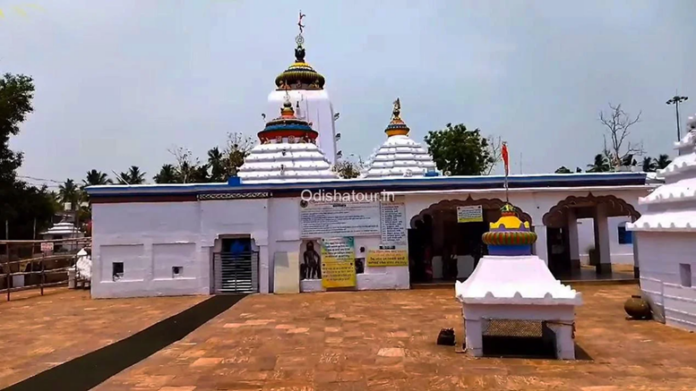
The Biraja Temple, or Birija Kshetra is a historic Hindu temple located in Jajpur about 125 kilometres north of Bhubaneswar, Odisha, India. The principal Murti in this temple is Devi Durga, who is worshipped as Viraja (Girija), and this place is also known as “Viraja Kshetra” and “Biraja Peetha”.
Brahmayamala Tantra has a hymn, “Aadya Stotra”, dedicated to Shakti. In the hymn, Vimala is the goddess of Puri and Viraja (Girija) is the goddess worshipped in the Utkala Kingdom, which became Odisha.
According to the Tantra Chudamani, Sati’s navel fell in the Utkala Kingdom, also known as “Viraja kshetra”. Adi Shankara, in his Ashtadasha Shakti Peetha Stuti describes the goddess as Girija. In Tantra literature, the Oddiyana Peetha is located in eastern India near the Vaitarani River (an Oddiyana is an ornament worn by a woman around her navel). 379 th nama (83 rd Shloka) in Lalitha Sahasranama Stotra is “Odhyanna Peetha Nilaya “, which refers to this Biraja Temple at Odisha. This place has also been mentioned in the Kapilasamhita, Brahmanda Purana, Vayu Purana, Brahma Purana, Astapithamahatmaya and Chaitanya Charitamrita.
Shakti Peeth
Sati, the daughter of Daksha had married Shiva against her father’s wishes. Daksha did not like Shiva as he lived in the burial grounds and smeared himself with ash and had strange attendants. Once Daksha performed a grand Yajna or sacrifice ritual for which he invited all the Gods and Goddesses and other divine beings, but did not invite Sati and Shiva. Sati who came to know about it was hurt, and she asked Shiva to take her to the Yajna. But Shiva in his wisdom dissuaded her from going. However, an adamant and irked Sati arrived at the Yajna, only to be insulted by her father, who also hurled abuse at Shiva. Sati felt humiliated and she jumped into the sacrificial fire and immolated herself. Shiva became angry and he went to the place of the Yajna and created havoc, destroying everything and beheading Daksha. He then retrieved the charred body of Sati and carrying it on his shoulders began the dance of destruction, Tandava Nritya.
The Gods were alarmed as the entire universe was now on the verge of destruction because of Shiva’s wrath. SriVishnu then used his Sudarshan Chakra, which cut the body of Sati into pieces. As Shiva roamed the heavens, her body parts fell at different places on the earth. Wherever her body part fell, that place came to be known as a Shakti Peeth. They are regarded as centres of primordial energy. it is generally believed that there were 101 places where the remains of Sati fell. Of these 51 are regarded as the most important of the Shakti Peeths. Adi Shankaracharya spells out 18 of these Shaktipeethas, and one of them is the Biraja temple of Jajpur, where he mentions the deity as Girija. The Brahmanda Purana mentions 64 Shakti Pithas, while the Skanda Purana lists 20 Shakti Pithas.
The Goddess Girija or Biraja, the holy temple and the river Vaitarani find mention in the Skanda Purana, the Brahmanda Purana, the Vayu Purana, as well as the great Indian epic, Mahabharata.
Shaktism intersects with Tantra as the worship of feminine energy forms the core of Tantra’s practice. Hence Biraja Devi and the Biraja temple find mentioned in various tantric texts. Jajpur was a major centre of tantra and tantric rituals in ancient times. One of the oldest surviving Tantric texts, “The Brahmayamala or Picumata,” dating back to the 7th century, mentions Goddess Biraja Devi, as Girija-the Goddess of the Utkala Kingdom, along with Vimala-the Goddess of Puri.
The Tantra Chudamani which gives details of 52 Shakti Peethas, also gives the names of the Mother Goddesses of each Shakti Pitha and the Bhairav associated with each. It mentions that Sati’s navel fell in the Utkala kingdom or Viraja Kshetra.
Temple History
The Bhaumakaras (8th to 10th centuries A.D.) had their capital at Guhadevapataka or Guheshvarapataka, which is believed to be the present-day Jajpur, where the Viraja Devi temple is located. Iconographic indications from the deity in the sanctum of Biraja temple, point towards a period around the 5th century CE during the Gupta Period. Various independent sculptures found in the vicinity of the temple, help to date the temple to the 8th and 9th centuries CE. It is believed that the Goddess Biraja Devi metamorphosed into the current form in which she presides during the Gupta period around the 4th or 5th century CE.
During the rule of the Bhaumakara, Birja Devi was worshipped as the presiding deity of the royal family. A new temple was built during the 11th century by the Somavanshi king Yayati II, also known as Chandihara Mahasivagupta III. The Somavanshi kings Yayayti I and Yayati II renovated and built many temples. It is believed that a great Ashwamedha Yaga or Horse Sacrifice was performed in what was then called Yayatinagara (present-day Jajpur) by Yayati Keshari on the banks of the Vaitarani river. It is believed that 10,000 Brahmins from Kanyakubj (Kanauj) were brought for the rites and they later settled in the region. The Somavanshi kings were also instrumental in the introduction of the Rath Yatra ritual at the Maa Biraja Devi Temple, Jajpur. The temple was destroyed in the mid-16th century by the forces of Kalapahar, a commander of the Bengal Sultanate. The temple was repaired and reconstructed in the 19th century by a local Zamindar named Sudarshan Mohapatra.
Shrines in the temple
There are four entrance points to the temple. The main entrance is from the east called Simhadwara, flanked by sculptures of lions and elephants. There is a tower (deula) on the top of this entrance. A squarish Vimana topped with Amalakha, Kalasha and a flag is erected over the Garbagriha. Four lions can be seen on the four corners of the Vimana. The Garbagriha is accessed through a hall (Jagamohana) connected by an Antaralaya (connecting passage). Sculptures and images that belong to earlier periods including that of the Bhaumakaras and the Somvanshis (9th to 12th century A.D.) are seen attached to the wall that encloses the temple complex and also on the outer walls of many subsidiary shrines and structures.
The Durga Murti in this temple has two hands (dwibhuja) unlike four hands normally found for Durga Murti in other temples, spearing the chest of Mahishasura with a trident in her right hand and pulling his tail with her left hand. Her right feet is on a lion, while her left feet is on Mahishasura’s chest. Mahishasura is depicted as a water buffalo. The Murti’s crown has images of Ganesha, Shivalinga, a moon and a serpent believed to be Vasuki. This iconography suggests that she is Aadi Parashakti, the supreme Goddess in whom all the energies and power of the universe reside.
There are many smaller shrines in the temple that include many shrines to Shiva. Some of the shrines are dedicated to Isanesvara, Jupesvara, Mrityunjayesvara, Bhusandesvara, Bagalamukhi, and Vaidyanatha.
Bagalamukhi temple
A small and beautiful temple stands towards the right corner, behind the Garbagriha of the Biraja Devi Temple. This is a temple dedicated to Bagalamukhi, one of the 10 Tantric Goddesses (Dasa Mahavidyas). The Goddess is armed with a cudgel and is believed to use it to smash away the delusions and myths of her devotees. The temple is adorned with a porch which has two lion sculptures on either side. The door of the temple has carved images of the 10 Mahavidyas.
In front of the main Biraja Devi shrine is a small shrine to Shiva who is worshipped here as Baba Vaidyanath.
Nabhi Gaya
Gayasura was a great devotee of Bhagwan Vishnu. He worshiped Vishnu for a long time and got a boon that ‘his body should become so pious that any person who sees him attains Mukti (salvation) immediately.’
Gayasura started to grow his body to an enormous size with the help of Yoga Shakti. His wish was to show himself to all so that everybody on the earth attains Mukti. This made Indra (the king of Heaven) fearful and he prayed to the Trimurthis- Brahma, Vishnu and Maheshwara – to give a solution for this.
The Trimurthis approached Gayasura in the form of three Brahmins. They told Gayasura that they are going to do a very sacred Yagna and for that requested land from him. Gayasura happily agreed to it. But, they said that all the places on earth have witnessed bad incidents in their history and so they are unfit for their sacred Yagna.
Gayasura asked them to tell the solution. They suggested that since he got the boon from Vishnu that whoever sees his body gets salvation, that makes his body the best place for the Yagna. Gayasura accepted and offered his body as the surface on which the seven days Yagna could be performed.
He expanded his body with his power and slept on the earth. His head was in Gaya of Bihar (Siro Gaya), his Navel was in Jajpur of Odisha (Nabhi Gaya) and his foot were in Pithapuram of Andhra Pradesh state (Pada Gaya). The Trimurthis, disguised as Brahmins, started doing Yagna.
On the final day of the Yagna, Bhagwan Shiva took a form of the cock and made a doodle doo sound at midnight. Considering it as the sign of morning Gayasura woke up and the Yagna was disturbed. The Brahmins felt very sad. They questioned him that if he couldn’t control himself for just seven days then how is he willing to bear the sins of the entire humanity for the eternity?
Gayasura realised his mistake. Trimurthis appeared before him and assured that his body will remain as it is and the entire land in those three places will become sacred because of him. These three important places are also three of the 18 Shakti Peethas, namely,
- Mangala gauri at Gaya (Bihar)
- Girija (Bhiraja) at Jajpur (Orissa)
- Puruhutika at Pithapuram (Andhra Pradesh)
Pitru Tarpan
These three Shakthi Peethas have become famous for performing Pitru Tarpan (shradh puja) because of Gayasura. Vayu Purana and Agni Purana have a reference of Gayasura and the three Shakti Peethas as mentioned above.
Pitru Tarpan is a ritual performed to the deceased ancestors to satisfy their souls and free their souls from any unfulfilled desires and seek their blessings.
Inside the Biraja Temple in Odisha, is an extremely deep well. Anything that is dropped inside disappears after some time. People throng the temple for doing Shradh and Pind Daan for their ancestors. After the completion of all stipulated rites and rituals, the offerings in the form of the Pinds, are dropped into this well. It is believed, that whatever be the quantity of material that is put into the well, it gradually disappears, and the well is empty again.
Virajakshetra is in triangular form. In each corner one can find a Siva temple at equal distance. These are Bileswar, Khiltateswar and Baruneswar. The first two temples have received land grants from king Anangabhimadeva, as is evident from Madalapanji. (The Madala Panji is a chronicle of the Jagannath Temple, Puri, Odisha. It describes the historical events of Odisha related to SriJagannath and the Jagannath Temple. The Madala Panji dates from the 12th century.)
Jajpur was once popular for both Buddhism and Jainsim. Accounts from Hieun Tsang in 639 A.D. indicate the existence of Puspagiri Vihar in the precincts of Jajpur. Tantrayan sprang upon the decadence of Buddhism towards the 8th century.
Rituals and festivals
The primary ritual in the temple is Sharadiya Durga Puja, which begins on the night of Krishna Paksha Ashtami. This falls before Mahalaya, and ends on Ashwin Shukla Paksha Navami. The puja, known as Shodasha Dinatatmika Puja, lasts for 16 days. The ratha (chariot festival) is known as Simhadhwaja, and its flag bears a lion. Navratri is celebrated as Aparajita Puja.
Other festivals include Nakshatra, Shravana, Prathamastami, Pana Sankranti, Raja Parva and Navanna. Devi is worshipped daily in accordance with Tantra and Agama traditions as Mahishasuramardini by the Brahmins of Jajpur.
Rath Yatra
The only Rath Yatra for a Devi in Odisha happens at the Birajadevi temple in Jajpur. The Rath yatra is celebrated during Durga Puja and is celebrated for nine days. The Rath Yatra of Biraja Devi was a tradition that was incorporated into the temple rituals by the Somavanshi rulers.
The Rath Yatra festival begins with Sunia which is also the Odia New Year that falls on Bhadrapada Shukla Dwadashi. On this day a procession is taken out from the temple, known as Banajaga Jatra, to find the trees for the making of the chariot. This procession is also termed Bilwa Barani. The Bilwa tree is worshipped after the worship of Ganesh and Saraswati. The construction of the chariot, known as Simhadhvaja, starts on Sunia day. the Utsav Murthy of Biraja Devi is seated in the chariot, and a grand procession takes place around the entire compound once for nine days of the festival.
On the ninth day of the Rath Yatra, a puja called Aparajita Puja is performed and the Goddess symbolically kills the demon Mahishasura. The Biraja Mata Rath Yatra is a beautiful aspect of the Shakti culture that is the heritage of Odisha, and Jajpur in particular.
Triveni Amavasya is observed on the No Moon Day of the Magha month of the Hindu calendar. It usually falls in the month of January-February. This day is celebrated as the birthday of Biraja Devi. On this day the deity is decorated as Goddess Savitri, the consort of SriBrahma. She is decorated completely in yellow along with gold ornaments and worshipped with the chanting of the holy Gayatri Mantra.
Dola Purnima is a festival that is celebrated on the Purnima or Full moon day of the Hindu calendar month of Falguna (January-February). A procession of the Utsav Murthy (representative Murti) of Biraja Maa is taken in a palanquin called Jhulan Jatra to the Dolamandapa or Dolavedi. This is a platform with a pedestal within the premises of the Biraja temple.
Varuni or Baruni Festival
This is a festival celebrated on an auspicious day in the Hindu calendar month of Chaitra that falls in March or April. On this day, people congregate in Jajpur for a holy dip in the waters of the Vaitarani river. The deity Biraja Devi is also bathed in the holy waters of the Vaitarani river on this day, at the auspicious hour.
Mahavisuva Sankranti
Mahavisuva Sankranti, also known as Pana Sankranti (Odia New Year) is celebrated on the first day of the solar month of Vaisakha according to the Hindu calendar. On this day the deity is grandly decorated with the “Bada Simhara Vesa,” and special worship is carried out.
Many great personalities had visited the holy land of Biraja Kshetra that includes the founder of the Natha Sampradaya, Matsyendranatha who lived during the 10th century. It is also believed that Padmasambhava a Buddhist monk gained enlightenment in the presence of Ma Birajadevi. Guru Nanak and Adi Shankaracharya too are believed to have visited Biraja temple. In the 15th century, Chaitanya Mahaprabhu, on his way to Puri, visited the divine Biraja Temple. The writer of the national song Vande Mataram, Bankim Chandra Chaterjee worked as the Deputy Magistrate from1882 to 1884 in Jajpur (Orissa was under the Bengal province during that period). He penned ‘Devi Chaudharani’ based on a real story while living at Jajpur, which was published in 1884.
How to reach Biraja temple?
Jajpur is located around 130 KMs from Bhubaneshwar, the capital city of Odisha and well connected by road. Nearest railway station is Cuttack (78 KMs). Bhubaneshwar is well connected by train, airport and road.
