


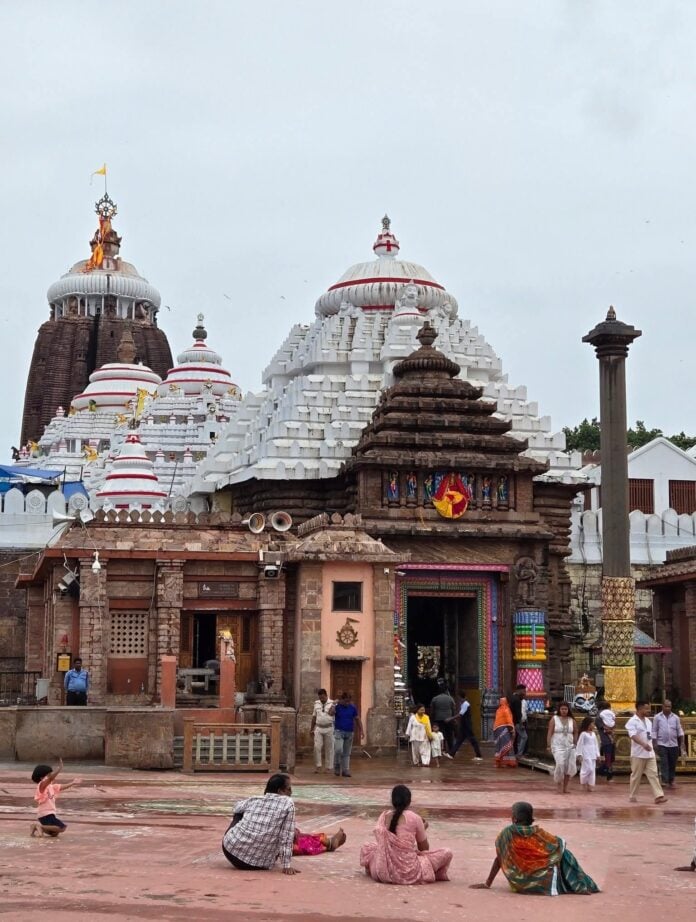
On the eastern edge of the Indian subcontinent, where the Bay of Bengal meets the coast of Odisha, stands one of Hinduism’s most revered and enigmatic sacred sites: the Jagannath Temple of Puri.
Puri is a historic pilgrimage city in eastern India, in the state of Odisha, roughly 60 kilometres south of Bhubaneswar, the state capital. The city faces the Bay of Bengal and occupies a significant place in the religious and cultural history of the eastern Indian subcontinent.
On the wider map of the world, Puri lies in South Asia, on India’s eastern coastline along the Bay of Bengal, which forms the northeastern part of the Indian Ocean. Its position has made it both a coastal city and, for centuries, an important destination in the sacred geography of Hinduism.
The Jagannath Temple, dedicated to Lord Jagannath, a form of Vishnu, is far more than an architectural monument. It is a living centre of worship whose influence extends across India and throughout the wider Hindu world.
With the annual Rath Yatra, or chariot festival, approaching, devotees once again begin gathering in Puri. The festival is among the most extraordinary expressions of public Hindu devotion, when the temple’s three principal deities are carried in enormous, elaborately decorated chariots before vast crowds of pilgrims.
For international visitors, the spectacle can be understood at one level as an extraordinary display of faith, architecture and tradition. But Puri cannot be fully understood through tourism alone. Its history stretches across centuries, while its legends reach deep into Hindu sacred tradition.
The present temple was rebuilt on the site of an older temple after the 10th century and is associated with Anantavarman Chodaganga Deva, the first king of the Eastern Ganga dynasty. Historical accounts place the major construction of the temple in the 12th century.
A Sacred City on the Bay of Bengal
Puri’s location helps explain much of its enduring importance.
Situated on India’s eastern coast, the city faces the Bay of Bengal, one of the world’s largest bays and a major maritime region of the Indian Ocean. To the west and north lies the wider cultural landscape of Odisha, a region known for its ancient kingdoms, distinctive temple architecture and rich religious traditions.
Puri became particularly prominent under the Eastern Ganga dynasty, whose rulers played a central role in the development of the Jagannath Temple. Over subsequent centuries, the city became one of Hinduism’s great pilgrimage destinations.
Its importance is reinforced by its status as one of the four Char Dham pilgrimage sites, alongside Badrinath in the Himalayas, Dwarka in western India and Rameswaram in southern India.
For Hindus, therefore, Puri is not simply a city on the coast of Odisha. It is part of a sacred geographical network stretching across the Indian subcontinent.
The Temple’s Historical Origins
The Jagannath Temple was built in the 12th century AD by Anantavarman Chodaganga Deva, a king of the Ganga dynasty. This is supported by inscriptions in the Kendupatna copperplate of his descendant, Narasimhadeva II.
Anantavarman was originally a Shaivite and became a Vaishnavite after conquering the Utkala region, where the temple is located, in 1112 AD. An inscription dated 1134–1135 AD refers to his donations to the temple, and it is therefore believed that construction began sometime after 1112 AD.
The history is, however, more layered than a single foundation date might suggest.
According to another historical tradition, the temple was established by Anangabhima Deva II. Different accounts give 1196, 1197, 1205, 1216 or 1226 as the year of construction. These differing dates suggest that construction may have been completed, or that major renovation work took place, during the reign of Anantavarman’s son, Anangabhima.
The temple complex continued to develop under later rulers, including members of the Ganga dynasty and the Suryavamsi Gajapati dynasty.
The result is a monument shaped not by one historical moment but by centuries of royal patronage, religious devotion and architectural development.
A Centre of Vaishnava Tradition
The importance of Puri extends well beyond the political history of Odisha.
The Jagannath Temple is considered extremely sacred throughout the Hindu community, particularly among followers of Vaishnavism. Many great Vaishnava saints, including Ramanujacharya, Madhvacharya, Nimbarkacharya, Vallabhacharya and Ramananda, were closely associated with the temple.
Ramanuja established the Emar Math near the temple, while Adi Shankara established the Govardhan Math, one of the four seats of the Shankaracharyas.
The temple also has special significance for followers of Gaudiya Vaishnavism. Its founder, Chaitanya Mahaprabhu, was deeply attracted to Lord Jagannath and lived in Puri for many years.
Through these religious connections, Puri became much more than a regional centre of worship. It became a meeting point for major traditions within Hindu religious thought.
Jagannath, Balabhadra and Subhadra
At the centre of the temple’s religious life are three principal deities: Jagannath, Balabhadra and Subhadra.
Their idols are seated on the Ratna Bedi, or jeweled altar, inside the sanctum sanctorum, alongside representations of the Sudarshana Chakra, Madanmohan, Sridevi and Vishwadhatri.
Unlike the stone and metal idols found in many Hindu temples, the principal images at Puri are carved from neem wood. They are decorated with different clothing and ornaments according to the seasons.
The wooden idols are also periodically replaced through the Nabakalebara ritual, making the relationship between the physical image and the continuity of the deity one of the most distinctive aspects of the Jagannath tradition.
The worship of these deities is believed to predate the construction of the present temple and may have originated in an ancient temple.
The Legend of Nilamadhava
The religious history of Jagannath cannot be separated from its legends.
According to accounts found in the Skanda Purana, Brahma Purana and other Puranas, as well as later Odia texts, Lord Jagannath was originally worshipped as Lord Nilamadhava by a Savara king named Vishvavasu.
King Indradyumna, having heard about the mysterious deity, sent a Brahmin priest named Vidyapati to find the place where Vishvavasu secretly worshipped him in a dense forest.
Vidyapati tried repeatedly but could not find the shrine. Eventually, however, he married Vishvavasu’s daughter, Lalita.
At Vidyapati’s repeated requests, Vishvavasu took his son-in-law to a cave where Lord Nilamadhava was worshipped.
Vidyapati, determined to find the location again, secretly scattered mustard seeds along the route. When the seeds germinated several days later, they helped him identify the path to the cave.
King Indradyumna then travelled to the land of Odra, present-day Odisha, to see and worship the deity. But by the time he arrived, the deity had disappeared.
The king was devastated.
Determined not to return without seeing the deity, he undertook a fast unto death on Nilachala. A divine voice then assured him: “You will see him.”
The king subsequently sacrificed a horse and built a temple for Vishnu. An image of Narasimha brought by Narada was installed there.
Later, the king is said to have received a vision of Jagannath in his sleep. A subtle divine voice instructed him to find a fragrant tree by the sea and use its wood to make the sacred images.
Thus began another chapter in the sacred story of Jagannath.
The Legend of the Divine Carpenter
Another traditional account offers an even more dramatic explanation for the distinctive form of the three deities.
The original image of Jagannath, according to tradition, appeared at the end of the Treta Yuga near a banyan tree on the seashore in the form of an Indranila Mani, or blue-coloured jewel.
The object was believed to be so powerful that it could provide instant salvation. Lord Dharma, or Yama, therefore wanted to hide it from the world and succeeded.
During the Dvapara Yuga, King Indradyumna of Malwa sought the mysterious image and undertook severe penance. Vishnu instructed him to travel to the Puri seashore and find a floating piece of wood from which the sacred images could be fashioned.
The king found the wood and performed a yajna. Lord Yajna Narasimha appeared and instructed that Narayana should be created in fourfold expansion: the Supreme Self in the form of Vasudeva, his Vyuha as Sankarshana, Yogamaya as Subhadra and his separation as Sudarshana.
Vishwakarma, the divine architect, appeared as a craftsman and began creating the images of Jagannath, Balabhadra and Subhadra.
When a luminous piece of wood was seen floating in the sea, Narada instructed the king to make three images from it and place them in a mandapa.
Indradyumna asked Vishwakarma to construct a magnificent temple for the deities. Vishnu himself then appeared disguised as a carpenter and agreed to make the images on the condition that he would not be seen in public until the work was complete.
After two weeks, however, the queen became deeply concerned. No sound was coming from the temple, and she assumed that the carpenter had died.
She urged the king to open the door.
When they entered, they found Vishnu at work. But Vishnu subsequently abandoned the task, leaving the images unfinished.
The idols had no hands.
A divine voice nevertheless instructed Indradyumna to install them in the temple. It is widely believed that although the images have no hands, they can see and possess the world.
For believers, the unfinished form is therefore not a defect. It is part of the sacred identity of Jagannath.
A Monumental Temple Complex
The Jagannath Temple complex covers more than 400,000 square feet and is surrounded by a high fortified wall.
The approximately 20-foot-high outer wall is known as Meghanada Pacheri. Another wall surrounding the main temple is known as Kurma Bedha.
The complex contains at least 120 temples and shrines. Its rich sculptures and distinctive Odia architectural style have made it one of India’s most important and widely visited religious monuments.
The main temple consists of four principal structural sections:
Deula, Vimana or Garbhagriha — the sanctum where the three principal deities are seated on the Ratna Bedi, or jeweled throne.
- Mukhashala
- Natamandira, also known as Jagamohana
- Bhoga Mandapa
The principal temple is a curvilinear structure topped by Vishnu’s “Shri Chakra”, also known as the “Nilachakra”. Made of Ashtadhatu, or eight metals, it is considered sacred.
The Shri Jagannath Temple is the tallest among the existing temples in Odisha. Its spire was built on a raised stone platform and rises 214 feet above the inner sanctum, dominating the surrounding landscape.
The terraces and adjoining halls, or mandapas, rise in stages towards the summit, resembling the peaks of a mountain.
A Temple with Strict Rules of Access
The Jagannath Temple is not an ordinary tourist attraction.
Non-Hindus are not permitted to enter the temple. Visitors who are not allowed inside can view the temple and its premises from the steps of the nearby Raghunandan Library and pay their respects to the image of Lord Jagannath at the main entrance.
The temple remains open from 5 a.m. until midnight.
Unlike many other temples, devotees can move behind the idols. During special darshan, or Parimanik Darshan, devotees are required to make a pranami to enter and approach the idols. During the Mela, or general attendance, from 7 to 8 a.m., all devotees are allowed to approach the deity without making a pranami.
These restrictions underline an important distinction for international visitors: the Jagannath Temple is not simply a historic structure. It is an active religious institution governed by its own traditions and practices.
The Mysteries of Puri
Over the centuries, Puri’s temple has also become associated with a remarkable collection of mysteries and extraordinary claims.
Some are deeply embedded in popular belief, while others remain subjects of curiosity and debate.
1. The Daily Flag
The temple’s main dome is said to be approximately the height of a 45-storey building. According to tradition, the flag on top of the dome has been changed every day for 1,800 years by a person who climbs to the summit.
It is said that if the flag is not changed for even one day, the temple premises would have to remain closed for the following 18 years.
2. The Flag and the Wind
The temple flag is remarkably said to fly in the opposite direction to the wind. How this is possible remains an enduring mystery in popular accounts of the temple.
3. The Sudarshana Chakra
A massive Sudarshana Chakra stands at the highest point of the temple. It is said to be 20 feet high and weigh approximately one tonne.
The chakra can be seen from every direction in the city. Devotees believe that wherever they are, the Lord’s gaze is always upon them.
The chakra is regarded as Lord Krishna’s own Sudarshana Chakra.
4. The Direction of the Wind
According to the normal coastal pattern, during the day the wind blows from the sea towards the land, while at night the direction reverses.
In Puri, however, it is said that the opposite occurs: during the day, wind travels from the land towards the sea, while at night the reverse takes place.
5. The Enormous Chakra
Another traditional claim holds that the enormous chakra was brought to the gopuram 2,000 years ago and installed on top of the temple.
How such a massive object was placed there remains a popular mystery.
6. The Missing Shadow
The temple is reportedly designed in such a way that the shadow of the main structure is never visible at any time.
7. Birds and Aircraft
Another remarkable claim is that no aircraft, and not even birds, are seen flying over the temple.
The phenomenon is frequently cited among the temple’s enduring mysteries, although no established explanation is provided in the traditional accounts.
8. The Sound of the Sea
The Bay of Bengal is not far from the temple.
Before entering through Singhadwara, the main gate, visitors can hear the sound of the sea. Once they cross the gate, however, the sound is said to disappear.
After leaving the temple, the sound of the sea can once again be heard.
9. The Temple Kitchen
The temple is said to receive anywhere from 2,000 to 20,00,000 devotees a day.
Yet according to popular tradition, the quantity of cooked prasad prepared remains the same throughout the year. Despite this, the prasad reportedly neither runs short nor remains excessively in surplus.
The food is cooked in earthen pots using wood as fuel. Exactly seven pots are placed one above another.
Remarkably, the food in the topmost pot is said to cook first, while the food in the other pots is believed to cook simultaneously.
For devotees, this is another example of the extraordinary nature of the Jagannath tradition.
10. The Nabakalebara Mystery
During the Nabakalebara ritual, it is said that the old idols are buried in the ground.
According to the tradition, after 21 days the old images are no longer visible and are believed to disintegrate on their own.
More Than a Monument
For the outside world, the Jagannath Temple can easily be viewed through familiar categories: historic monument, architectural masterpiece, pilgrimage destination or tourist attraction.
None of these descriptions is wrong. None, however, is sufficient.
Puri is a place where history and living faith exist side by side.
Its geographical location on the Bay of Bengal places it within the great coastal landscape of South Asia. Its history connects it to the dynasties that shaped medieval Odisha. Its religious traditions connect it to some of the most influential figures in Hinduism. Its legends reach into the mythic ages of Hindu sacred history.
And its rituals continue in the present.
That continuity is perhaps the temple’s greatest significance.
The wooden images of Jagannath, Balabhadra and Subhadra are periodically renewed, yet the tradition remains. Dynasties have disappeared, political boundaries have changed and generations of pilgrims have come and gone, but the temple continues to occupy a central place in Hindu religious life.
The annual Rath Yatra captures that continuity more vividly than anything else.
As the three deities leave the temple in their enormous chariots, Puri itself becomes part of the sacred procession. The streets fill with devotees, the city becomes a vast religious gathering place, and an ancient tradition once again becomes a contemporary event.
For international readers, Puri offers an extraordinary encounter with a civilisation in which architecture, mythology, ritual and daily life remain deeply intertwined.
It is a historic city on India’s eastern coast, but its spiritual geography extends far beyond Odisha.
It is a medieval monument, but it is not trapped in the medieval past.
It is a temple surrounded by legends and mysteries, but its most remarkable feature may be the simplest one: people still come, generation after generation, to worship.
That is why the Jagannath Temple of Puri matters.
It is not merely a monument to a vanished world.
It is a living expression of a tradition that continues to shape the present.
