


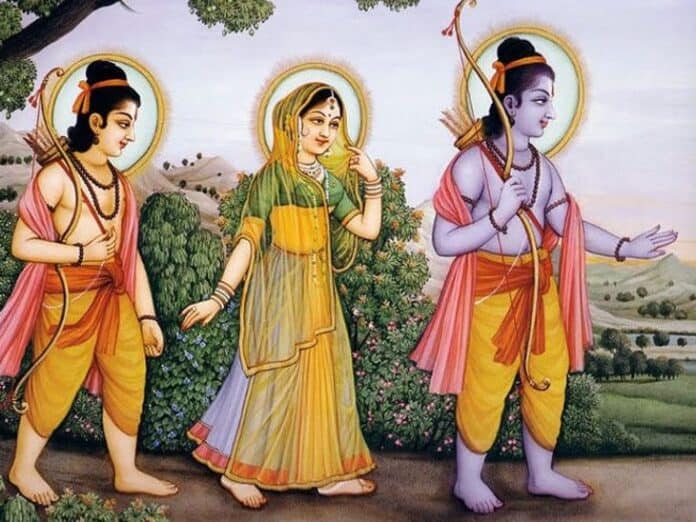
The life and legacy of Rama, immortalized in the Ramayana, spread far beyond India through ancient trade, cultural and religious exchanges, royal patronage, and literary adaptation across South and Southeast Asia. Over many centuries, different regions adopted the kavya and created their own local versions. These traditions are sometimes called “Ramakavya” traditions. Each country adapted the kavya into its own language, literature, art, temple carvings, and dance performances. Even regional Indian works such as Kamba Ramayanam helped inspire the spread of the Ramayana tradition across Asia. These adaptations show how the ideals of dharma, devotion, courage, and righteous leadership found meaning in many different cultures.
Nepal:
In Nepal, the Ramayana tradition is closely connected with Sita, who is believed to have been born in Janakpur. The famous Janaki Temple attracts thousands of devotees every year. During Ram Navami, pilgrims from India and Nepal gather here to celebrate the birth of Rama and honor the sacred union of Rama and Sita.
Indonesia:
In Indonesia, especially on the island of Java, one of the oldest Ramayana adaptations outside India was written in the 9th century, known as the Kakawin Ramayana. At the historic Prambanan Temple, more than 200 stone panels depict scenes from the Ramayana. In Bali, the story is performed through the famous Kecak, where groups of performers chant rhythmically while enacting scenes from the epic. The Ramayana Ballet continues to present the story of Rama in a grand theatrical form.
Thailand:
In Thailand, the Ramayana became the national epic called the Ramakien. Beautiful murals illustrating this story can be seen inside Wat Phra Kaew (Temple of the Emerald Buddha), one of Thailand’s most sacred royal temples. The Ramakien is also performed through the classical masked dance drama known as Khon. The influence of Rama is so strong in Thailand that kings traditionally adopt the royal title “Rama,” such as Rama IX.
Cambodia:
In Cambodia, the Ramayana developed into a local version called the Reamker, which emphasizes loyalty, bravery, and moral duty. At the famous Angkor Wat, visitors can see magnificent stone carvings that depict scenes from the Ramayana. The story is also preserved through traditional Cambodian dance and theatre performances.
Laos:
In Laos, the Ramayana story appears in a version called Phra Lak Phra Lam. The title means “Lord Lakshmana and Lord Rama.” In this version, the story includes strong Buddhist ideas, and Rama is sometimes viewed as a Bodhisattva. The epic is reflected in temple murals and traditional performances.
Myanmar:
In Myanmar, the Ramayana is known as Yama Zatdaw, which means “The Drama of Rama.” It is performed as a traditional Burmese dance-drama where actors wear elaborate costumes and act out scenes from the epic.
Malaysia:
In Malaysia, the Ramayana appears in the literary work Hikayat Seri Rama. The story is often performed through Wayang Kulit, a traditional shadow-puppet theatre in which flat leather puppets are moved behind a lit screen while a narrator tells the story.
Philippines:
In Vietnam, the Cham civilization preserved Ramayana influences in temple art, especially at the Po Nagar Temple. Though the temples honor local deities, stone carvings depict scenes and motifs from Rama’s life, showing the epic’s impact on Cham culture.
Vietnam:
In Vietnam, elements of the Ramayana can be seen in ancient Cham temples such as Po Nagar. These temples were built by the Cham civilization and show strong Indian cultural influence through their architecture and carvings.
China:
Even in distant regions such as China, rare literary references like Leigongquan suggest that Ramayana ideas may have traveled through ancient Silk Road cultural exchanges.
Pakistan:
Painting of Sri Rama and Sita with Hanuman in a Sikh samadhi in Gulyana, Punjab-Pakistan. Gulyana, is a 900-year-old historic village of Potohar, and is located 10 km south of Gujar Khan. The landscape here is dominated by old buildings, havelis, Hindu temples and Sikh samadhis, which were erected much before the birth of Pakistan.
The structures are badly neglected and deteriorating. The murals (including Rama–Sita–Hanuman) are fading and damaged.
Other countries:
The Ramayana tradition also continues among Hindu communities around the world. In countries such as Singapore, Mauritius, and Fiji, devotees celebrate Ram Navami, conduct Ramayana recitations, and organize temple worship.
Across all these regions, the Ramayana has influenced literature, architecture, dance, theatre, and moral teachings for many centuries. Today there are more than three hundred known versions of the Ramayana around the world, showing how the story of Rama continues to inspire people with its timeless message of dharma, devotion, courage, and righteous leadership.
