


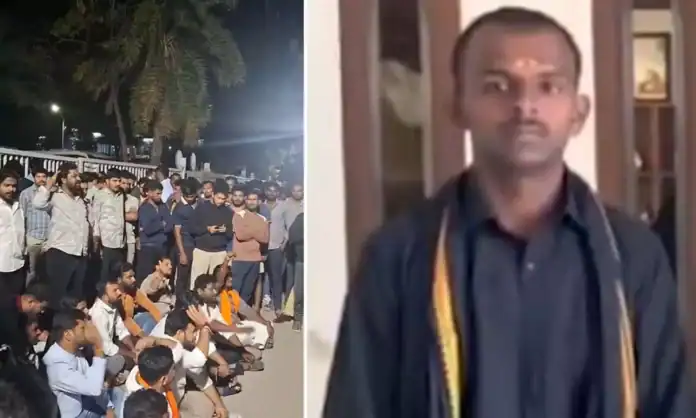
A dispute over an employee’s Ayyappa Deeksha attire has triggered protests outside Tata Consultancy Services (TCS) at Adibatla in Rangareddy district, Telangana, near Hyderabad. The employee, identified in reports as Manish, alleged that he was stopped at the office entrance on 19 November after arriving wearing a traditional mundu and an Ayyappa Mala while observing the religious vow.
The incident has raised a larger question: can a private company ask a Hindu employee to set aside visible signs of a religious vow in the name of a dress code, especially when the employee says he had informed management well in advance? TCS has not issued a public statement on the allegations, while Adibatla Police have described the matter as a misunderstanding and said no formal complaint had been received.
What allegedly happened
Manish, who reports say has worked at TCS for about two years, said he had informed his team leader and managers nearly two months earlier that he would observe Ayyappa Deeksha. He alleged that, despite this advance notice, he was prevented from entering the Adibatla office when he reported for work in traditional Deeksha attire.
According to the employee’s account, he was wearing a traditional mundu—a garment comparable to a dhoti—and an Ayyappa Mala. He alleged that his senior, Sikender Shah, objected to the attire and that he was denied entry on dress-code grounds.
Manish also questioned why similar restrictions were not applied to other employees, alleging selective treatment. Protesters demanded that he be allowed to work while observing his religious vow and called for a uniform application of the company’s dress policy.
Protest outside TCS
The allegation quickly drew Ayyappa devotees, local Hindu organisations and Bharatiya Janata Party (BJP) workers to the TCS campus at Adibatla. Protesters raised slogans against the management and demanded that Manish be permitted to attend office in his Deeksha attire.
BJP leader Andela Sriramulu Yadav joined the protest, according to reports. Police intervened as the gathering grew, and the situation was later brought under control. Some reports mentioned a scuffle between protesters and police, though the demonstration ultimately ended peacefully.
The Vishwa Hindu Parishad (VHP) has since warned companies against restricting Ayyappa Deeksha observance. The organisation’s intervention reflects concern that corporate dress codes should not become a pretext for treating Hindu religious practices as inconvenient or unprofessional
Police version
Adibatla Police initially said that no formal complaint had been received and that the circumstances were being verified. An official told reporters that the situation was under control and that the matter was being examined.
Why the Ayyappa Mala matters
Ayyappa Deeksha is a religious vow observed by devotees of Bhagwan Ayyappa, particularly before the pilgrimage to Sabarimala in Kerala. It traditionally lasts 41 days and involves prayer, vegetarian food, abstinence, self-discipline and a simple way of living.
Devotees commonly wear black, blue or saffron clothes and a tulsi or rudraksha mala. For many devotees, these are not optional accessories or fashion choices; they are outward marks of a vow undertaken before Bhagwan Ayyappa.
That is why the Adibatla dispute has struck a chord among Hindu employees. A rule that requires an employee to remove a religious mark—or change traditional clothing—can be experienced not merely as a workplace inconvenience, but as pressure to hide one’s Dharma at the office gate.
The corporate dress-code question
TCS has not publicly explained its dress policy or said whether HR acted under a written rule, a client requirement, or an individual manager’s instruction.
Bharatiya law protects religious freedom under Article 25 of the Constitution, subject to reasonable restrictions concerning public order, morality and health. Articles 14, 15 and 16 deal with equality and non-discrimination in State action and public employment; they do not automatically impose the same obligations on every private employer.
Private companies may reasonably regulate attire for safety, hygiene, client-facing roles and professional requirements. But a dress code must be applied consistently and cannot become a cover for treating one community’s religious observance as unacceptable while other forms of religious or cultural expression are accommodated.
What remains unresolved
Three questions remain central to the Adibatla controversy:
- Did TCS actually stop Manish from entering the office because of his Ayyappa Mala and traditional attire?
- Was the instruction a general, consistently enforced dress-code rule, or an ad hoc demand directed at one employee?
- Why did management allegedly wait until the employee arrived at work, despite his claim that it had been informed about the Deeksha nearly two months earlier?
The police say the matter was a misunderstanding and has been sorted out. But for Hindu devotees, the deeper issue will not disappear with a peaceable ending: a Bharatiya workplace must be able to accommodate a Hindu employee’s Deeksha without making him feel that his faith is a problem to be managed.
