


The impact of El Niño in Bharat is heavily tied to the weakening of the Southwest Monsoon, which supplies over 70% of the country’s annual rainfall. This monsoon arrives in Kerala around early June, covers most of the country by mid-July, and begins withdrawing from northwest Bharat by September. Since the atmospheric Walker Circulation shifts eastward over the Pacific Ocean, moisture transport toward the Bharatiya subcontinent decreases dramatically. Historically, nearly 44% of El Niño years have resulted in below-normal monsoons or severe droughts in Bharat. (According to a Ministry of Earth Sciences statement in Parliament in December 2024, 7 out of 16 El Niño years since 1950 experienced below-normal Bharatiya monsoon rainfall.)
The consequences of El Niño spread across several critical sectors of the Bharatiya economy and society such as: Agriculture and Food Inflation, Water Scarcity and Heatwaves, Extreme Weather Paradoxes.
The Counter-Balancing Factor: The IOD
An El Niño does not always result in a catastrophic drought. Its negative effects can sometimes be neutralized or weakened by a positive Indian Ocean Dipole (IOD)—often called the “Indian El Niño”. When the western Bharatiya Ocean becomes warmer than the eastern part, it injects additional moisture into the region, occasionally saving Bharat from a severe rainfall deficit. The positive IOD is an established ocean-atmosphere phenomenon, and it can strengthen the Bharatiya monsoon and sometimes offset the adverse influence of El Niño. However, the extent of this effect varies. Therefore, it is important for Bharat to initiate long term measures to mitigate the negative impact of things like El Niño. This article proposes to discuss some of the long-term measures to protect the ecosystem.
Green buildings
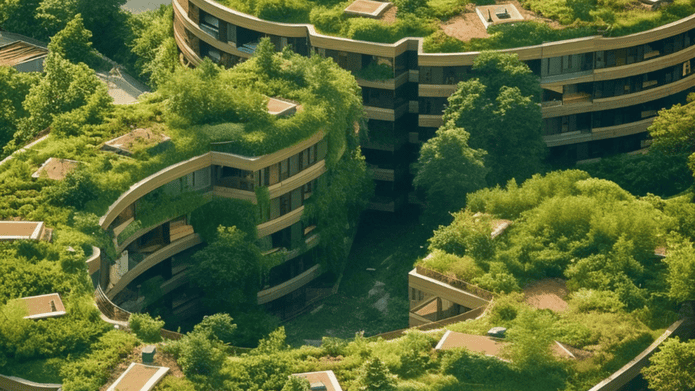
A green building is an environment-friendly structure, in sync with nature, which makes efficient use of land, materials, energy, and water and costs less in terms of maintenance charges. Green building enhances energy efficiency, limits water consumption, and makes maximum use of non-toxic materials by recycling the same. It also generates minimum waste during the construction process and reduces the negative impact on the environment.
While green buildings and sustainable urban development cannot directly prevent the occurrence of El Niño, they can substantially strengthen Bharat’s resilience to its consequences. Energy-efficient buildings reduce electricity consumption and heat exposure, rainwater harvesting improves water security, and sustainable urban planning helps cities cope with heatwaves, water and power shortages and other climate-related stresses.
The market for green buildings in Bharat is steadily expanding beyond its early developmental stage, though its penetration rate remains at a nascent 5% to 7% due to the rapid pace of new non-certified constructions. The market has easily surpassed its previous 2022 milestone of 10 billion square feet—which carried an estimated valuation between USD 35 billion and USD 50 billion—and is now riding a massive wave of growth with an untapped potential exceeding USD 1.4 trillion. According to the Indian Green Building Council (IGBC), Bharat has achieved a massive 16.48 billion square feet of ‘Green Building Footprint’. The council notes that the country’s sustainable portfolio has grown to feature more than 20,458 registered green projects alongside thousands of certified and large-scale development projects across the nation. According to the LEED (Leadership in Energy and Environmental Design)-GBC Bharat survey, Maharashtra ranks first in green buildings in Bharat, followed by Karnataka, Haryana, Tamil Nadu and Uttar Pradesh. The U.S. Green Building Council (USGBC) notes that Bharat ranks third globally for overall LEED green building certifications, driven by these top-performing states expanding their commercial real estate portfolios to meet net-zero carbon goals.
Under its updated commitments for the Paris Climate Agreement, Bharat is working to reduce the emissions intensity of its GDP by 45% and create an additional carbon sink to absorb 2.5 to 3 billion tonnes of carbon dioxide equivalent through enhanced forest and tree cover by 2030. Bharat has already made significant progress toward these goals, reducing its emissions intensity by 37.38% and achieving a 2.44 billion-tonne carbon sink from the 2005 baseline.
Around 40 per cent of the greenhouse gases emissions worldwide are released by construction activities, considering the huge volumes of energy required to build and sustain the houses.
The World Green Building Council (GBC) defines a net zero carbon building as a building that is highly energy efficient and fully powered from on-site and/or off-site renewable energy sources. IGBC is a part of ‘Advancing Net Zero’ project of World GBC. IPCC (Intergovernmental Panel on Climate Change) report also stresses need to decarbonize real estate sector by 2050. An ideal house in the village should be built using material that is found within a few-mile radius of the house. The policy should be to build the house without disturbing the trees and water bodies. The design of the building structure should be aligned with the direction of the wind and natural light so that the energy usage is at the minimum level and reduces the dependence on ACs, fans and heaters.
Taking into consideration the above aspects if the house is constructed with eco-friendly material that is available locally, then its construction cost will be relatively cheaper than the conventional house.
Potential in major cities
In major cities there is greater scope for generation of captive solar power and water conservation in large apartments and gated communities by initiating the following measures-
- Installation of solar panels
- Water meters for accountability
- Reusing treated water (Sewage Treatment Plant)
- Rainwater harvesting from terrace
In commercial buildings there is scope for generation of captive solar power and eco-friendly toilets that reduce the negative impact on the environment. These measures lead to conserving water and energy resources and preventing environmental pollution from contaminated wastewater.Incinerating toilets incinerate the waste into a small amount of sterile ash that can be safely disposed of in the natural environment and require no water to function. They’re a popular option in remote areas where there is no access to sewers or septic systems.The bio-digester technology developed by DRDO (Defence Research and Development Organisation) to meet the sanitation requirements of soldiers serving in the high altitudes of Ladakh and Siachen, is a simple, low-cost technology for treating human waste and providing safe sanitation facility.
The Bio-digester toilets are designed to convert human waste into gases and manure. It converts human excreta into usable water (irrigation and gardening) and gas (cooking and heating). Bio toilets treat human waste at the source itself, eliminating the need for its transportation thereby avoiding the sewage infrastructure and environmental pollution.
Therefore, these DRDO Bio-toilets can be installed anywhere irrespective of land terrain or water availability. The bio-toilet system meets all regulatory and environmental standards.Similarly, in Ecosan toilets, there is no need to flush and the urine and faecal matter is utilised as valuable urea and manure. This concept totally avoids sewage and manual scavenging.
Real Estate Industry and Climate Issues
It is interesting to note that RERA (Real Estate Regulatory Authority) is silent on the environmental issues, and it does not mention about green buildings because environment-related issues in general are covered by other laws such as the Environment (Protection) Act, Air (Prevention and Control of Pollution) Act, Water (Prevention and Control of Pollution) Act, etc. There is rising global concern about carbon neutrality for the international Building Development Organisations. It is a fact that real estate industry has not been active like the technology industry in tackling climate issues. One reason is that retrofitting existing buildings to make them more sustainable often requires an upfront investment and the related cost savings accrues only over the long term. Therefore, sophisticated techniques like LCA (Life Cycle Assessment) and WLC (Whole Life Costing) need to be increasingly promoted in order to create greater awareness among the people on the overall benefits of green buildings.
Government Incentives for Green Building Projects
The Ministry of Environment, Forest and Climate Change (MoEFCC), Government of Bharat, offers fast track environmental clearance for green building projects which are Precertified/ Provisionally Certified by IGBC (India Green Building Council) & GRIHA (Green Rating for Integrated Habitat Assessment). The Ministry of Housing and Urban Affairs, Government of Bharat, has announced free of cost 1% to 5% extra ground coverage for FAR (Floor Area Ratio) for GRIHA projects with plot size of more than 3000 sqm. Several Municipal Corporations have announced discounts in property tax to home owners, for projects that are certified under SVA GRIHA certification. All IGBC & GRIHA rated green building projects in the MSME sector are eligible for financial assistance at concessional rates from Small Industries Development Bank of India (SIDBI).
Carbon Credit Market
In Bharat, the carbon credit market has surged far beyond its early voluntary phase and is valued at over USD 44 billion, with aggressive projections estimating it will exceed USD 400 billion by 2034. Following the Energy Conservation (Amendment) Act, 2022 passed by Parliament, the government officially established the Carbon Credit Trading Scheme (CCTS). Transitioning from the older Perform, Achieve, and Trade (PAT) mechanism, the compliance market became operational, enforcing legally binding emissions intensity targets across heavy industries including aluminium, cement, chlor-alkali, pulp and paper, petroleum refining, petrochemicals, and textiles. This operationalized framework cements the Government’s strategy to utilize a formal, domestic market-based mechanism to meet its updated Paris Agreement climate targets. Bharat’s newly operational Carbon Credit Trading Scheme (CCTS) are highly variable and dynamic, as official trading sessions on the designated power exchanges only kicked off in the second half of 2026.
Enormous scope for Green Housing in Bharat
The ‘Housing for All’ plan in Bharat can provide an opportunity to assimilate affordable and green housing and thereby, create a sustainable change to Bharat’s residential housing market. Depending on the economic status of the people green buildings can be – low cost, medium cost, and high-cost models. Low-cost houses for EWS (Economically Weaker Section) may be constructed under green building models. Integrated townships (both residential and industrial) may be developed under green building models to recycle, reuse and reduce the waste. Plastic roads/ solar power roof top roads may be part of such integrated townships. It is estimated that the total plastic waste available in the country would not be adequate if all rural roads in Bharat are converted into plastic roads. Plastic roads also provide a permanent solution to the disposal of waste plastic.
Over the past decade, green real estate assets across the top markets in Bharat have grown exponentially, with the green-certified share of total Grade A office inventory surging from 31% in 2021 to 66%, totalling over 503 million square feet. The market is rapidly moving toward global sustainability standards, with certified stock expected to hit 636 million square feet. Bengaluru and Delhi-NCR continue to lead in sheer volume, capturing a combined 50% share of the country’s total certified office stock. However, Hyderabad has overtaken other major markets to lead in green penetration, with an impressive 75% of its total Grade A office stock certified green, closely followed by Bengaluru at 73% and Delhi-NCR at 62%.
Need for an Integrated Approach
Coordinated and integrated approach between three major transformative Urban Missions viz., Smart Cities Mission (SCM), Atal Mission for Urban Rejuvenation and Urban Transformation (AMRUT), and Pradhan Mantri Awas Yojana-Urban (PMAY-U) is very much needed for achieving better outcomes in Green Housing. The macro level policy in this regard should aim at the following with a strategic approach:
- self contained habitats/ villages
- Self contained houses in towns and cities
- Self contained apartments
- Self contained townships
- Self contained cities
Building on recommendations from the FICCI – Trilegal White Paper on ESG, which highlighted that Bharat requires a massive USD 170 billion in annual green investments to achieve its 2030 Nationally Determined Contributions, the Reserve Bank of India (RBI) and the National Housing Bank (NHB) have formalized frameworks to incentivize sustainable credit lines. The RBI implemented the Master Directions on Climate Finance and Green Deposits, which directly integrates green-certified building constructions and energy-efficiency retrofits into the mainstream lending frameworks of commercial banks and housing finance companies. Domestic tracking indicates that Bharat’s tracked green growth finance hovers around USD 50 billion annually and these structured regulatory policies are aimed at bridging the capital deficit by drawing down deep-pocketed institutional and international private investments into the housing sector.
Let us hope that with collective participation of all the major stakeholders, Bharat will be moving towards green housing for all and more importantly counter the adverse effects of global warming caused by things like El Niño.
Reference:
- https://igbc.in/.
- https://unfccc.int/sites/default/files/NDC/2022-08/India%20Updated%20First%20Nationally%20Determined%20Contrib.pdf.
- https://globalabc.org/sites/default/files/2025-03/Global-Status-Report-2024_2025.pdf.
- https://www.pib.gov.in/Pressreleaseshare.aspx?PRID=1809572®=48&lang=2.
- https://www.pib.gov.in/PressReleasePage.aspx?PRID=2083268®=3&lang=2.
