


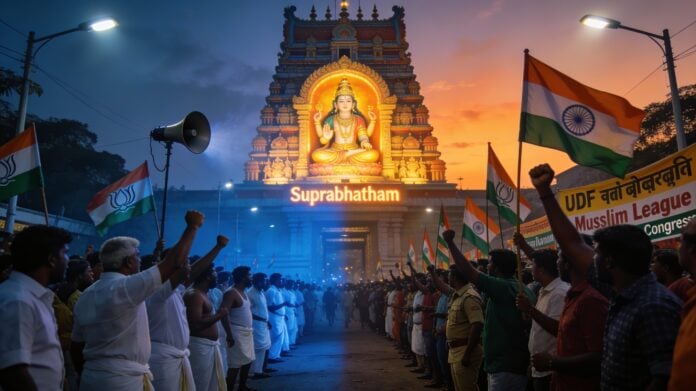
Tensions have flared in Kerala’s Malappuram district after slogans demanding a halt to early-morning devotional songs in Hindu temples were raised during a United Democratic Front (UDF) victory celebration near a local Mahavishnu Temple in Edavanna. The incident has sparked a polarizing debate over Hindu religious freedom, noise norms and political messaging in a district already known for its sensitive communal and political landscape.
Incident near Mahavishnu Temple
The incident occurred in Edavanna, Malappuram, during a victory procession organised by UDF workers after the alliance won a ward in the local panchayat elections. The procession passed in front of the Mahavishnu Temple at Kolappad, where participants raised slogans specifically targeting the devotional songs played from the temple premises.
According to reports, the slogans demanded that the devotional music from the temple should not be audible outside the temple compound and warned that such practices would be stopped. The chants were followed by “UDF Zindabad” slogans, highlighting the political character of the event rather than it being a spontaneous local protest.
Long-standing temple practice
The Mahavishnu Temple at Kolappad has reportedly been playing early-morning devotional songs, including Suprabhatham, at around 5 AM for several years. Local sources cited in the report stated that the practice is not considered a disturbance in the area and is in line with long-standing temple traditions across Kerala, where early-morning devotional music is common.
Temple representatives and local residents also asserted that the temple committee had obtained the necessary police permissions for using sound systems in the morning and that the music is played in accordance with existing regulations. Despite this, UDF workers in the procession allegedly raised slogans claiming that the devotional songs were causing inconvenience to residents and should not be allowed to extend beyond the temple premises.
Political context and UDF role
The slogans were raised in the backdrop of UDF gains in local body polls, even though the alliance currently sits in the opposition in the Kerala Assembly. The victory celebration in Edavanna was a joint event featuring workers of both the Indian Union Muslim League (IUML) and the Indian National Congress, with flags of both parties prominently visible.
Critics argue that the nature of the slogans and their timing suggest a political message: that if the UDF were to come to power in the state, certain Hindu temple practices like playing devotional songs over loudspeakers could face tighter restrictions or be curtailed. Observers quoted in the report see the episode as a demonstration of the UDF’s attempt to consolidate support in areas where religious organisations play a key role in mobilising votes.
Targeted opposition to Hindu practices
The episode has been projected by critics as an example of selective opposition to Hindu religious practices in a district where amplified religious sound from other communities is widespread. Malappuram district has numerous mosques where the azan is broadcast five times a day via loudspeakers and where religious programmes such as swalaath and other gatherings often use amplified sound, including during late evening and night hours.
Critics contend that while such mosque-related practices continue without interruption or major objection, the UDF protest has singled out early-morning devotional songs from temples, raising concerns about bias. They also emphasize that the protest was not confined to one party, pointing to the joint participation of Muslim League and Congress workers as evidence that this was a coordinated UDF action rather than an isolated case of individual misconduct.
Reactions and broader implications
The incident has triggered concern among Hindu groups and some local residents, who see it as interference in constitutionally protected religious practices carried out with proper permissions and within regulatory limits. Commentators quoted in the report claim that this reflects a broader pattern of what they describe as institutional and political interference with Hindu temples and rituals in the state of Kerala.
Observers further warn that such confrontations over devotional music and loudspeaker usage could deepen communal polarization if not addressed sensitively by political parties and administrative authorities. The controversy has also revived discussions on the need for uniform, transparently enforced sound norms for all religious institutions to prevent perceptions of discrimination and to balance the right to worship with the right to a peaceful environment.
