


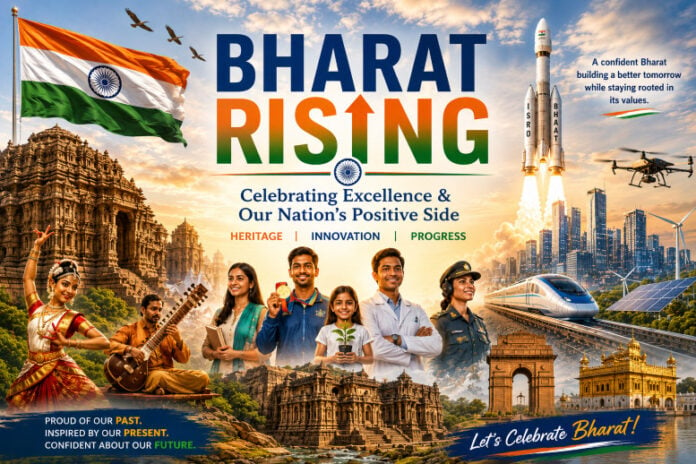
Bharat is a land with a rich past, an inspirational present, and an aspirational future. However, more often than not the spotlight is never shone on those individuals and communities who are making a difference and bringing glory to the nation. Small victories that go unnoticed, have a huge potential to positively influence the society.
The Bharat Rising Series cuts through the noise to bring you the most inspiring stories, remarkable achievements, and positive progress from across our nation and the wider Bharatiya community. In this weekly series, we not only bring to you inspirational present-day stories but also provide a glimpse of the rich civilizational heritage that goes under the radar.
Education
Bharat’s young students have made the nation proud by winning five medals at the 5th International Olympiad on Astronomy and Astrophysics for Juniors (IOAA-Jr.) 2026, held in Thailand from 1 to 8 November. The Bharatiya team secured two gold medals, two silver medals and one bronze medal among participants from 25 countries. This remarkable achievement highlights the scientific talent, dedication and curiosity of India’s younger generation. It also inspires students to explore astronomy, space science and research.
Science
Bharat’s first LED Dome Planetarium was inaugurated by PM Modi in Karnataka’s Mysuru on 13 November. COSMOS Planetarium located on the University of Mysore campus is an advanced facility that uses modern LED technology to provide an immersive experience of the universe. It will help students, researchers and visitors understand astronomy and space science through advanced visual presentations. This achievement is an important step towards promoting scientific education, innovation and curiosity among young Bharatiya citizens.
Economy
Bharat’s electronics industry has recorded impressive growth, with exports increasing by 44% to reach US$31.97 billion during April–September 2026–27. This reflects Bharat’s growing manufacturing capabilities and rising global demand for its products.
Bharat’s total exports have also shown strong growth, reaching approximately US$568.84 billion between April and October 2026. This highlights the country’s expanding presence in international markets and the growing contribution of its businesses.
In the renewable energy sector, Bharat’s installed solar power capacity has reached approximately 174.55 GW by October 2026. This is an important step towards clean energy, reducing dependence on fossil fuels and building a sustainable economy.
Additionally, initiatives involving Microsoft, NITI Aayog’s Atal Innovation Mission and Samhita-Collective Good Foundation are exploring ways to use Artificial Intelligence (AI) to empower small businesses. These efforts can improve productivity, create opportunities and help Bharatiya enterprises compete globally.
Civilizational Bharat Snippet
Bharat’s rich past deserves to be celebrated as well as introduced to the younger generations. There are several dynasties lost in the sand of time & kept away from public eye by left-leaning academicians and politicians. Similarly, several practices, concepts, ideas, and customs, that can serve us well even today, have been discarded or kept buried due to so-called modernization. This snippet aims to give a glimpse of dynasties that deserve the spotlight, highlight concepts that enrich our civilization, and/or practices/customs that may help us find solutions to our modern problems.
Tulsi Vivah: Its Importance and Environmental Message in Today’s World
Hindu traditions are more than just rituals. They are a celebration of one or the other aspect of life. Environment is not separate from human life. Hindu Dharma teaches us to see the divine in every living being and even one categorized as non-living by modern definitions. Therefore, Tulsi Vivah, celebrated today (Kartik Shukla Dwadashi), has a greater significance than just celebrating a divine marriage.
Tulsi Vivah is an ancient Hindu tradition that celebrates the ceremonial marriage of the Tulsi plant (Holy Basil) with Bhagwan Vishnu, represented by Shaligram. It is celebrated on the Dwadashi Tithi of the Shukla Paksha in the month of Kartik. Beyond its religious significance, Tulsi Vivah carries a meaningful message about respecting and protecting nature.
In Hindu tradition, Tulsi is considered sacred and is worshipped as a symbol of purity, devotion, and prosperity. Traditionally, families grow Tulsi plants in their homes and offer daily prayers to them. This practice encourages people to develop a personal connection with nature and recognize the importance of plants in our lives. Tulsi is also traditionally valued for its medicinal properties.
Today we are faced with numerous environmental problems. Issues such as climate change, rising carbon footprints, air pollution, deforestation, and biodiversity loss are becoming serious concerns. Bharat can surely show the way forward through its rich civilizational practices. Tulsi Vivah reminds us that nature is not merely a resource to be used but a responsibility to be protected. Worshipping a plant encourages environmental awareness and inspires us to care for greenery around us.
The festival can be celebrated beyond rituals by planting more trees, reducing plastic usage, conserving water, and adopting eco-friendly lifestyles. Instead of using plastic decorations and wasting resources, we can choose natural and biodegradable materials.
The true message of Tulsi Vivah is that respecting nature is an essential part of respecting life. By connecting traditional values with modern environmental responsibility, we can inspire future generations to protect our planet and create a greener, healthier, and more sustainable world.
Suggested Reading
1) The Colonial Lens and the Chronicler’s Trap: Why Medieval Indian History Needs a New Voice
3) Japan Turns to India for Train Technology: Why This Railway Breakthrough Matters
